Breaking News
Breaking News
from Washington and beyond

House Judiciary Investigates Kushner: “Pawn of the Saudi Monarchy”

House Committee Democrats are investigating Jared Kushner for his obvious corruption.

Jared Kushner
Ludovic MARIN/AFP/Getty Images
Jared Kushner

Democrats on the House Judiciary Committee are investigating Jared Kushner over conflicts of interest between his business activities and his work as a peace negotiator for the Trump administration.

Representative Jamie Raskin, the ranking member of the committee, sent a letter to Kushner arguing his job managing the private equity firm Affinity Partners and his diplomatic work for the president—who happens to be his father-in-law—have “been haunting American foreign policy since President Trump returned to Washington in 2025.”

“You cannot both be a diplomat and a financial pawn of the Saudi monarchy at the same time; you cannot faithfully represent the United States with billions of dollars in Saudi and Emirati cash burning a hole in every pocket of every suit you own,” Raskin wrote, referring to Affinity Partners’s extensive investments from “Saudi Arabia and other Gulf oil autocracies.”

“Your clients Saudi Arabia and the Royal Crown Prince Mohammed Bin Salman have unique and significant strategic, economic and political interests that are certain to diverge sharply from the strategic, economic and political interests of the American people,” Raskin’s letter states.

“When you approach negotiations related to the catastrophic Iran War, the prospect of prolonged military conflict there, the rights of women and religious minorities in the Middle East or the closure of the Strait of Hormuz, are you representing 100% the interests of your business partners in Saudi Arabia and other Gulf oil autocracies or are you representing 100% the interests of the American people?”

Kushner secured $2 billion in funding for his firm from the Saudi Public Investment Fund six months after Trump’s first term ended. The firm is also bankrolled by Qatar and the United Arab Emirates. At the same time, he has served as a negotiator between Ukraine and Russia and in U.S.-Iran talks, while also being involved in Trump’s “Board of Peace” in Gaza. Still, Kushner has no official government position, which means he can claim that he isn’t subject to legal requirements about his financial interests.

In his letter, Raskin requested extensive records from Kushner, including his business dealings, his communications on behalf of the Trump administration, corporate information about his investment firm, and communications with foreign governments. Kushner is not likely to comply, especially considering that Democrats don’t have control of Congress. But come November, that could change, giving Raskin and other Democrats stronger investigative and subpoena powers.
Late-Night Republican Revolt Derails Trump’s FISA Surveillance Plan

Republican infighting is preventing them from renewing the controversial surveillance law.

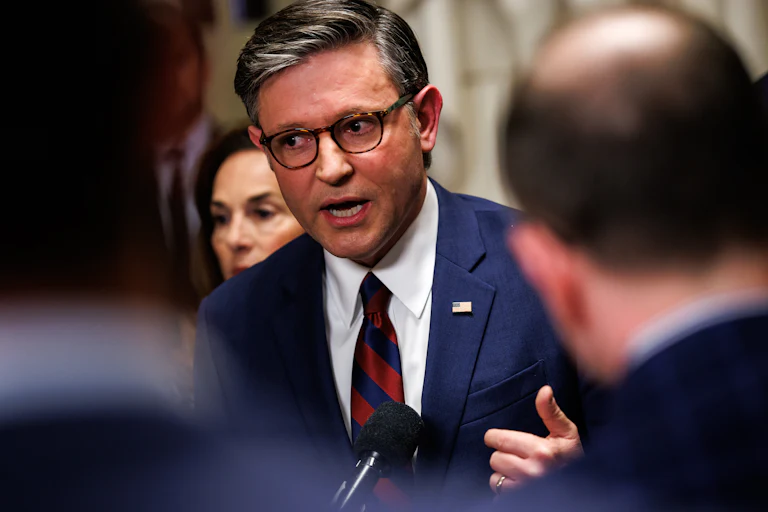
House Speaker Mike Johnson speaking
Samuel Corum/Getty Images
House Speaker Mike Johnson

GOP leadership tried and failed to force President Trump’s long-term Foreign Intelligence Surveillance Act (FISA) extension through the House in the dead of night on Friday, as 20 Republicans joined Democrats to derail both the five-year and 18-month renewal plans for the contentious spying program. Instead, after back-to-back failed votes, they agreed to a mere 10-day extension shortly after 2 a.m.

“We just defeated [Speaker Mike] Johnson’s efforts to sneak through a five-year FISA authorization tonight,” Democratic Representative Ro Khanna said. “Now, they will have to fight in daylight.”

Four Democrats, including Jim Hines, broke with the party to try and help Johnson force the original FISA plans through. Not only did they fail, they drew even more attention to the surveillance bill that has been criticized by both the left and right for years.

“Speaker Johnson (R-LA) and Rep. Jim Himes (‘D’-CT), in EXTREMELY poor form and bad faith, tried to sneak through a FISA reauthorization missing key privacy protections at 2am last night,” Drop Site News’s Julian Andreone wrote on X. “This was a deliberate and bipartisan attempt to subvert the democratic will of the American people, turning over mass surveillance powers to Trump, including the ability to monitor your emails, search history, online dating matches, and even buy your commercial data.”

The vote now heads to the Senate, even as the program expires on Monday.

Progressive Democrat Wins Special Election in Huge Rejection of AIPAC

Analilia Mejia was backed by Senator Bernie Sanders and Representative Alexandria Ocasio-Cortez.

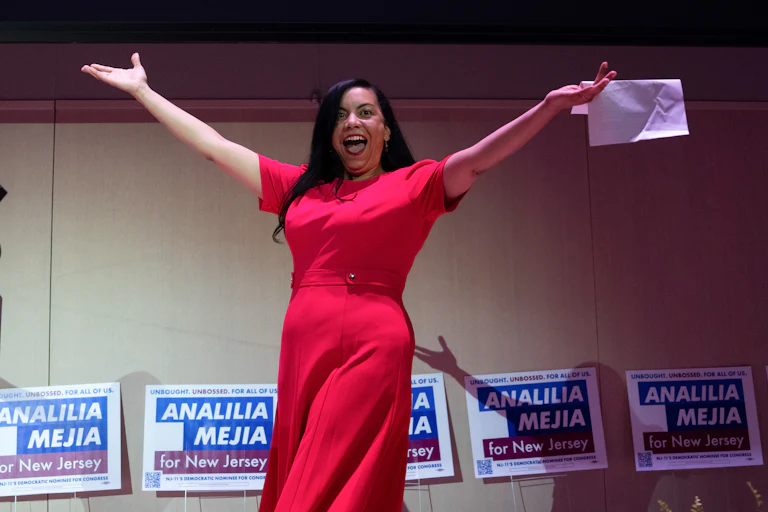
Analilia Mejia raises her arms and smiles with her mouth open while walking on stage. She holds a piece of paper in one hand.
Adam Gray/Bloomberg/Getty Images
Analilia Mejia

Voters in New Jersey were hungry for change—so they elected a progressive Democrat.

Analilia Mejia won in a landslide in New Jersey’s 11th congressional district Thursday, beating out her Republican opponent Joe Hathaway to serve the remainder of former Representative Mikie Sherrill’s term. Sherrill’s seat was left suddenly vacant after she won the state’s gubernatorial election.

The daughter of Colombian and Dominican immigrants, Mejia ran on an adamantly anti–Donald Trump message and secured a whopping 70 percent of the vote as a result. The Associated Press called her victory shortly after the votes started rolling in.

Mejia, a co-director of the nonprofit progressive advocacy group Center for Popular Democracy, had previously served as the national political director of Senator Bernie Sanders’s 2020 presidential campaign—a detail that Republicans cited ahead of the election to claim that the 47-year-old activist was too extreme and too left. Voters in the northern New Jersey district did not agree.

“I think we’ve been tilting a little bit more to the right lately, which worries me,” Saran Cunningham, an 86-year-old retired special educator in the area, told The Guardian before the results rolled in. “I think that we need people in Congress who will fight for things that will help people as opposed to hurting them.”

Mejia was endorsed by Sanders, as well as New York Representative Alexandria Ocasio-Cortez and Massachusetts Senator Elizabeth Warren.

The progressive Democrat’s positions echo several of the policies that made Sanders a national phenomenon, including support for universal health care coverage, tuition-free college, student loan forgiveness programs, and strengthening unions and expanding labor protections in order to bolster America’s middle class.

But she believes that it’s some of her more independent views that have made her stand out to voters. In February, ahead of the primary election, Mejia credited her ardent opposition to ICE and the agency’s violent “overreach” as a defining policy point that connected with voters.

Mejia has also been vocal in her criticism of Israel, publicly denouncing the state’s war on Palestine as a genocide. That caught the attention of the American Israel Public Affairs Committee, which funneled money into the race to bolster her opponents. In the end, the pro-Israel lobby’s efforts may have been one of the reasons that voters in New Jersey sent Mejia to Congress.

In a fiery victory speech Thursday, Mejia told a cheering crowd that her election was the beginning of a crusade against power that has a ​​“stranglehold over every aspect of our lives.”

Mejia does not yet have a concrete date for when she will start her term.

Trump, 79, Insists He’s Never Heard of a “Corner Store” Before

Donald Trump made the bizarre and out-of-touch remark during an event about affordability.

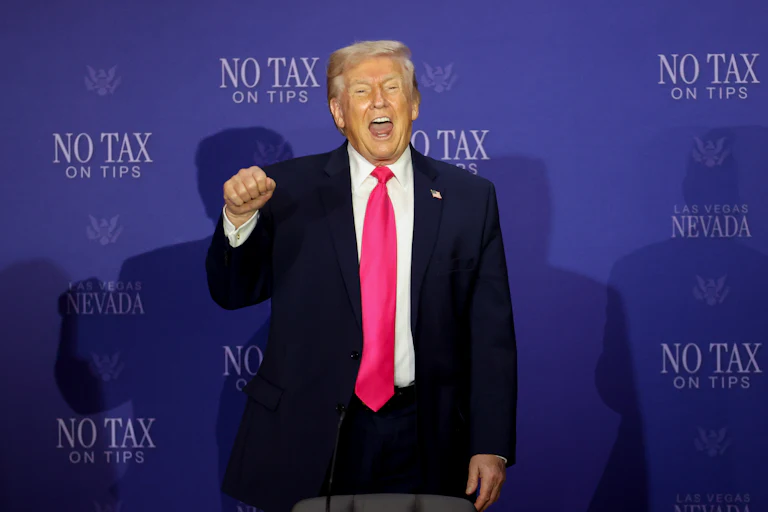
Donald Trump stands with his fist raised and his mouth open
Ian Maule/Bloomberg/Getty Images

Does President Donald Trump really not know what a corner store is?

Speaking about taxes Thursday in Las Vegas, Trump’s apparent contempt for even discussing affordability was on full display, as he joked he had no idea what a corner store was.

“The Great Big Beautiful Bill also slashed taxes on millions of American small businesses, including restaurants, dry cleaners, corner stores—what is a corner store? I’ve never heard that term,” he said.

“I know what a corner store is, but I’ve never heard it described. A corner store. Who the hell wrote that, please?”

Like Trump’s campaign remark that groceries are an “old-fashioned” thing, his latest comment demonstrates just how far removed he is from Americans’ everyday lives.

That’s how he’s able to claim with a straight face that the U.S. economy is in good shape, even as Americans struggle to pay for gas, suffering through heightened inflation and a jobless boom.

Trump’s manner of reading speeches for the first time, struggling to understand or even pronounce the words, is also concerning for the oldest person to be elected president. Trump, who grew up in New York City, can’t possibly claim to not know what a corner store is—unless he actually forgot.

Trump Dodges Key Question on Strait of Hormuz Blockade

Who knows how long the blockade will last?

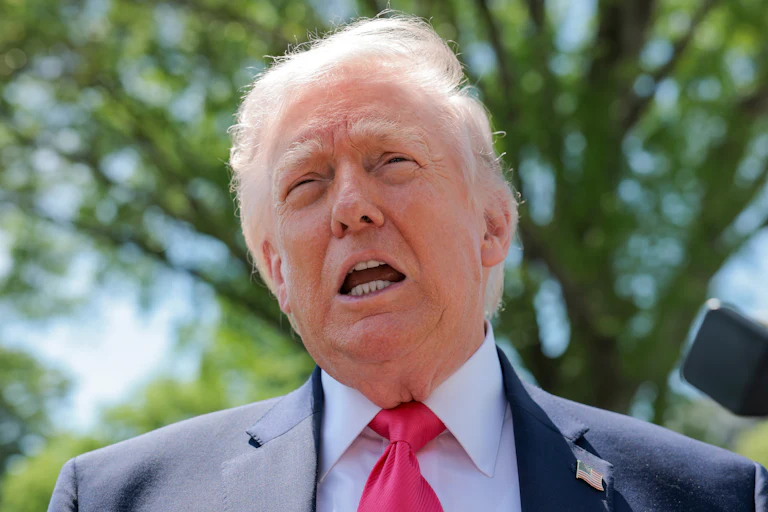
Donald Trump speaks to reporters outside the White House
Anna Moneymaker/Getty Images

The U.S. seems ready to block Iran’s primary oil tradeway “indefinitely.”

Donald Trump dodged questions Thursday about a lack of progress at the Strait of Hormuz, instead claiming that “no ship” was passing the blockade that the U.S. had imposed on the waterway at the beginning of the week.

“How long can you sustain the blockade on the Strait of Hormuz?” asked a reporter.

“We’re doing very well with the blockade, it’s very routine for us, the Navy is incredible. And I think the blockade is doing very well. No ship is even thinking about entering, no ship is going past our Navy,” said Trump.

But that’s not true. Data obtained by Reuters indicated that the president’s blockade hardly affected traffic on the waterway the first day it was imposed, and at least one U.S.-sanctioned Chinese tanker sailed right by.

White House deputy chief of staff Stephen Miller told Fox News earlier in the week that America’s military could keep up the pressure campaign forever.

“This embargo is squeezing the economic life out of the Iranian regime. The United States has the capacity to continue this indefinitely if Iran chooses the wrong path,” Miller said Wednesday night, further claiming that Trump had made energy costs a priority ahead of the war in Iran.

Meanwhile, Americans and their wallets are hurting. Gas prices across the U.S. have surged beyond $4 a gallon. In five states—California, Hawaii, Nevada, Oregon, and Washington—gas has risen above an average of $5 a gallon. The soaring price has driven up the cost of practically everything else, as inflated transportation and shipping prices get offloaded to customers. Trump warned Tuesday that the cost of gas “could be the same or maybe a little bit higher” come midterm season.

As Trump’s two-week ceasefire in Iran comes to a close, it’s becoming less and less clear as to when exactly the war will end, and whether the U.S. has made any meaningful progress in its peace negotiations. Trump has repeated that the “war can be over very soon,” though talks to end it have so far fallen apart.