The Supreme Court did something extraordinary on Thursday night: It refused to help the state of Alabama carry out an execution. Since the retirement of Justice Anthony Kennedy in 2018, the Supreme Court’s conservative majority has almost never intervened in capital cases on the defendants’ behalf. The justices have even overridden lower courts’ stays so that executions could take place on the state’s preferred schedule, even in cases where serious constitutional issues were at stake.
But in Lovelace v. Lee, the court declined to step in at Alabama’s request. The case is important for three reasons. First and foremost, it appears to be the first successful constitutional challenge to a specific execution method since the Eighth Amendment’s ratification in 1791. Jeffrey Lee, a death-row prisoner who was convicted of killing two people in 1998, filed a federal lawsuit last year to challenge Alabama’s plan to execute him via nitrogen hypoxia. Alabama adopted the new method in 2018; Lee argues that it would violate the Eighth Amendment’s ban on cruel and unusual punishment.
Nitrogen-hypoxia executions are fairly simple in theory. Earth’s atmosphere is roughly 78 percent nitrogen and 20 percent oxygen, with trace elements rounding out the remaining two percent. Humans have evolved to breathe large amounts of nitrogen, and we can do so indefinitely as long as some oxygen is present. Alabama’s plan is to simply subtract the oxygen—or, more accurately, to place a mask over Lee’s face so that he only breathes pure nitrogen until he dies.
The state has already killed seven death-row prisoners by this method; Louisiana also executed a man via nitrogen hypoxia last year. Three other states have authorized the method. Proponents describe it as relatively simple and largely painless, even compared to lethal injection. Justice Sonia Sotomayor described it differently in a dissenting opinion last year:
Take out your phone, go to the clock app, and find the stopwatch. Click start. Now watch the seconds as they climb. Three seconds come and go in a blink. At the thirty-second mark, your mind starts to wander. One minute passes, and you begin to think that this is taking a long time. Two . . . three . . . . The clock ticks on. Then, finally, you make it to four minutes. Hit stop.
Now imagine for that entire time, you are suffocating. You want to breathe; you have to breathe. But you are strapped to a gurney with a mask on your face pumping your lungs with nitrogen gas. Your mind knows that the gas will kill you. But your body keeps telling you to breathe.
Sotomayor said that the death-row prisoner in that case would “immediately convulse,” “gasp for air,” and “thrash violently against the restraints holding him in place as he experiences this intense psychological torment until he finally loses consciousness” before finally dying about 15-20 minutes later. The justice’s description also assumes that everything goes as planned. Unsurprisingly, Lee asked the court to let him be executed by firing squad instead, which can be virtually instantaneous when done correctly.
A federal district court judge in Alabama rejected those claims, citing the high threshold for execution-method challenges laid out by the Supreme Court in the 2015 case Glossip v. Gross. (More on that later.) The Eleventh Circuit Court of Appeals reversed that ruling and instead that there would be a “substantial risk of serious harm,” then asked the district court to consider whether Lee’s firing squad recommendation would be viable. The district court concluded that it would be and entered judgment in Lee’s favor.
In its appeal to the justices, Alabama claimed that the ruling amounted to “the first-ever permanent ban on a legislatively enacted method” in American history. The Supreme Court itself has never explicitly held a specific method of execution to be unconstitutional. Though the justices have suggested in passing that the Eighth Amendment forbids certain medieval methods of execution, such as breaking someone on a wheel or burning them as the stake, the high court have never before compelled a state to abandon its preferred option.
Instead, execution methods have changed over the years largely due to public pressure and criticism. Hanging was the most common method of execution in the 19th century, but it was often administered by unskilled amateurs. A competent hangman would ensure that the prisoner’s neck snapped at the first drop. More common outcomes were grisly scenes of strangulation or, in rare cases, decapitation.
By the early 20th century, states began to experiment with alternatives. New York carried out the first execution by electric chair in 1890 after the Supreme Court rejected the prisoner’s Eighth Amendment challenge. Electrocution was billed as a more scientific and humane method of execution in the early 1910s, but the reality was far more grim. In the late 1990s, the state of Florida carried out multiple executions with an unreliable electric chair, including at least one where a prisoner’s head burst into flames.
After the Supreme Court agreed to hear an Eighth Amendment challenge to Florida’s use of electrocution, Governor Jeb Bush called a special session of the state legislature to switch to lethal injection. A three-drug cocktail developed by an Oklahoma medical examiner in the 1970s soon became the most widely used method of killing death-row prisoners in the late 20th century. This form of lethal injection was explicitly sanctioned by the Supreme Court in the 2008 case Baze v. Rees.
Things fell apart a few years later. The European Union imposed an embargo on drugs for executions in the United States in 2011 amid pressure from death-penalty abolitionist groups. Many pharmaceutical companies had already largely cut off the flow in previous years. With no U.S.-based manufacturers of certain key drugs, death-penalty states began to rely on unfamiliar chemical cocktails. This haphazard improvisation led to a series of botched executions in the mid-2010s, including one in Arizona in 2015 where a prisoner survived for almost two hours while gasping for air after the injections.
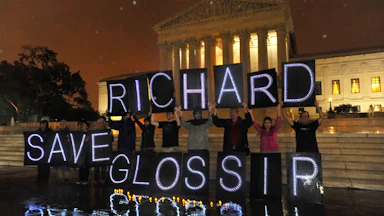
The Supreme Court ultimately heard a challenge to Oklahoma’s use of the controversial sedative midazolam in the 2015 case Glossip v. Gross. They were not as receptive to the Eighth Amendment argument as abolitionists had hoped. At oral arguments, Justice Samuel Alito asked whether it was “appropriate for the judiciary to countenance what amounts to a guerrilla war against the death penalty,” which had “reduced” states to using less reliable drugs like midazolam. That hostile mindset was reflected in the court’s final opinion, which Alito wrote.
In the American constitutional order, the government has powers and the people have rights. When the former conflicts with the latter, the latter must generally prevail unless the government has an exceedingly good reason for doing something. The government’s mere desire to enact a preferred policy is typically not enough to overcome a person’s constitutional rights.
Alito apparently disagrees. In Glossip, he subordinated a prisoner’s right to be free from cruel and unusual punishment to the state’s desire to kill prisoners. Because the death penalty is constitutional, he reasoned, “there must be a constitutional means of carrying it out.” Alito borrowed this flawed reasoning from Chief Justice John Roberts, who first expressed it his three-justice plurality opinion in Baze. Glossip marked the first time that a majority of the court embraced it.
In his own concurrence in Baze, Alito had warned that the court “should not produce a de facto ban on capital punishment by adopting method-of-execution rules that lead to litigation gridlock.” In Glossip, he turned that policy preference into constitutional law. To win the “guerrilla war,” Alito also required death-row prisoners to provide courts with a “substantially” less painful alternative method to be killed when challenging a state’s chosen option an Eighth Amendment grounds in the future.
That requirement also came from Roberts’s plurality opinion in Baze, where the chief justice laid out a hard-to-overcome standard for challenges to execution methods. “To qualify, the alternative procedure must be feasible, readily implemented, and in fact significantly reduce a substantial risk of severe pain,” Roberts wrote. Showing marginal improvements in safety weren’t enough. Only then would a state’s refusal to adopt the alternative method be sufficient to suspect a desire to inflict cruel and unusual punishment.
This is a threshold plainly designed to produce a specific outcome: leave constitutional challenges theoretically intact, but make it effectively impossible for them to succeed. You can see echoes of this approach in later decisions written by Alito. Earlier this month in Louisiana v. Callais, for example, the conservative justices erased the last vestiges of the Voting Rights Act by imposing bespoke hurdles. In effect, they elevated a state’s interest in partisan gerrymandering—a fig leaf in some states for eradicating Black electoral influence—above the Fourteenth and Fifteenth Amendments.
Alito even required VRA plaintiffs to produce maps to achieve a state’s stated redistricting goals when they accuse that state of racial gerrymandering, echoing his earlier demand in Glossip for death-row prisoners to describe their preferred way to die when challenging an execution method. There is something deeply unseemly about the Supreme Court forcing litigants to argue against their own interests if they wish to defend their constitutional rights. It smacks of deterrence by humiliation.
Moreover, this case was procedurally irregular, to say the least. The Supreme Court’s shadow docket typically works by hearing arguments for interim relief. (Justice Brett Kavanaugh has even argued that it should be called the interim docket.) In other words, the court’s shadow-docket rulings almost always involve preliminary injunctions and temporary restraining orders. Final judgments by lower courts are generally resolved by the court’s merits docket—which until ten years ago was just “the docket.”
Alabama’s challenge was different. Steve Vladeck, a Georgetown University law professor and expert on the shadow docket, warned the justices in a friend-of-the-court brief that the state was asking for something more significant this time. “Alabama’s application wears the familiar costume of a ‘state-on-top’ death penalty application—where a State asks this Court to vacate a lower court’s temporary stay so that an execution may proceed,” he wrote.
“But the relief it actually seeks is far more extraordinary—the evisceration of a federal court’s final equitable judgment,” Vladeck continued. The Supreme Court has a long history and well-established set of precedents for handling last-minute appeals from death-row prisoners. Indeed, until the mid-2010s, that was the most significant work it performed on what we now describe as the shadow docket. Since Alabama was asking the court to “effectively set aside a final judgment on the merits,” Vladeck explained, they were really asking for summary reversal, which the court handles through its normal petition-for-certiorari process.
The justices did not explain the reasoning for their decision in Thursday’s order. Alabama’s procedural misstep is significant enough, however, that it would not surprise me if the six justices who voted to deny the state’s request did so entirely for the reasons Vladeck described, regardless of their thoughts on the underlying merits of the lower courts’ rulings. Since the justices didn’t explain themselves, however, that would be only speculation on my part.
You might wonder why I spent so much time describing execution methods if this is simply a procedural outcome. I admit that the court may ultimately overturn the district court’s ruling on the merits docket; that, too, would not surprise me given the court’s post-Kennedy approach to capital punishment. Surely there is another bespoke rule that they could craft to ensure that the state of Alabama can kill people without hindrance that would not repeal the Eighth Amendment altogether.
But that brings me to the third and final thing that’s revealing about this case: three justices still would have sided with Alabama. Alito, along with Justices Clarence Thomas and Neil Gorsuch, indicated in the court’s order that they would have granted Alabama’s motion to stay the lower-court ruling. Since we’re talking about an execution here, that is also effectively a judgment on the merits—Jeffrey Lee could hardly retain counsel or continue appeals from beyond the grave.
As I’ve noted before, the Roberts Court is almost institutionally hostile to death-row prisoners. It treats the capital-defense bar as almost inherently suspect, as evidenced by Alito’s affront to the “guerrilla war” that death penalty opponents once waged. Again, nobody wrote any opinions in this matter so we can’t say for sure why they voted the way that they did.
That doesn’t stop us from drawing some reasonable inferences. For Roberts, Kavanaugh, and Justice Amy Coney Barrett, their skepticism of death-row inmates has limits and Alabama’s plea to suffocate this particular prisoner to death apparently found them. For the court’s other three conservative justices, there appears to be almost nothing that they are willing to prioritize over a state’s desire to kill someone.