Breaking News
Breaking News
from Washington and beyond

Trump Goes After His Next Political Enemy: Eric Swalwell

The Democratic representative has been referred to the Justice Department as Donald Trump takes his revenge.

Representative Eric Swalwell speaks in the Capitol.
Anna Moneymaker/Getty Images

Donald Trump appears to be targeting his next political adversary: Democratic Representative Eric Swalwell.

Bill Pulte, the director of the Federal Housing Finance Agency, has referred Swalwell to the Department of Justice for a criminal probe, alleging mortgage and tax fraud on his Washington, D.C. home, NBC News reports. It’s the fourth time the administration has tried to use mortgage fraud against Democratic opponents, with New York Attorney General Letita James, Federal Reserve Governor Lisa Cook, and Senator Adam Schiff also facing similar allegations.

Pulte wrote in a letter to Attorney General Pam Bondi Wednesday that Swalwell may have made false or misleading statements in loan applications, claiming that the congressman took out several million dollars in loans and refinancing based on the Washington home being his primary residence. The letter calls for an investigation into insurance fraud, mortgage fraud, and tax fraud allegations, and any other related crimes.

Swalwell, who was involved in both of Trump’s impeachments, didn’t seem surprised by the attack.

“As the most vocal critic of Donald Trump over the last decade and as the only person who still has a surviving lawsuit against him, the only thing I am surprised about is that it took him this long to come after me,” Swalwell said in a statement.

In September, Swalwell said he fully expected to be prosecuted by the Trump administration, based on the fact that he was named on FBI Director Kash Patel’s enemies list in his 2022 book Government Gangsters.

“Adam Schiff is under investigation now, so I’m ready for it. I expect it, but I’m not going to flinch. I’m not hiding under the bed. I’m not going to shrink because that’s the aim. That’s why they do this, is they hope that dissent and oversight goes away,” Swalwell said at the time.
John Fetterman Hospitalized After Heart Issue Caused Him to Fall

Doctors discovered Fetterman had had a ventricular fibrillation flare-up, a form of cardiac arrest.

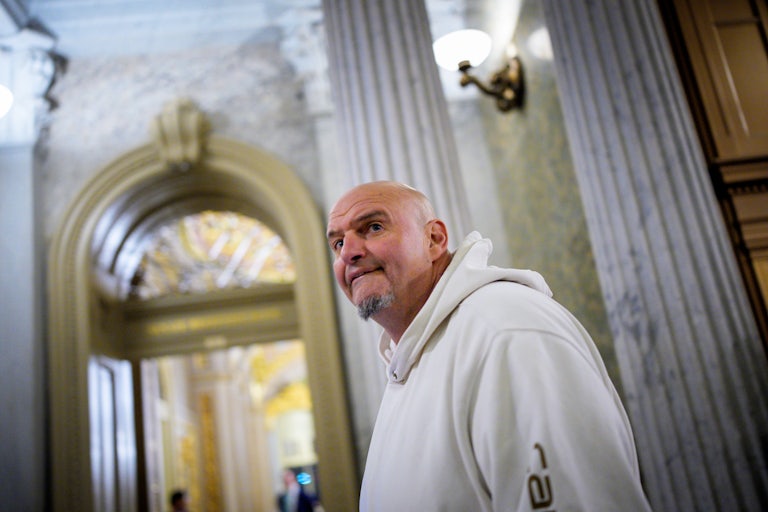
Senator John Fetterman walks in the Capitol
Andrew Harnik/Getty Images

Senator John Fetterman was hospitalized Thursday “out of an abundance of caution” after taking a fall near his home in Braddock, Pennsylvania. 

“Upon evaluation, it was established he had a ventricular fibrillation flare-up that led to Senator Fetterman feeling light-headed, falling to the ground and hitting his face with minor injuries,” the spokesperson said in a statement.  

Ventricular fibrillation is an irregular heart rhythm that can prevent blood flow to other parts of the body. Doctors consider it a form of cardiac arrest. This condition can be caused by a previous heart injury or issue, drug misuse, or a severe imbalance of potassium or magnesium. 

In the statement, the spokesperson said Fetterman was doing well but opted to remain in hospital while doctors fine-tuned his medication. 

“If you thought my face looked bad before, wait until you see it now!” Fetterman joked in the statement.

Fetterman’s former chief of staff shared his concerns in May that the Democrat, who suffered a stroke in 2022 one month before being elected to the Senate, had stopped taking his medications, was skipping doctors appointments, and had engaged in reckless behavior. 

Earlier this week, Fetterman voted with Republicans on a reworked funding deal to end the government shutdown, which was then signed into law by President Donald Trump on Wednesday. Fetterman had long broken with the rest of the Democrats over the shutdown, voting more than a dozen times to reopen the government.

How Did Todd Blanche’s Interview With Ghislaine Maxwell Miss This?

A recently released email suggests Maxwell knew Trump had spent time at Epstein’s house.

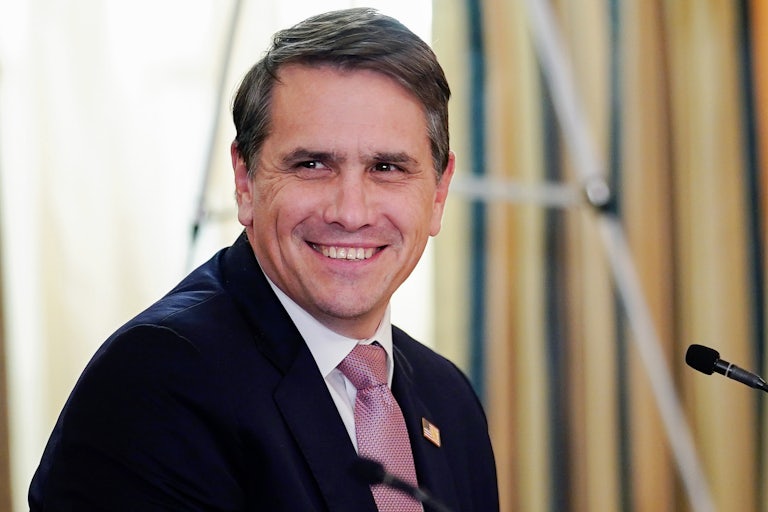
Todd Blanche looks toward the camera while smiling.
Will Oliver/EPA/Bloomberg/Getty Images
U.S. Deputy Attorney General Todd Blanche

Deputy Attorney General Todd Blanche seemed to acknowledge on Thursday that thousands of recently released email exchanges from disgraced sexual predator Jeffrey Epstein contradict the information Epstein’s accomplice Ghislaine Maxwell gave Blanche during their interviews this summer. 

When Blanche first spoke to Maxwell, she told him that she had never seen President Trump at Epstein’s house, and that the two were just casual friends. 

“I think [Trump and Epstein] were friendly like people are in social settings. I don’t—I don’t think they were close friends or I certainly never witnessed the president in any of—I don’t recall ever seeing him in [Epstein’s] house, for instance,” Maxwell said, according to interview transcripts. “I actually never saw the president in any type of massage setting. I never witnessed the president in any inappropriate setting in any way. The president was never inappropriate with anybody.”  

The emails she sent in 2011 tell a very different story.

“I want you to realize that that dog that hasn’t barked is trump. [Redacted] spent hours at my house with him ,, he has never once been mentioned. police chief etc.,” Epstein wrote to Maxwell in 2011, allegedly referring to one of his sex-trafficking victims. These emails were released Wednesday by the House Oversight Committee. 

“I have been thinking about that …” Maxwell responded. While Maxwell’s email doesn’t directly contradict her assertion that she never saw the president at Epstein’s house, they certainly suggest she knew that he’d spent time there.

Now the public is turning back to Blanche, scrutinizing his questioning of Maxwell given that there is motivation for her to lie for or about Trump to improve her chances of getting a pardon from him.

“An important side note about today’s Epstein/Trump revelations. They show that Todd Blanche’s questioning of Ghislaine Maxwell was either (a) completely incompetent; or (b) intentionally crafted not to elicit facts incriminating Trump,” George Conway wrote on X. “Either way, he is not fit to serve as Deputy Attorney General of the United States.”

“George, you’ve never been confused for a trial lawyer, and these kinds of posts explain why. When I interviewed Maxwell, law enforcement didn’t have the materials Epstein’s estate hid for years and only just provided to Congress,” Blanche responded, not seeming to deny that these emails suggest Maxwell misled him. “Stop talking. It’s unbecoming.”

Blanche’s excuse was widely deemed insufficient.

“Todd Blanche would have had these emails before interviewing Maxwell. Why didn’t he question her directly about her exchanges? Why did he not follow up when she said things that were obviously a lie??” former FBI lawyer Asha Rangappa mused. “This shows that was a performance intended to dupe the public and benefit her (and Trump).”

Either Blanche was deceived by the sexual predator he moved into a cushier prison or he is being untruthful about when he found out about Maxwell’s emails to Epstein, and what he actually interviewed her about. Either way, this saga is nowhere close to ending.

Trump Plans Lavish Dinner for Saudi Crown Prince Investing in Kushner

Mohammed bin Salman isn’t the head of Saudi Arabia, but Donald Trump is pulling out all the stops for him anyway.

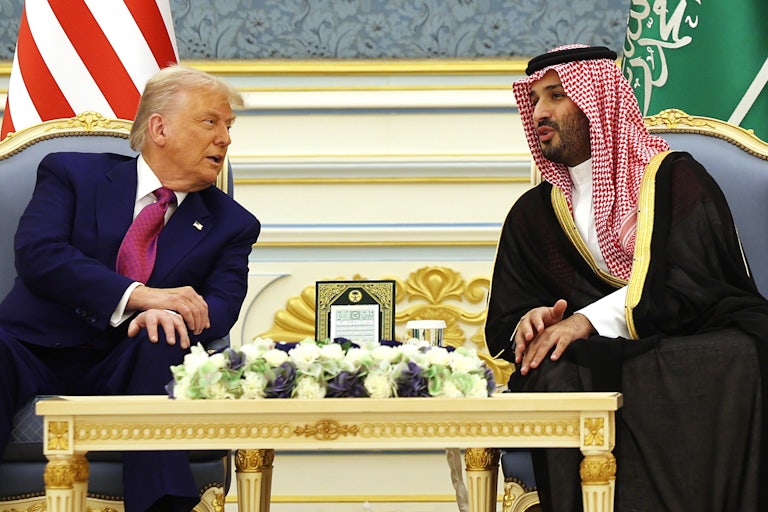
Donald Trump and Saudi Crown Prince Mohammed bin Salman lean over to speak to each other while seated with a table between them.
Win McNamee/Getty Images

Donald Trump apparently thinks the time is right to throw a lavish party for Saudi Crown Prince Mohammed bin Salman. The president has been sending out invitations for a November 18 dinner to business leaders, members of the Trump administration, and some members of Congress. Since MBS, as he’s colloquially known, is not an official head of state, it wouldn’t be an official state dinner, but it will be a “formal dinner with a lot of pomp,” reports Jake Sherman of PunchbowlDC.

The dinner will be part of MBS’s visit to the United States, where the crown prince will be meeting with Trump at the White House earlier in the day, and will host a U.S.-Saudi investment summit at the Kennedy Center the next day. In May, Trump signed a $142 billion weapons deal with Saudi Arabia, following a pledge from MBS to invest $600 billion in the U.S. in January.

The president and his family also have extensive business ties to Saudi Arabia. The Trump Organization is currently working on Trump Tower Jeddah and also has plans for a Trump property in Riyadh. Trump’s son-in-law Jared Kushner has received billions from foreign sources including Saudi Arabia for his private equity firm, Affinity Partners, and speaks regularly with MBS.

Earlier this month, Trump was criticized for holding a lavish “Great Gatsby” dinner at his Mar-a-Lago estate while SNAP benefits were expiring. He hosted another fancy meal at the Florida country club last week. Given the Saudis’ close financial ties, Trump’s all-out attempts to impress MBS probably won’t help his administration’s reputation for corruption and excess.

More Women Than Ever Want to Leave the U.S.: Poll

Fewer women want to deal with the consequences of Donald Trump’s presidency.

Two women stand on a street in New York City
Edward Berthelot/Getty Images

A growing percentage of young women no longer see a future in the United States.

Roughly 40 percent of women between the ages of 15 and 44 said that they would permanently move abroad if they were able to, according to a 2025 Gallup Poll. That included 45 percent of single women, and 41 percent of married women.

It’s a stark difference from how young women felt when they were asked the same question a decade ago. In 2014, just 10 percent of that demographic said they wanted to leave the country, matching responses from all other queried gender and age groups.

That began to change when Donald Trump entered office, but it wasn’t always a partisan issue. Interest in leaving the country was relatively stable before 2017, rarely fluctuating regardless of the country’s leadership.

Young men, meanwhile, don’t currently feel the same level of pressure to exit the country. Just 19 percent of the same male-focused age group expressed the same desire to leave America.

The current differential in national satisfaction between young women and their male counterparts is the highest since Gallup began asking the question in 2007—but that’s not the only remarkable component to the data. “Few countries have shown gender gaps this wide in the desire to migrate,” Gallup noted.

American women’s desire to move abroad corresponds to their lagging faith in the country’s institutions: Young women have lost more faith in America and its government over the last decade than any other group.

That could be, in part, because of the Supreme Court’s 2022 decision in Dobbs v. Jackson Women’s Health Organization, which eliminated the constitutional right to an abortion. Young women have reported a “steep decline in their confidence in the judicial system” in the years since, according to Gallup, reporting that confidence levels fell from 55 percent in 2015 to just 32 percent in 2025. This is more than any other age group, Gallup noted.

Women’s overall happiness has dropped since 1972, “both relative to where they were forty years ago, and relative to men,” author Marcus Buckingham wrote for HuffPost last year. That’s regardless of whether those women have children; how many children they might have; whether they’re married, rich, educated, young, or old.

The potential dreamy future of a woman in the early 1970s stands in stark contrast to the grim horizon beyond 2025. The headlines of that decade abounded with significant legal achievements for the supposedly “weaker sex”: Roe v. Wade opened up a woman’s right to choose, Title IX sex discrimination laws were enacted to protect girls’ educational opportunities, Congress passed the Pregnancy Discrimination Act and legalized in vitro fertilization, and the Supreme Court extended contraceptive access to unmarried individuals (in Eisenstadt v. Baird).

Meanwhile, women were able to sincerely compete with men in the workplace, and for the first time, in 1974, women were able to apply for bank loans and credit cards in their own name. By all means, the future seemed bright for the young women of the country.

But that rapid pace of female advancement has since fallen to the wayside. Contemporary stressors for young people span from climate change to economic barriers such as the high cost of living, a national housing shortage, astronomical health care costs, and limited financial freedom, all reasons that have been cited as rationales for delaying the prospect of childbirth.

The country’s leadership has decided not to meaningfully focus on any of those problems in its flailing efforts to offset the country’s declining birth rates, however. Instead, the Trump administration has pitched a $5,000 “baby bonus” (that definitely doesn’t smell of socialism) to convince young couples to have more children. The president—who has dubbed himself the “king of IVF”—also promised in October to expand access to the procedure by “making it legal” for American companies to offer health coverage for IVF (something that was already legal and widely available). It is still unclear how Trump intends to enforce the program.

Pronatalist Republicans have also pushed for a slew of reforms that they claim would boost childbirth, but otherwise seem so inadequate at addressing the concerns of young people that those reforms would be insultingly meaningless. Some conservative family advocates have pressed the White House to deregulate childcare facilities and child car seats, which they argue would reduce the cost of living and result in more babies. Others have suggested that the Trump administration should bestow a “National Medal of Motherhood” on women with six or more children as a method to incentivize bigger families.