Newsletter
Fighting Words
What got me steamed up this week

Trump’s A.G. Just Did Something So Corrupt She Should Be Fired Already

Note to right-wing “media” and all you fantasists who believe them: This is what judicial sleaze actually looks like.

Trump and Attorney General Pam Bondi in the Oval Office
Andrew Harnik/Getty Images
Trump and Attorney General Pam Bondi in the Oval Office on February 5

Pam Bondi was approved by the Senate to be attorney general on February 4. On February 5, she was sworn in. And on February 10, five days into her already ghastly tenure, she committed an act so electrically sleazy that in a normally ordered world, she’d be forced from office immediately.

Why Bondi? Why is my wrath not limited to Emil Bove, the acting assistant attorney general? After all, it was Bove (apparently rhymes with “no way”) who wrote the instantly infamous memo ordering Danielle Sassoon, the acting U.S. attorney for the Southern District of New York, to dismiss all charges against New York Mayor Eric Adams “as soon as is practicable.” (Sassoon quit instead.)

True enough, Bove’s Bond-villain name and his broodingly pharaonic countenance help finger him as an easy bad guy. But read the damn memo. Here’s how it starts: “You [Sassoon] are directed, as authorized by the Attorney General, to dismiss the pending charges in United States vs. Adams.”

As authorized by the attorney general. There it is. The top law enforcement officer of the United States, five days on the job, ordered that corruption charges, painstakingly assembled over a multiyear period by prosecutors in New York’s Southern District, be dismissed. Why? Well, your average fair-minded person, presented with the facts as I’ve laid them out so far, would assume that said attorney general and her people had discovered new information that exculpated the mayor. That’s how justice works in the movies, right?

But not here. In fact, Bove’s memo admits the opposite! It reads: “The Justice Department has reached this conclusion without assessing the strength of the evidence or the legal theories on which the case is based.” Couldn’t be clearer. Bondi’s decision—and please, please, call it that; Bondi’s decision, not Bove’s—had nothing to do with evidence. So what did it have to do with?

Two factors. The first is timing. The memo states: “It cannot be ignored that Mayor Adams criticized the prior Administration’s immigration policies before the charges were filed.” That’s a staggering sentence. It assumes an almost casual and universal corruption on the part of prosecutors in the Southern District generally, and the U.S. attorney in particular.

This is an outrageous charge: that prosecutors are working to exact political revenge for presidents. That is a morality that Fox News and others have gotten millions of American to cynically buy into. It is not the real-life morality of the Southern District, which for decades has rightfully enjoyed an apolitical reputation. Even when there have been politically ambitious U.S. attorneys in charge who were clearly bringing cases that might benefit them politically—most obviously, Rudy Giuliani prosecuting corrupt Democratic bosses in the 1980s—it had to be admitted that the prosecutions were legit. Giuliani won convictions in those cases, and the city was better off.

But this is an accusation—by the nation’s top law-enforcement officer—that the Southern District is, or was, a priori corrupt. It’s the kind of accusation, history instructs us, that is usually made by people who are guilty of exactly that which they allege.

And it is an accusation lodged specifically at former U.S. Attorney Damian Williams. Yes, Williams was appointed by Biden. Yes, Williams is a Democrat. But what is his record of politically selective prosecutions?

Well, let’s see. He oversaw the indictment of former New York Lieutenant Governor Brian Benjamin—a Democrat and, for what it’s worth, like Williams, a Black man (I mention this only because the right-wing media would surely claim the fact as relevant were it expedient to do so). He oversaw the indictment of Democratic Senator Bob Menendez of New Jersey. In 2018, as an assistant U.S. attorney in the same Southern District, he helped secure the indictment and conviction of Sheldon Silver, the powerful former speaker of the New York State Assembly—and, yes, another fellow Democrat.

And bear in mind, of course, that the investigation of Adams stretched back years. Read the indictment. It’s more than 50 pages, and it tracks events going back to 2016. You don’t assemble that in a week. Southern District investigators were obviously building an Adams case for years—probably before Williams was even named U.S. attorney, which happened in 2021, and long before Adams cozied up to Donald Trump.

On top of all that, suspicion of corruption has swirled around Adams’s head practically since he took office. The notion that the filing of the Adams indictment was somehow tied to his refusal to talk nice about Kamala Harris before the election is the kind of absurd conspiracy that used to be laughable in this country, consigned to the John Birch margins, before the right-wing media promoted this kind of thinking to the extent that it became imprintable on millions of fevered minds.

But remember—that’s only the first factor cited by Bove (and Bondi). The second, if you can believe it, is far more ridiculous. The indictment against Adams needs to be dropped posthaste, Bondi ordered, because it’s distracting him from doing his job! I’m not joking: “The pending prosecution has unduly restricted Mayor Adams’ ability to devote full attention and resources to the illegal immigration and violent crime that escalated under the policies of the prior Administration.”

This is, to put it politely, not how the law works in this country. Remember that the Supreme Court ruled—unanimously—that even a sitting president can’t be immune from civil litigation on the grounds that it will distract him from his duties. But that was about Bill Clinton, a scourge of the right. For a darling of the right, the rules appear to be different.

Except that the dismissal of these charges carries a big asterisk. They were dismissed “without prejudice,” meaning they can be refiled anytime Bondi—or Donald Trump—wants them to be. In other words, Mayor Adams is too busy fighting crime and immigration, but only for as long as Bondi and Trump think he’s fighting it their way. Once he’s not, cuff him.

So things go in a nation where it is openly declared that some people are above the law. That was not supposed to be the United States (although often it has been, in the case of rich people). It was supposed to be places like Daniel Ortega’s Nicaragua. But now it is the United States. I didn’t declare it so. Trump did—more specifically, his White House counsel David Warrington did this week, in the form of a memo obtained by The Washington Post stating that it is now the official policy of the Trump administration that the president and vice president (What? Why?) and their top lawyers “can discuss ongoing criminal and civil cases with the attorney general and her deputies.” In other words, Trump—or Vance—can make one phone call and set any investigation they wish in motion, or get one quashed. In other words, they are the law.

But don’t forget the central role here of Bondi: “As authorized by the attorney general.” She has proven in a week that she will corrupt her office to any point and in any way that Trump desires. Don’t take it from me. Take it from Sassoon—a Republican and a Federalist Society member who, far from thinking Adams innocent, was about to file a superseding indictment charging him with even more corruption, including tampering with evidence. And take it from the five Justice Department prosecutors who followed Sassoon with their resignations.

This is a crisis. A legal and constitutional crisis of a sort seen only a few times in this country’s history. And yet the squashing of the Adams case will pass, as all these things pass, with nary a peep from elected Republicans because a serial liar with a mighty propaganda machine working overtime for him has convinced half the country that up is down, that honor is venality, and that integrity is just a ruse for suckers who believe all that garbage from our schoolbooks.

This article first appeared in Fighting Words, a weekly TNR newsletter authored by editor Michael Tomasky. Sign up here.
Trump’s Gaza Plan Is Not a Distraction. It’s a Potential War Crime.

The U.S. has committed war crimes in its history, but they’ve never been part of stated peacetime policy—until this week.

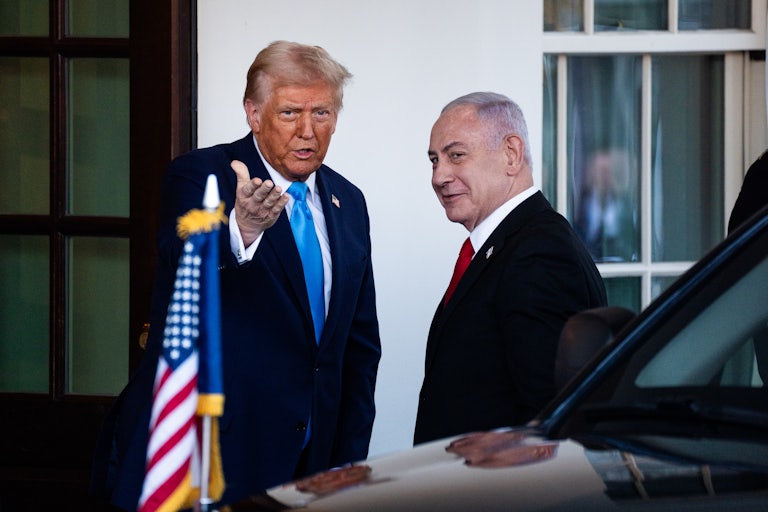
Trump greets Israeli Prime Minister Benjamin Netanyahu at the White House
Demetrius Freeman/The Washington Post/Getty Images
Trump greets Israeli Prime Minister Benjamin Netanyahu at the White House on Tuesday.

When the initial shock began to wear off from Donald Trump’s announcement Tuesday evening describing his “beautiful” plans for Gaza that “everybody loves,” two schools of thought emerged.

The first was that we can’t possibly take this seriously. The president apparently thought of it two hours before blurting it out. It’s preposterous on several levels. Never going to happen.

The second was that Trump said it to distract us from his and the Great Salutist’s attacks on democracy at home—making the press obsess about the Middle East so maybe they won’t notice how he’s destroying USAID.

These are both wrong. We should assume that Trump is deadly serious about this. This is exactly the stuff of deeply held Trumpian fantasy—hotels, casinos, golf courses, steakhouses, bathrooms with chandeliers. And if that’s true, then by definition it’s no mere distraction.

But here’s what it also is: a potential war crime. A plan to forcibly move a people out of a place where they have been living for decades (centuries, actually) amounts to a pretty clear violation of the 1949 Geneva Conventions and the 1998 Rome Statutes, which established the International Criminal Court. It’s ethnic cleansing, plain and simple.

One understands the impulse to laugh it off, I guess. It’s ridiculous. But it is not merely ridiculous, and to laugh it off is to minimize its savagery toward a people who have just experienced tens of thousands of deaths and who are now literally walking back to their homes, except for the fact that in most cases, when they get there, their homes are being carted off piece by piece in wheelbarrows.

Yes, it’s very hard to imagine how the United States and Israel would pull off the feat of displacing two million Palestinians to places that don’t want them and won’t take them. Very hard—but not quite impossible. The Associated Press reported Thursday that Israel has already begun preparations for the departure of Palestinians from Gaza. Details were thin, but the AP dispatch did report that “Israeli Defense Minister Israel Katz said Thursday that he has ordered the military to make preparations to facilitate the emigration of large numbers of Palestinians from Gaza through land crossings as well as ‘special arrangements for exit by sea and air.’”

That sure sounds to me like they’re at least thinking through the logistics. Besides which, forced deportation is all the rage among corrupt authoritarians these days. As goes Aurora, Colorado, so goes Rafah.

Ever since Trump blurted this out, the White House has backtracked, and the confusion and crossed signals convey that it isn’t a serious thing. Press secretary Karoline Leavitt assured the White House press corps that no American troops would be committed to this project (Trump himself said the same on Truth Social Thursday morning). Secretary of State Marco Rubio said that Palestinians would leave Gaza for an “interim” period only, while it was being rebuilt. Trump of course has said the opposite: that Gazans would find beautiful, modern homes … somewhere.

But don’t let the current confusion lull you. Trump means this. How he’d get the Palestinians to leave, and who would take them—yes, those are rather large snags. It’s highly unlikely that this will ever happen on the scale in which it’s happening in Trump’s head right now. But what if Israel manages to “facilitate the emigration” of, oh, 300,000 Palestinians? That’s 15 percent of the Gaza population. What would we call that?

But whether it ends up being two million or 300,000 or 157 isn’t really the point we need to be focusing on here. The president of the United States has made the expectation that we will at least abet—if not carry out—a war crime into official U.S. policy. The current impassioned defenses of the USAID remind us, as we often forget, that the U.S. does spread plenty of good across the world. At the same time, we know all too well that we have spread more than our share of misery and committed some war crimes, from Dresden and Tokyo to Abu Ghraib.

But I don’t think we’ve ever announced, with pride, that violation of the Geneva Conventions and other international laws is our policy. In fact, the Bush administration took great pains in the run-up to Iraq to ensure that the relevant U.N. resolutions were worded in such a way that the U.S. was not in violation of international law. But now, we are bragging that the potential commission of a war crime is just another weapon in the U.S. arsenal.

The administration has showed us pretty clearly on the domestic policy front what it thinks of the law. Why should this be any different? And anyone naïve enough to have believed last year that Trump cares anything about the Palestinian people should have some pretty heavy scales falling from their eyes right now. I’m not lecturing anybody about how they voted. I am saying, though, that if you fooled yourself into thinking that Trump’s campaign stop in Dearborn, Michigan, last year was anything more than a cynical attempt to harvest some disgruntled votes, well, I fear time will reveal to you your miscalculation. Let’s just hope it’s not at the price of two million people being forcibly uprooted from their land.

This article first appeared in Fighting Words, a weekly TNR newsletter authored by editor Michael Tomasky. Sign up here.

We’ve Now Learned the Three Principles of Trumpism, and They’re Ugly

Trump 1.0 was a Jackson Pollock—splat splat all over the place. Trump 2.0 is painting within very precise lines. It’s terrifying—but it should help plan how to fight.

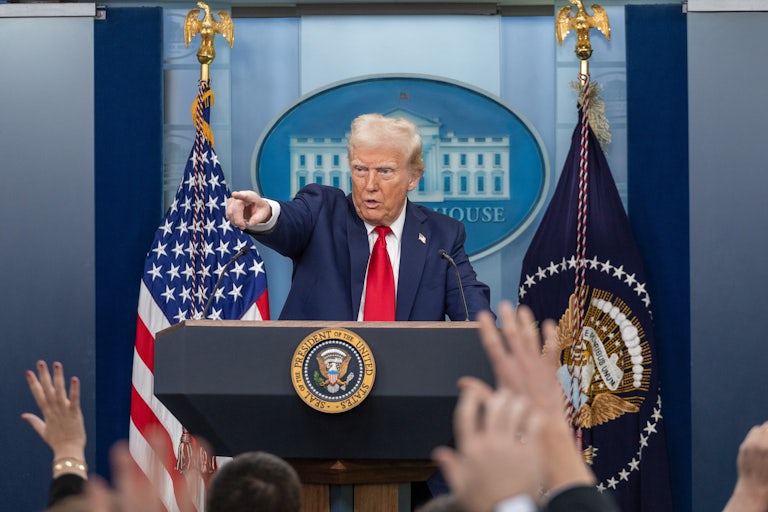
Donald Trump points while standing behind a lectern during a press conference at the White House.
Hu Yousong/Getty Images

We’re nearing the end of week two of Trump 2.0, and several things are already manifestly clear. First and foremost, that the new Trump administration was more than ready to hit the ground running at noon on January 20. As one journalist friend said to me: “We were prepared for a 2,000-volt dose of MAGA. We got a 20,000-volt dose.”

The scope and audacity of the moves floored everyone. There have been a lot of complaints about the Democrats; with Democrats, there’s always something legitimate to complain about (their timidity, their rationales for nonaggression). But there’s also an extent to which, in this case, everybody was taken aback by the tsunami of orders, the fuck-you unqualified-ness of crucial appointees, and more. That we’ve needed a few days to take it in is understandable.

But now we know. I write these words on Day 12 of the new Trump era, and already, the three guiding principles are obvious:

1. There is no such thing as settled law. There is law Trump and the broader right accept, and law that they don’t accept, and everything in the latter category will be relentlessly challenged.

2. There is no such thing as independence within the government. There is only loyalty to Trump and the cause.

3. Diversity is poison. It’s the job of the federal government not merely to arrest its progress where it is but to push it back, aggressively.

Let’s examine each.

With respect to the first principle, the key evidence exists in the form of certain moves Trump has made that challenge settled law. The Office of Management and Budget order attempting to block all federal grants and loans is Exhibit A. The Trump people know very well that this is money appropriated by Congress, and that money appropriated by Congress is money that a presidential administration has no legal right to rescind.

So it’s not that they aren’t aware of what the law says. Rather, they know and just don’t care. They know very well that the order violates the 1974 Impoundment Act. That’s not a problem. It’s the point. They want to challenge the law, have people bring lawsuits, and hopefully from their perspective have it get to the Supreme Court, where, in theory, there are at least five justices available to overturn the Impoundment Act.

Why play it this way? Well, there are two motivations here—Trump’s, and that of the broader right. Trump’s motivations are simple to understand: It’s just so that he will have fewer constraints on his executive power. For the right, this is a longtime goal that precedes Trump’s arrival on the scene. They hate this post-Nixon reform that gives power to a drunken Congress (especially when run by Democrats), and they want a (Republican) president to be able to unilaterally cancel piles of federal spending. If you’re of a certain age, you remember Ronald Reagan’s obsession with the line-item veto. This is its kissing cousin.

The same motivations are on display with the firing of the 18 inspectors general. They know that these dismissals violated the law. Their point is to change the law: to have the Supreme Court affirm that the president can fire these people at will—or ideally, that he can even just order such offices dissolved.

These are just a few of the ways this drive for raw and unchecked power has manifested itself over these first few days, and we’ll see many more. And by the way, this is all straight out of the pages of Project 2025.

Principle two: The firings of the 12 prosecutors who worked for Jack Smith. A half-dozen or so top-ranking FBI officials told to resign or retire. The buyouts offered to roughly two million federal employees. The point of these and other similar moves is obvious, and it’s exactly what we’ve known ever since Axios broke that Schedule F story back in July 2022: Across the federal bureaucracy, career bureaucrats are to be replaced by operatives loyal to Trump.

This, again, is both a Trump goal and a longer-held goal of the broader right. For Trump, the motivation is obvious: Nothing is more important to him than loyalty. For the right, the point is to reshape the bureaucracy and fill it with people who seek not to carry out the mission of the Environmental Protection Agency or the Department of Housing and Urban Development but who seek to subvert it.

And yes, a Democratic president can come in and replace all those people if he or she wants, but it’s a reasonable bet that the Democrat will be slow and timid about doing so—or that their respect for norms will override the commonsense urge to fumigate the civil service of Trumpian parasites and return it to its former level of professionalism.

From the perspective of Trump’s Project 2025 goons, they know they can break more things than future Democrats will be able, perhaps even willing, to fix. And so the sledgehammers swing. Result: On balance, the federal bureaucracy will have fewer dedicated civil servants who can perform their jobs under Democratic or Republican regimes, as has been the norm in the United States for a century, and instead will be more packed with right-wing ideologues.

Principle three is more ideologically aggressive than the first two, because diversity has become so embroidered into so many aspects of American life and culture, accepted even by many facially conservative institutions, such as large corporations. There are certainly instances of woke leftism in this country, chiefly in the academy, which are illiberal and lamentable. But by far, the reality is that a broad consensus exists that diversity is a good thing that has enriched society.

Trump is moving with gobsmacking speed against this consensus on many fronts. His statement that DEI was basically to blame for the Washington, D.C., plane crash was, of course, intentional; no doubt uttered to push this idea into the media maw so that it got talked about and argued over at the expense of conversations about the fact that he dismissed that aviation safety board or that Elon Musk bullied the holdover Federal Aviation Administration head out the door. Mainly, however, he wanted to get more Americans to start thinking in the MAGA way: that any instance of sloppiness, inefficiency, or incompetence can be laid at the feet of liberal diversity initiatives. Oh, and by the way—the kinds of diversity initiatives that he railed against Thursday for weakening the FAA? They were put in place in 2019, under President Trump.

The assault is multipronged. If you haven’t, for example, read the language of the executive order banning transgender people from enlisting in the armed services, you should do so. It basically says that these Americans, who have volunteered to risk their lives if necessary for their country, are inherently incapable of loyal service: “Adoption of a gender identity inconsistent with an individual’s sex conflicts with a soldier’s commitment to an honorable, truthful, and disciplined lifestyle, even in one’s personal life. A man’s assertion that he is a woman, and his requirement that others honor this falsehood, is not consistent with the humility and selflessness required of a service member.”

These are the ugly organizing principles of Trump 2.0. But on the bright side: At least we know them. At least they are self-evident to us, just 12 days in. It’s like Germany announcing they’re marching through the Ardennes before they even do it. The battle lines are clear. We can’t say we don’t know what we’re fighting for.

At the End of Week One, Every Dark Prediction Is Already Coming True

Trump 2.0 is following the “Nike rule”: Just do it, and dare the courts to come after them later.

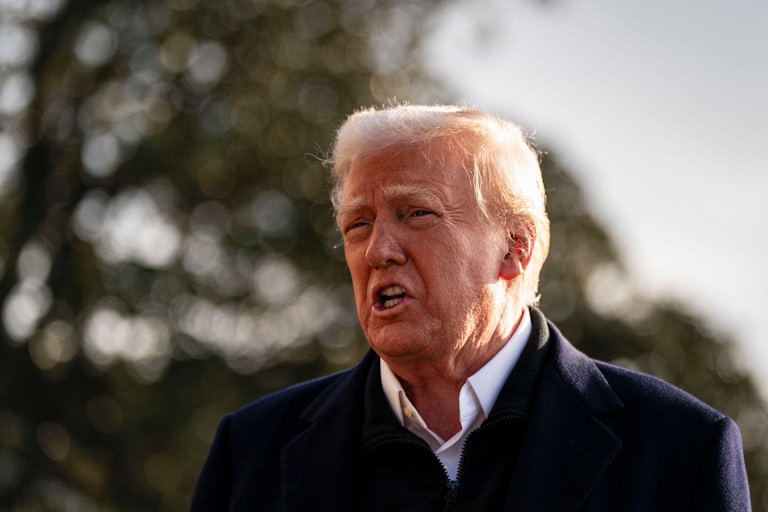
Trump at the White House
Al Drago/Bloomberg/Getty Images
Trump at the White House

We’re nearing the end of week one of Trump 2.0. What have we learned? Three things, all of them ugly:

1. They came in prepared this time, with outrageous and lawless executive orders written and ready to roll out.

2. When Trump makes an impromptu decision (“Fuck it: Release ’em all”), it’s based on his worst and most authoritarian instincts.

3. Obviously, this administration will act totally without regard to precedent or law.

From ending birthright citizenship to the shocking halt of grant processing at the National Institutes of Health and diversity, equity, and inclusion initiatives, and so much more, Trump is following what we might call the “Nike rule”: Just do it, and let the courts sort it out; if some court comes along in two years and says what he’s been doing is unconstitutional or against some law, well, he got away with doing it for two years.

He went too far, for now, on birthright citizenship. A federal judge in Seattle not only called Trump’s executive order “blatantly unconstitutional” but said it “boggles the mind.” Judge John C. Coughenour imposed a two-week restraining order, blocking the administration from moving forward. Trump will no doubt move to get the matter in front of a friendlier judge.

Most likely, the Supreme Court will have to weigh in someday. It’s kind of hard to imagine the justices or any court overturning birthright citizenship, since it says in plain English right there in the Fourteenth Amendment—which, remember, is as much the Constitution as the first 10 amendments, as the words “We the People”: “All people born or naturalized in the United States, and subject to the jurisdiction thereof, are citizens of the United States and of the State wherein they reside.” But then again, this Supreme Court has surprised us before. “Originalism” probably doesn’t cover those meddling slavery-enders of the 1860s.

The NIH order effectively freezes that body’s grant-making process, which accounts for about 80 percent of its $47 billion budget. It’s potentially devastating to scientific research in this country, and it portends a bigger shakeup at NIH when budget time arrives—especially if Robert F. Kennedy Jr. is confirmed as secretary of health and human services. And I hardly need to tell you why all of this is happening. It’s not because the Trumpists care passionately about scientific research and have wonderful ideas about reforming the system. It’s for one reason and one reason only. Hint: It rhymes with ouchy.

On the DEI front, a conservative administration is bound to have a different view of these initiatives from a liberal one, and, yes, Trump won the election. A recalibration of these policies, or the appointment of a task force to reexamine them, would have been hard to object to from a small-d democratic perspective.

That, however, is not what’s happening. Some of the language in the memorandum from Charles Ezell, the acting director of the Office of Management and Budget, goes well beyond that. The memo directs federal employees to snitch on their colleagues. It reads in part: “If you are aware of a change in any contract description or personnel position description since November 5, 2024 to obscure the connection between the contract and DEIA or similar ideologies, please report all facts and circumstances to [email protected] within 10 days” (the A adds “accessibility” to the list of crimes, even though accessibility rights for people with disabilities are clearly enshrined in law). It threatens possible “adverse consequences” for employees who don’t comply. By next Friday, all executive agencies are to submit “a written plan for executing a reduction-in-force action regarding the employees who work in a DEIA office.”

Even more worrying is the administration’s halting of work by the Justice Department’s Civil Rights Division. No new cases, no indictments, no settlements, no nothing. Usually, administrations just decide on a case-by-case basis which of its predecessor administration’s lawsuits it will pursue and which it will drop; not the Nike administration. It’s all chucked out the window. The wide presumptions are that the division that integrated the University of Mississippi will pursue no civil rights cases, and all consent decrees monitoring police departments will be canceled.

That’s because Trump is a bigly law-and-order Republican, right? Well, not so fast. What kind of law-and-order Republican grants a wholesale pardon to some 1,550 rioters, 89 of whom have pleaded guilty to felony charges of assaulting Capitol Police officers (and some D.C. officers) on January 6, 2021? We know what kind. The kind who enforces the laws he agrees with and flouts or tries to undo the laws he doesn’t like. And that’s called lawlessness.

Again: It would have been … not exactly defensible, but politically less vulnerable to criticism if Trump had decided to pardon only those who weren’t charged with committing violence against officers. But that isn’t what he did. Fuck it: Release ’em all.

I think he knew exactly what he was doing here. In freeing that many people—and especially in freeing the two generals of this army, Proud Boy Enrique Tarrio and Oath Keeper Stewart Rhodes—Trump has potentially loosed upon an unsuspecting nation his own private militia. Is it early days to jump on the Germany 1930s analogies? All right, I’ll leave that alone. For now, Tarrio vows “retribution” against his pursuers, saying the “people who did this … need to be put behind bars and they need to be prosecuted.”

But let’s say there’s another Charlottesville, or a police shooting, or a mass shooting with a seemingly racial element. Do we really think these 1,550 people will just be content to stay at home and watch it all unfold on Fox? The father who called his own son a “traitor” (the son helped turn the father in) and said, “Traitors get shot”?

All this in four days. If these four days haven’t woken you from postelection slumber, you need to ask yourself what it would take. And imagine what four years will be like.

This article first appeared in Fighting Words, a weekly TNR newsletter authored by editor Michael Tomasky. Sign up here.


It’s Time to Check Back in, Liberals—Trump 2.0 Will Be Far, Far Worse

Most people I know—even me, to an extent—have been avoiding it. Well, we don’t have that luxury anymore.

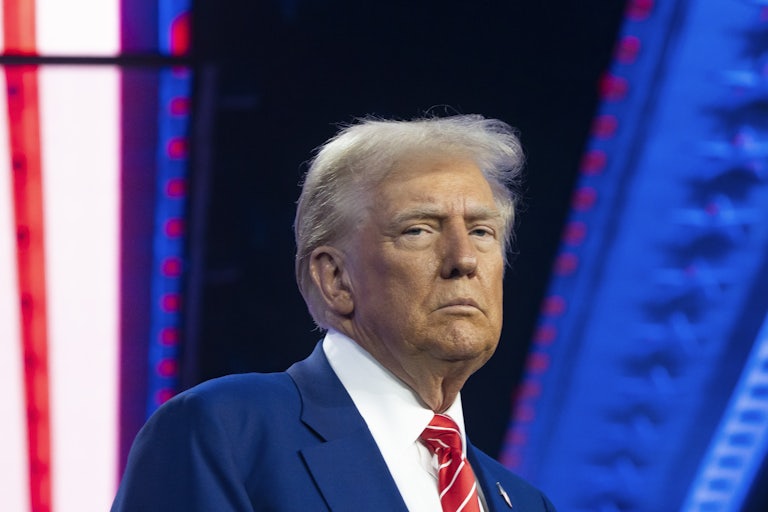
Donald Trump
Rebecca Noble/Getty Images

After the election, nearly all my friends, those who are political junkies and those who are only casual users (and no, I’m not friends with anyone who isn’t at least a casual user, which is something I should perhaps think about), said: “I need a break. I’m checking out for a while.” The idea that the country would ignore everything it had seen and elect Donald Trump again was just unprocessable.

We saw this manifest itself in a number of ways, notably MSNBC’s lower ratings, which right-wingers crowed about on social media. As Governing magazine put it, “When a sports team loses, its fans don’t hang around for the postgame show.” I did this myself. I took nearly three weeks off work and read relatively little news. It was kind of great.

Folks, it’s time to reengage. Trump will take the oath of office at noon on Monday. Soon thereafter, this parade of misfit toys we’ve been watching testify this week will occupy their Cabinet positions. Orders will start percolating out—from Stephen Miller, Russell Vought, and other Trump deep staters—to start doings things differently. Trump already knows certain leverage points in the federal bureaucracy that took him months or years to locate the first time around. And he’ll have one big thing that he didn’t have in 2017: a pliant and willing establishment that signals a desire to be 100 percent on his side and that will give him every benefit of every doubt as he pulls at the republic’s threads.

It blows my mind, and ought to blow yours, that the three richest men in the world will be on Trump’s inaugural podium. It’s significant because, whatever their other powers and properties, they are three of the country’s most powerful media titans. Elon Musk owns the country’s most prominent news-oriented social media platform. Mark Zuckerberg owns the largest social networking service. And Jeff Bezos owns a newspaper that isn’t the ubiquitous behemoth that X and Facebook are, but even so, The Washington Post, at least to people on the broad left in the nation’s capital, means far more emotionally than the first two.

It’s worth staying with the Post for a paragraph here. Bezos bought the paper with seemingly good intentions in 2013 and poured a lot of money into it. Maybe, in retrospect, he went on too big a hiring spree. But that doesn’t excuse what’s been happening there lately. It’s a tragic mess, with its Murdoch-tainted publisher causing many excellent staffers to head for the exits. Bezos not long ago declared himself “very optimistic” and “very hopeful” about Trump’s return. This week, Post executives voted to adopt a new tag line/mission statement: “Riveting Storytelling for All of America.” Wow. This statement commits the paper to … what, exactly? I guess it’s quaint and hopelessly antique of me to mention that newspapers were once meant to be the people’s eyes and ears against corruption and assaults on the civic weal. The Post decided to keep “Democracy Dies in Darkness” for now. At least they didn’t vote to add, “Hey, if it happens, it happens.”

We are in an odd sort of waiting room at the moment. Trump and all his minions and enablers have told us many times what his administration will set out to accomplish: Project 2025, sweeping out the vermin, all the rest. At the same time, Trump himself has sent occasional mixed signals, indicating that it won’t really be that draconian, and every so often we read stories in the press meant to reassure us that, for example, rounding up and detaining 10 million people is literally not possible in four short years.

Well … call me cynical, but I sense a lot of people trying to convince themselves that it won’t be as bad this time around. I mean: Were you reassured by Pam Bondi’s testimony, for example? When Adam Schiff asked the attorney general nominee if she would pursue an investigation into Liz Cheney on Trump’s behalf, she said, “Senator, that’s a hypothetical, and I’m not going to answer it”—before lecturing Schiff that what he really ought to be concerned about is crime in California. But the maximum-cringe moment came when Chris Coons asked her what she’d do if Trump ordered her to do something “outside the boundaries of ethics or law.” Bondi’s reply: “Senator, I will never speak on a hypothetical, especially one saying that the president would do something illegal!” Senator Coons, how dare you!

We’ve been navigating a hall of mirrors in this country ever since George W. Bush and Dick Cheney et al. convinced America that we had to invade a nation that had done nothing to us, possessed no weapons of mass destruction, and, deplorably as it may have treated its own people, had no serious imperialist designs on its region (unlike the country—Iran—that our invasion ended up strengthening). Twenty years on, the mirrors are just stranger and more relentless and pitched at more confounding angles. And it won’t stop.

And the main point: There are more and more people in positions of power telling us, “Mirrors, what mirrors? You’re imagining things.” Goldman Sachs CEO David Solomon said this week: “There has been a meaningful shift in CEO confidence, particularly following the results of the U.S. election.” The data would suggest that he meant a shift to the negative, since the president who oversaw the creation of 16 million jobs is leaving and the former president who oversaw a net loss of jobs is returning. But that is not of course what he meant.

So here we are. On Inauguration Day eight years ago, I was at a liberal confab down in Florida (as it happened, just a few miles from a Trump property). That morning I ran into James Carville. So, I asked, are you going to watch him take the oath of office? The only-from-Carville reply: “Are you kiddin’ me? I’d rather watch my uncle’s colonoscopy.”

A great line. But I watched that day, and I’ll be watching Monday. I still feel that the more of us who witness him swearing to defend and protect the Constitution, the better. And I want to see what he has to say in his address, and you should too. You can’t tune him out, even if you wanted to. It’s time to reengage.

This article first appeared in Fighting Words, a weekly TNR newsletter authored by editor Michael Tomasky. Sign up here.