Breaking News
Breaking News
from Washington and beyond

Trump Ramps Up Attacks on Trans People by Targeting Another College

The Department of Education has opened an investigation into Smith.

Education Secretary Linda McMahon speaks during a Senate subcommittee hearing
Graeme Sloan/Bloomberg/Getty Images
Education Secretary Linda McMahon speaks during a Senate subcommittee hearing.

President Donald Trump’s Department of Education is targeting Smith College for accepting transgender women.

The DOE’s Office of Civil Rights announced Monday that it would investigate Smith College for allowing “biological males into women’s intimate spaces” in violation of Title IX, the landmark 1972 law banning sex discrimination, which the Trump administration has used to rampantly discriminate against transgender people.

“Title IX contains a single-sex exception that allows colleges to enroll all-male or all-female student bodies—but the exception applies on the basis of biological sex difference, not subjective gender identity,” the DOE said in a statement. “An all-girls college that enrolls male students professing a female identity would cease to qualify as single sex under Title IX.”

Smith College is considered a historically women’s college, or HWC, founded as a single-sex education institution. The school accepts “any applicants who self-identify as women; cis, trans, and nonbinary women” and has accepted transgender women since 2015. Many other HWCs also accept transgender women.

As for the DOE’s phony concerns about “intimate spaces,” Smith College’s website says it provides single-occupancy, all-gender restrooms, and an all-gender locker room with private changing and showering areas on campus.

Shannon Minter, an attorney with the National Center for LGBTQ Rights, told CNN that the investigation was an “ominous” government overreach into the workings of private institutions.

“If [women’s colleges] have chosen—as many of them have—to admit transgender students, that’s something they should be able to do freely without being worried about persecution by the federal government,” he told CNN.

“This administration seems hell-bent on eliminating any inclusion of transgender people anywhere in our society.”
Read more about Trump’s attacks on higher education:

Lindsey Graham’s Idea of Victory in Iran Will Make You Want to Scream

So winning is just ... going back to how things were?

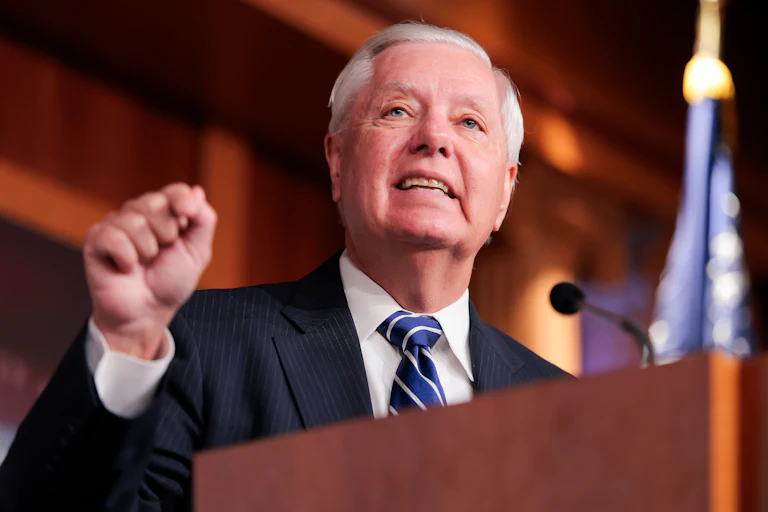
Senator Lindsey Graham gestures while speaking at a podium
Heather Diehl/Getty Images

MAGA’s best case scenario for the war in Iran is, apparently, a return to the prewar status quo.

In an interview with Fox News Monday night, South Carolina Senator Lindsey Graham claimed that the U.S. would win the Middle East war if it regained “freedom of navigation in the Strait of Hormuz” and attained relative peace for Iran’s neighbors—something that existed before Donald Trump decided to attack Iran.

“We’re close to victory,” Graham said. “Victory for me would mean regaining freedom of navigation in the Strait of Hormuz, degrading a little bit further—short, big, strong response—their military capability a bit further, threaten Kharg Island with destruction and pull out and try to get Israel and Saudi Arabia back to peace.

“The Strait of Hormuz is the only thing left,” Graham noted, touting White House talking points. “This has been a brilliant campaign by President Trump and our military.

“If we can take back control of the Straits of Hormuz, it is checkmate,” Graham said. “This thing is over.”

Yet even better than a win for the U.S. would be a win for Israel, according to Graham.

“The ultimate victory is that Saudi Arabia and Israel make peace, ending the Arab-Israeli conflict,” Graham continued, continuing to heap praise on Trump’s name by claiming that the president will “go down in history as the greatest peacemaker.”

U.S. involvement in the war was reportedly arranged following a February 11 meeting between Trump, Israeli Prime Minister Benjamin Netanyahu, and several U.S. and Israeli officials in the White House Situation Room. It was reportedly Netanyahu’s direct influence—and the ensuing pressure campaign—that thrust America into the war. U.S. military commanders advised Trump that components of Netanyahu’s plan to attack Iran were “farcical,” but by that point, Trump had already been inspired to go after Tehran’s theocratic regime.

The State Department backed the narrative via a government release penned late last month, detailing how the U.S. “is engaged in this conflict at the request of and in the collective self-defense of its Israeli ally, as well as in the exercise of the United States’ own inherent right of self-defense.”

Nonetheless, the White House has disputed that narrative, repeatedly insisting that Israel had nothing to do with Trump’s decision to involve the country in another unpopular war in the Middle East.

America has so far been at war with Iran for more than nine weeks and spent at least $25 billion in the process (though some estimates put the number at more than $70 billion). The regional conflict has damaged strategic alliances, stalled global trade, and thrust the world into an energy crisis due to the blockade on the Strait of Hormuz.

It is not clear exactly what the war in Iran has accomplished. Together, the U.S. and Israel have killed thousands of Iranian civilians and obliterated Iranian civilian infrastructure, failing to damage Iran’s nuclear capabilities in the process. Meanwhile, 13 U.S. soldiers have died.

The war has also spiked the cost of living for people around the world and agitated international relations—particularly between the U.S. and longtime allies in the Western hemisphere.

It has also sparked a political rejection of MAGA ideology across the U.S. as the American public becomes more and more disillusioned with its increasingly infirm, unstable, and volatile president.

Trump Targets Every 2020 Election Worker in Key Georgia District

The Department of Justice wants a list of names from Fulton County.

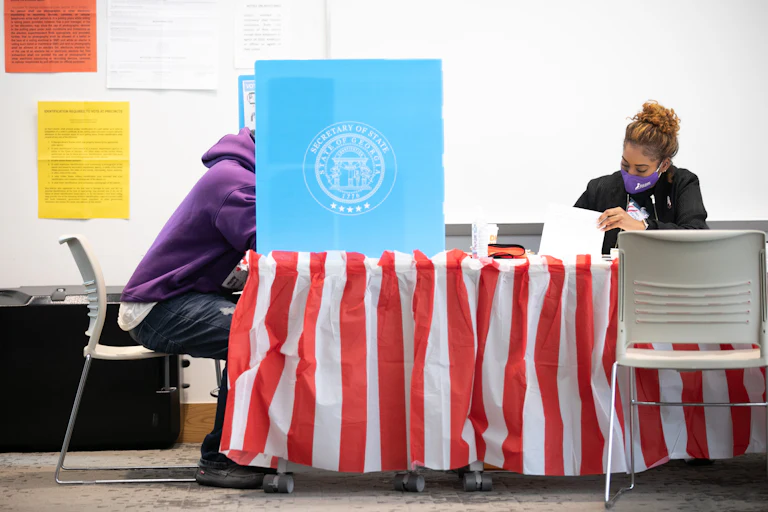
Sitting next to a masked poll worker, a Fulton County voter casts a ballot.
Jessica McGowan/Getty Images
Sitting next to a poll worker, a Fulton County voter casts a ballot on November 3, 2020, in Atlanta.

President Trump is trying to get the personal information of thousands of election workers and volunteers in Fulton County, Georgia, who helped with the 2020 election.

The Fulton County Board of Elections filed a 27-page motion Monday to block a Department of Justice subpoena seeking the personal information of election workers, calling the move unprecedented and politically motivated.

The subpoena, issued on April 17 but disclosed in court Monday, demands that the board’s custodian of records appear in federal court Tuesday with the full election staff roster, including names, home addresses, email addresses, and personal phone numbers of everyone involved in the 2020 presidential election in Georgia’s most populous county.

County attorneys say that this goes too far and could include nearly 3,000 county employees, temporary poll workers, and volunteers. Fulton County Commission Chair Robb Pitts told The Atlanta Journal-Constitution that the purpose of the subpoena is to “intimidate workers in our county, to discourage people from voting,” adding that the county would fight back with “with every possible resource.”

Trump and his MAGA base have pushed conspiracy theories that Joe Biden’s 2020 victory in Georgia was due to election fraud, even though those claims have been debunked in court. Since winning his second term as president, Trump has weaponized the federal government to go after Fulton County, sending his director of national intelligence, Tulsi Gabbard, to accompany FBI agents to raid an elections office there in January.

All of this could be a pretext for Trump to interfere in the November midterm elections, and even beyond that. The country could be in for several long legal battles.

House Paid Astonishing Sum to Make Sexual Harassment Claims Disappear

Congress is apparently filled with sex pests, according to recently revealed payout documents.

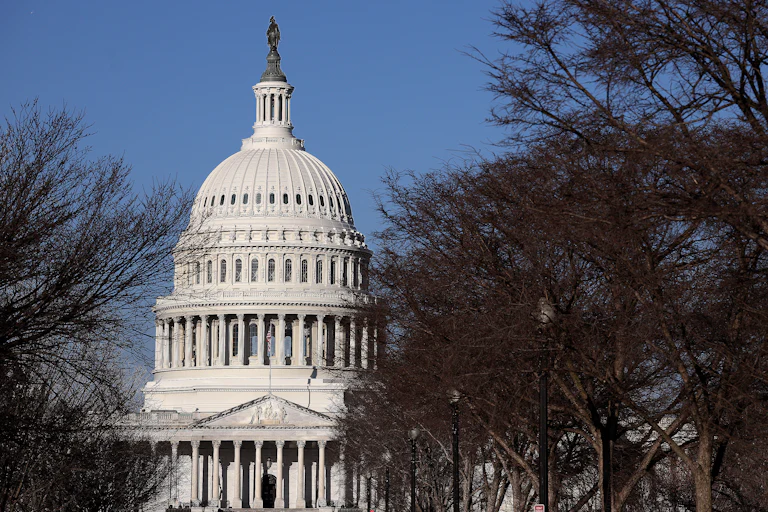
Capitol building
Kevin Dietsch/Getty Images

The federal government secretly used your tax dollars to settle sexual harassment claims against House members for decades.

According to documents from the Office of Congressional Workplace Rights and Republican Representative Nancy Mace, who recently forced the release of those documents through a subpoena, the federal government paid out more than $338,000 from 2004 to 2017 to secretly settle sexual harassment claims against six House members or their offices. The following year, Congress banned the federal government from paying off settlements for sex pests.

Mace said she plans to release the records publicly “once we confirm that personally identifiable information of victims and witnesses has been properly redacted.... Accountability is not a threat,” she said. “It is a promise.”

According to Mace’s calculations, those implicated include former Democratic Representatives Eric Massa ($115,000) and John Conyers ($77,000), and Republicans Blake Farenthold ($84,000) and Patrick Meehan ($39,000), whose misconduct was already public but not the exact sums. Less public settlements included an $8,000 payout on behalf of the late Democratic Representative Carolyn McCarthy’s office and a $15,000 payout for former Republican Representative Rodney Alexander. Alexander claimed the settlement had to do with accusations against one of his staffers at the time, while a former McCarthy aide did not respond to a query from Politico.

These payouts—which have received even more scrutiny in the wake of allegations of misconduct against former Representatives Eric Swalwell and Tony Gonzales—demonstate the massive lack of accountability for members of Congress. Our leaders are hiding behind our money instead of actually having to acknowledge their misdeeds.

Trump’s Iran War Is a Bigger Bust Than We Knew, Leaked Info Shows

What has Donald Trump actually accomplished?

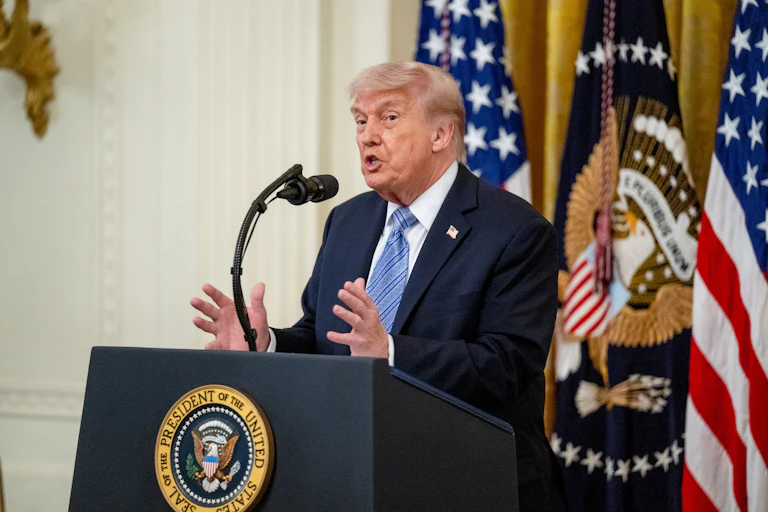
Donald Trump gestures and speaks at a podium
Daniel Heuer/Bloomberg/Getty Images

The war in Iran has done very little damage to the country’s nuclear capabilities, according to U.S. intelligence assessments.

So far, America has been at war with Iran for more than nine weeks and spent at least $25 billion in the process. The regional conflict has damaged strategic alliances, stalled global trade, and thrust the world into an energy crisis due to the blockade on the Strait of Hormuz. It has also killed thousands of people.

And yet assessments of Tehran’s nuclear program remain largely unchanged from roughly a year ago, when Donald Trump ordered strikes on three of Iran’s nuclear sites, hitting Fordo, Natanz, and Isfahan on June 22.

Prior to the June attack, U.S. analysts believed that Iran had the capacity to build a nuclear bomb within three to six months, according to three sources familiar ‌with the matter that spoke with Reuters Monday night. Afterward, U.S. analysts estimated that the attack—internally referred to as Operation Midnight Hammer—changed the Islamic Republic’s nuclear timeline back to about nine months to a year.

That estimate is still the same, according to Reuters’s unnamed sources.

Since February 28, the majority of U.S. and Israeli attacks have focused on hitting conventional military targets in Iran. The stagnant timeline suggests that such a strategy is not effective at diminishing Iran’s nuclear capabilities. To do that may require the destruction or removal of Iran’s remaining stockpile of highly enriched uranium, or HEU, reported Reuters.

Iran lacked a single bomb’s worth of uranium in 2018, three years after former President Barack Obama brokered the Iran Nuclear Deal to limit the country’s enormous uranium stockpile. But that changed when Trump withdrew the U.S. from the pact and imposed a series of tough economic sanctions against the Middle Eastern country.

By 2025, Iran had curated an 11-ton stockpile of enriched uranium, the whereabouts of which remain largely unknown. The total HEU stockpile could create as many as 10 bombs if fully enriched, according to a 2025 assessment by the International Atomic Energy Agency.

Trump has previously stated that his primary objective in the war was to completely eliminate Iran’s nuclear capabilities, but his administration has not been consistent in relaying its mission progress to the general public.

In the immediate aftermath of Operation Midnight Hammer, Trump and his administration claimed that Iran’s nuclear production was set back by multiple “years.” Yet former National Counterterrorism Center Director Joe Kent suddenly resigned over the issue in March, writing in his resignation letter that he could not “in good conscience” support the war in Iran because the country “posed no imminent threat to our nation.”