Newsletter
Power Mad
A weekly review of the rogues and scoundrels of American politics

Sending ICE to the Airports Is Trump’s Dumbest Idea Yet

Weary travelers already mired in the president’s ineptitude are getting a potent and visible reminder of this administration’s authoritarian misrule.

ICE agents stand next to a security line at Hartsfield-Jackson Atlanta International Airport
Megan Varner/Getty Images
ICE agents stand next to a security line at Hartsfield-Jackson Atlanta International Airport on March 23.

In recent months, we’ve reached the stage of President Donald Trump’s second term where some of his greatest problems are the result of misguided solutions to his previous screwups. We are spending millions on farm bailouts to cover Trump’s devastating tariffs. We’re in a war with Iran to reopen a shipping lane that was open before we started the war. And we are lifting sanctions on the oil that’s floating around at sea on tankers from the country we’re at war with because we need that oil in the market to reduce the cost of gas that spiked because, again, of the war we chose to start.

Essentially, the backlash to the problems Trump first caused forced a response that is destined to lead to more backlash. It’s a comically vicious cycle, but hey, this is kind of what you get when you elect a president who ran on the platform of “If I become president they can’t prosecute me for my many crimes.” But now, everyone who is flying out of a major U.S. airport can have themselves an up-close look at the clattering irony of Trumpian misrule as they stand in epically long security queues to watch recently redeployed ICE agents lumber around, stewing in their own pointlessness.

This decision by Trump, like so many others, really requires one of those “Let me get this straight” paragraphs to truly appreciate the ouroboros of ineptitude on display. So let me bang one out. ICE agents previously deployed to terrorize American cities have engendered such a heavy amount of blowback from the American public that Democrats were able to find the courage to stand firm against further funding of the agency until significant reforms are agreed to in a deal. Trump, who can’t tolerate negotiating with Democrats, has killed off compromises that would permit the funding of the Department of Homeland Security’s other agencies. Because of this department-wide shutdown, the TSA is unfunded, so unpaid workers are dropping like flies and people are having to spend hours in the airport security lines.

The solution to all of this: Send hundreds of ICE agents to these airports to … well, beyond a few reports of agents making cursory and redundant ID checks, it’s not clear what they were meant to do in this situation, and by all accounts they aren’t improving things at all. (Though Lauren Boebert did claim that ICE was making things great again at Minneapolis-St. Paul International Airport before it was pointed out to her that ICE had not been deployed to that airport.) Because this is ICE we’re talking about, there was mayhem to be had: San Francisco travelers were witness to a particularly horrific arrest this week. But as Defector’s Barry Petchesky reported, the agents are mostly just standing around, diddling on their phones, and begging for a coffee shop manager to hit them with a classic, “If there’s time to lean, there’s time to clean.”

The origin story of the plan to send Immigration and Customs Enforcement thugs to the airport truly is nutty. As CNN reported, this all began when “Linda from Arizona” called in to The Clay Travis and Buck Sexton Show last week to make her pitch: “I think I have a solution to the TSA problem.” She said, “We need to bring in ICE agents.” Travis took the idea to Fox News to make a direct appeal to the president. Per the report, “CNN searched TV transcript databases and found no other mentions of the idea on major networks until Travis brought it up.” Naturally, Trump ended up insisting that the idea was his. Look, I know this has been a bad week for the AI industry (or as I call it, the “use-up-all-the-energy-to-build-soulless-data-centers-to-steal-the-whole-of-human-endeavor-and-creativity-in-order-to-make-shittier-facsimiles-of-things-people-already-do” industry), but for all the talk of AI slop, here we have some human slop that, against all odds, is substantially worse.

ICE deployments have caused no small amount of harm to the American people. Besides the terror they cause, they are one of the big drivers of the affordability crisis in the United States. Just this week, the Financial Times reported how ICE crackdowns have essentially broken the home-building industry in Texas’s Rio Grande Valley. So the decision to make ICE agents—who are a sort of sprawling reminder of how Trumpism isn’t working—more visible to the public is an odd one.

While no one wants to encounter Trump’s brownshirts on the streets of their town, their presence has proven to be oddly galvanizing to the growing dissident movement against Trump. It takes the stupidity and ineptness of authoritarianism and shifts it from a theoretical concern to something local and tangible. It gives people the opportunity to perceive misrule for themselves, and provides a target for their ire. And it keeps people well brined in the salty swirl of everything being politicized.

I personally don’t know if the wreckage of Trump’s own policy stupidity is evident to him. He is, after all, fighting a daily battle with his flagging cognitive abilities. He may perceive the economy as great solely because his many avenues to personal self-enrichment are all paying off. We learned this week that his daily Iran war briefing consists of two-minute montages of stuff blowing up. The barriers between Trump and information awareness, in other words, remain strong. But with his approval ratings tanking, the economy cratering, and the undistilled chaos of his presidency spreading, Republicans might rue the day Trump decided to send a potent reminder to your local airport about how he’s making everything suck.

This article first appeared in Power Mad, a weekly TNR newsletter authored by deputy editor Jason Linkins. Sign up here.

Trump’s War With Iran Is a Product of His Deep Stupidity

There’s a simple and obvious reason we’re in this mess.

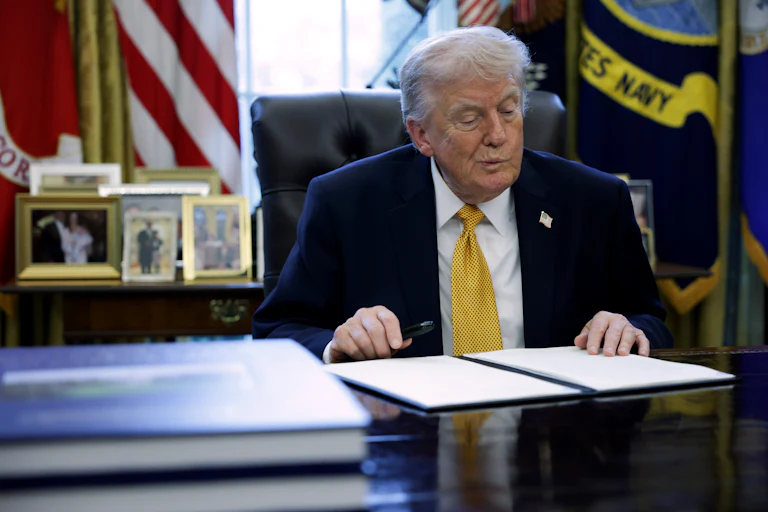
Donald Trump prepares to sign paperwork during a White House signing ceremony.
Alex Wong/Getty Images

What can be said about Trump’s war with Iran that isn’t already abundantly obvious? The answer: not much. It is not going well, and it probably won’t end well. But having spent time in the salt mines of Trump punditry, I can tell you that we’re going to endure a difficult round of think pieces purporting to explain How This Happened. So maybe this is the best time to assert the obvious, using my favored rubric of Trump analysis: Imagine if the dumbest person in the world and humanity’s biggest asshole were the same person, and that guy was president. Then imagine he started a war with Iran. Now check the news. One look, and here’s what you should be thinking: “Yep, that tracks.”

As with all of Trump’s presidential exploits, success is always constrained by two factors: The aforementioned sharp limitations of his intellectual capabilities and the fact that he is perpetually surrounded by an inner circle made up of clowns somewhere on the spectrum between “rampantly evil” and “thoroughgoing dipshit.”

“Why did President Trump decide to attack Iran?” The Atlantic’s Yair Rosenberg recently mused. “It depends on what day of the week you ask.” On some days, Trump was acting on (roundly discredited) intel that Iran was on the verge of acquiring nuclear weapons. On others, there is a scent of regime change in the air. Sometimes we are told that we were doing a classic “leading from behind” maneuver, trailing Israel into a conflict it’s long sought. Frankly, I give a lot of credit to the “wag the dog” scenario: With the economy in shambles and Jeffrey Epstein riding high in the headlines, Trump needed a distraction. Also, we mustn’t forget that he’s a warmonger who just thinks it’s fun to blow things up. (For Iran War Stupidity completists, Popular Information’s Judd Legum has rounded up 17 separate and frequently contradictory reasons that the administration has submitted for our approval.)

I’ve been reading the comment sections (of the Financial Times, anyway), and Trump is getting his ass roasted: “Let me get all of this straight in my head. They want their allies to join in an ill-thought-out war of choice with unclear aims and an uncertain chance of success for any of the myriad aims stated so far. They want everyone else to just absorb any of the externalities, like influxes of refugees, disruptions to shipping, higher oil and commodity prices, and maybe even some incoming missiles. And then they also want to tariff everyone at 15 percent.” Brother, you seem confused, but you got it absolutely correct.

Trump is really going through it with the nations that were once, putatively, our allies before Trump launched a trade war with all of them and threatened to seize Greenland in an act of colonial conquest. In the space of days, Trump has gone from begging for European naval support to free the Strait of Hormuz to having those requests punted back in his face to spiraling out on Truth Social about how he didn’t actually need anyone’s help in the first place. Since then, he’s petulantly suggested that he might wreck the whole shop and leave the nations that rebuffed him to clean up the mess. Meanwhile, countries like France and Italy are simply working on side deals with Iran to be allowed to use the strait.

My colleague Heather Souvaine Horn recently expressed to me how maddening it is to see the Trump administration treat Iran’s clampdown of the Strait of Hormuz as if it’s some unfair trick the Iranians pulled and not one of the most singularly obvious strategic choices the regime could make under the circumstances—the other being Iran’s decision to attack other Gulf states, knowing that it would be a pain point for the U.S. both economically and diplomatically. But by Trump’s own admission, the very fact that Iran retaliated in any way has caught him completely flat-footed. “They weren’t supposed to go after all these other countries in the Middle East,” he told reporters on Monday. “They hit Qatar, Saudi Arabia, UAE, Bahrain, Kuwait. Nobody expected that. We were shocked!” Right now, there are 13-year-old kids about to invade Kamchatka in their first-ever game of Risk that look like Carl von Clausewitz compared to Trump.

This week, The New Republic’s Alex Shephard wrote that it will be Iran, not Trump, that dictates when and how this conflict ends. At least one anonymous administration official concurs, telling Politico that Iran’s leaders “hold the cards now.” “They decide how long we’re involved—and they decide if we put boots on the ground. And it doesn’t seem to me that there’s a way around that, if we want to save face.” Sounds great. Until then, if you want a vision of the future, imagine a boot stamping on a rake—forever.

This article first appeared in Power Mad, a weekly TNR newsletter authored by deputy editor Jason Linkins. Sign up here.
The Corporate Miscreants Driving the Affordability Crisis

These 20 firms all have something in common: Their CEOs get paid millions, their workers are being pushed onto public assistance, and voters are fed up with them.

Brian Niccol, chief executive officer of Starbucks Corp., during a Bloomberg Television interview.
Michael Nagle/Getty Images
Brian Niccol, CEO of Starbucks, during a Bloomberg Television interview

During his recent State of the Union address, President Donald Trump took a few minutes to talk about the affordability crisis that’s been gripping the nation—which is to say, he threw some balderdash in the direction of Democrats. Blaming the high prices he once referred to as a “hoax” on the “dirty, rotten lies” of the opposition party, he then neatly pirouetted into his next point: declaring the crisis over. “Their policies created the high prices. Our policies are rapidly ending them,” he said. “We are doing really well. Those prices are plummeting downward.”

It’s not hard to understand why Trump wishes this to be true. He is, after all, a one-man driver of the affordability crisis. As we’ve noted before, the mayhem he has unleashed on the streets of cities like Minneapolis is making it harder for ordinary Americans to make ends meet. The American people are bearing most of the cost of his chaotic tariffs scheme. And gas prices are set to spike anew now that he’s launched a war in Iran. Still, as with any problem playing out in the pocketbooks of voters, the president has plenty of company on the wrong side of the fight—like the corporate privateers who are driving the crisis deeper while profiting off of our pain.

A new report from the Institute for Policy Studies, or IPS, takes a deep dive into the battery of corporations they call the “Low Wage 20”: 20 firms that currently employ 6.7 million people across the United States. The names are familiar—Amazon, Starbucks, FedEx, Walmart, and Tyson Foods are habitual malefactors—but their sins are growing more mortifying by the day.

The most mortal of these, per the IPS, is the way these 20 firms’ “low-wage business models have left many of their workers with no choice but to rely on public assistance.” Fifteen of the companies’ median pay last year was “below the $35,631 income limit for a family of three to be eligible for Medicaid in most states”; at 13 of them, the pay fell short of the “$33,576 threshold for a family of three to be eligible for SNAP.” It’s bad enough when your business model essentially plans for government programs to provide the money you’re not willing to pay. But as TNR’s Grace Segers has relentlessly reported over the past year, the funding cuts and regulatory hurdles embedded in Trump’s “One Big Beautiful Bill” have pushed these programs, and their beneficiaries, into crisis.

The IPS says corporate power is driving the affordability crisis in other ways, as well, including a very basic one: They’re just paying people less. “Half of Low-Wage 20 firms reported a decline in their median pay between 2019 and 2024, after adjusting for inflation,” the report says. “Average median pay for the group dropped 4.6 percent, from $30,474 (in 2024 dollars) to $29,087.” These workers are increasingly getting priced out of the American dream too. All 20 of these corporate miscreants’ reported median pay last year was below the $59,600 needed to afford the rent on a two-bedroom apartment; seven of the firms’ median salaries are lower than the $25,533 average price of a used car.

Meanwhile CEO pay is doing what it always does—driving income inequality. The average CEO pay at these 20 firms was $18.6 million last year, while average CEO-to-median worker pay ratio “stood at a staggering 899 to 1, compared to the S&P 500 average of 285 to 1.” Brian Niccol of Starbucks took home the award for the most nonsensical disparity between CEO and employee income: He earns $95,801,676, while the median salary for a Starbucks employee was a mere $14,674.

There are a slew of policy decisions that can be made to alter this trajectory, from raising the minimum wage to bolstering labor rights to imposing a tax on stock buybacks. The IPS even suggests we adopt the practice of “bad business fees” designed to penalize companies for paying such paltry wages that their employees have no choice but to rely on public assistance to make ends meet. And of course, corporate democracy would go a long way to taming these excesses. As TNR contributor Osita Nwanevu has argued, more worker ownership can help limit income inequality while also providing firms with ballast to survive economic downturns.

It goes without saying that the ideological orientation of the White House and Congress guarantees little progress will be made on any of these fronts—especially with Trump looking backward to blame Democrats for the wreckage he’s meted out. But November’s elections loom—and as TNR contributor Dylan Gyauch-Lewis reported, poll after poll reveals a public hungry for lawmakers to confront corporate power directly, and that “large majorities of Americans blame corporations for their affordability issues.” There’s never been a better time to make some corporate enemies. These 20 will do for a start.

This article first appeared in Power Mad, a weekly TNR newsletter authored by deputy editor Jason Linkins. Sign up here.
How to Dismantle a Concentration Camp

Trump’s drive to build a network of detention centers is being met with some robust public resistance.

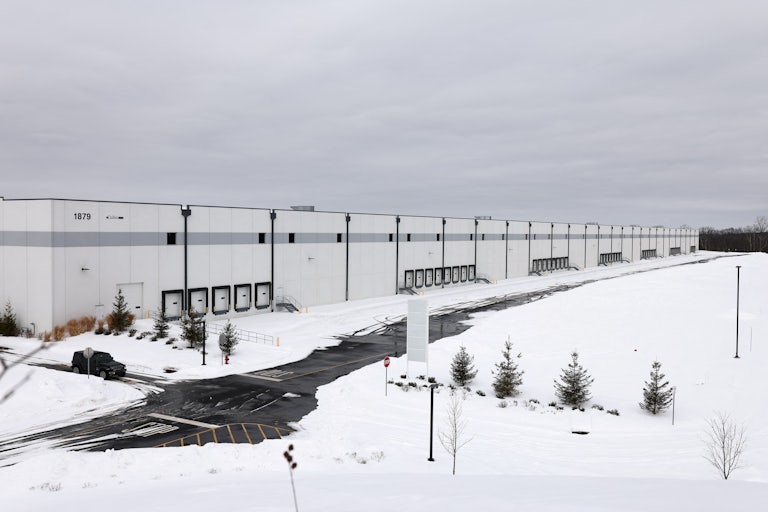
A warehouse ICE plans to use as a detention center in Roxbury, New Jersey, on February 16
Charly Triballeau/Getty Images
A warehouse ICE plans to use as a detention center in Roxbury, New Jersey, on February 16

This time last week, I had accountability on my mind, and the need for liberal leaders in a post-Trump future to transform frustration into lustration by bringing the agents and enablers of Trumpism to heel and forcing them to pay a price for their misdeeds. One thing I could have been more forthright about is what put me in the mood: It’s the old and ongoing story of the abuse being meted out by Trump’s brownshirts. Whatever you’ve been told about these goons standing down or lowering the temperature isn’t the straight story. Every day there are fresh tales of their villainy.

It may seem overwrought or cartoonish to call these people evil. But the story that recently cemented it for me took place last year at a deportation detention center in Dilley, Texas—which you may be familiar with because among the allegedly dangerous “worst of the worst” people they have in custody is a 2-month-old infant. As NBC News reported, last November the child detainees were sent to the gymnasium under the pretense that after months of eating contaminated food, they would be treated to a Thanksgiving dinner. But after being made to stare at tables stacked for a holiday feast, they were told that the food was for their jailers, not them.

So, yes, this is evil—despicable and Dickensian. But what’s particularly hair-raising is that we’ve only learned a fraction of what’s going on behind the closed doors of what are essentially concentration camps; what we don’t know is much more vast. And with the Trump administration splashing billions of taxpayer dollars to develop a network of these warehouse prisons, this evil may metastasize—and get better at keeping us in the dark.

It can already be said that 2026 is off to a grim start. As the American Immigration Council, or AIC, reported earlier this month, there were six deaths in ICE detention centers across the country in January. This includes the death of 55-year-old Geraldo Lunas Campos, which was ruled a homicide after a medical examiner concluded he’d died of “asphyxia due to neck and torso compression.” The AIC noted that while ICE is “legally required to report deaths that occur in its custody, its public disclosures often come late and have little information. Independent investigations frequently contradict these findings later.”

Reporting on what’s going on inside these facilities is notoriously difficult, but sometimes we get a shocking glimpse behind the walls and razor wire. In late January, The New Yorker offered one such look at the kaleidoscopic horror taking place in a detention facility in the Mojave Desert. There, detainees with experience at other detention facilities told reporter Oren Peleg that the California detention center “was unique in its mistreatment of those held in its custody,” with abuses ranging from “extremely delayed appointments with health-care professionals, the denial of medications and treatment, experiences with unsafe and unsanitary living conditions, and a general antagonism by medical staff toward detainees.”

A class action lawsuit filed against ICE and the Department of Homeland Security echoes these accounts. Therein, detainees describe the remote facility as a “torture chamber” and “hell on Earth.” Tess Borden, an attorney at the legal nonprofit Prison Law Office, told The New Yorker that “the conditions at the facility are so terrible that detainees are resigning themselves to self-deportation, instead of pursuing asylum and other immigration cases,” and that others were “also trying to take their own lives.”

If stories of this kind disappear from the news, it won’t be because ICE has reformed itself. Rather, it will probably be the result of a clampdown on information. In mid-February, guards at the Dilley detention center raided the family dormitories to seize and destroy letters and drawings made by the children detained there, after their letters were included in a ProPublica report describing the conditions. And lawmakers seeking to do their own lawful oversight continue to find their access denied. As Senator Alex Padilla mused after recently being denied entry to a detention center in San Diego County, “The big question I come with is, what do they have to hide?”

The other big question is what can be done to thwart the Trump administration’s effort to complete its network of prison camps. While we shouldn’t expect Democrats in the federal government to make headway on this matter anytime soon, we’re seeing a mass movement against these detention centers emerging at the local level. Public protest in Ashburn, Virginia, convinced a Canadian billionaire to scuttle a deal to sell warehouse facilities to ICE. Lawmakers in South Fulton, Georgia, preemptively passed a law banning DHS from acquiring warehouse properties in their jurisdiction.

And ironically enough, local jurisdictions are wielding the tools of proceduralism—the endless array of hoops to jump through that The New Republic contributor J. Dylan Sandifer has indicted as the means by which progress too often gets blocked—to throw a wrench in ICE’s works. State officials in Maryland led by Governor Wes Moore—who, per Sandifer, is a notable skeptic of proceduralism—have filed a lawsuit against ICE and DHS in an attempt to block the agency from transforming warehouses in their state into detention facilities. As The Washington Post reported, the state’s complaint borders on the mundane, but it’s really pulling out all the tricks: “The Trump administration did not conduct an environmental review nor seek public input on the project or provide a reasoned explanation on their decision-making, as required by law.”

Representative Alexandria Ocasio-Cortez recently fielded a question from a self-described “ordinary citizen” on social media, who asked, “What can we do to get the concentration camps shut down and restore accountability for those imprisoned against the law?” Her answer: “Local zoning is the way! A lot of these are being stopped or stalled by neighborhood organizing. These warehouses often need to be purchased, permitted, approved for occupancy and specs. Each one of those steps can be interrupted.”

One of the people who heartily approved of AOC’s advice was M. Nolan Gray, the author of Arbitrary Lines: How Zoning Broke the American City and How to Fix It. “As the guy who wrote the book on zoning abolition,” he wrote, “I’d like to go on record as saying: If you can use zoning to stop the concentration camps, fucking go for it.” It’s great to see everyone on the same page.

This article first appeared in Power Mad, a weekly TNR newsletter authored by deputy editor Jason Linkins. Sign up here.

There’s Only One Way to Eradicate Trumpism for Good

If accountability isn’t a central pillar of a post-Trump future, we will doom ourselves.

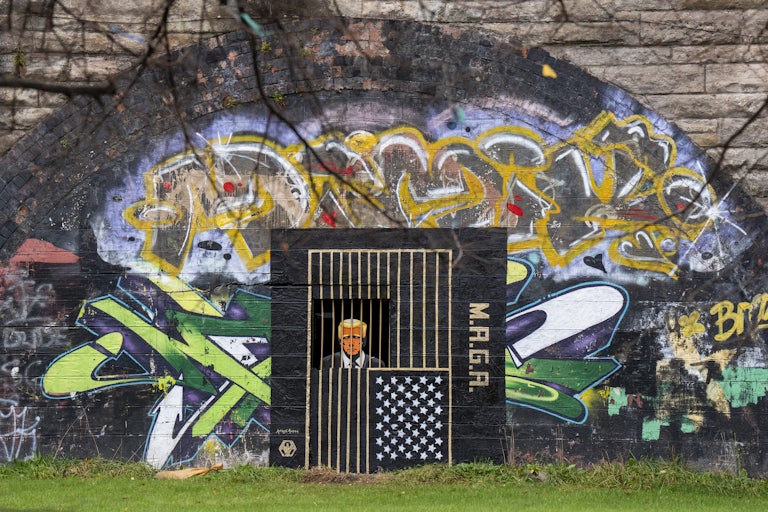
A piece of street art, by artist Ashley Rawson, depicting President Donald Trump behind bars
Jane Barlow/Getty Images
A piece of street art, by artist Ashley Rawson, depicting President Donald Trump behind bars

One of the weirder journalistic spectacles of the Trump era has been watching mainstream news organizations parachute into the hinterlands to try to understand the voters who ushered in, and continue to support, this age of cruelty in America. A recent classic was The New York Times’ herculean effort to find one Minnesota diner whose patrons were willing to talk shit about the ICE resistance in Minneapolis. There has not, however, been an equivalent effort to reveal the everyday people who saw the dangers of Trumpism coming. But this week, TNR contributor Toby Buckle returned to these pages to do just that.

I’m petty enough to enjoy a good round of “I told you so.” One of the better value propositions of your TNR subscription is that you’ll more frequently find yourself in the company of writers who recognized the dangers of Trumpism from several miles off and unflinchingly told the truth about it. That’s why Buckle’s warning that a mere election victory won’t be sufficient to right this ship has stuck in my mind: “We must undertake an ambitious program of accountability and reform in order to create liberal democracy in America again.” So here’s something else I’m going to be right about in advance: The failure to hold the malefactors of Trumpist fascism to account will only ensure its return.

This isn’t some loose theory. Perhaps the best proof of this fundamental fact can be found in recent history, as both Trump’s rise and his return were preceded by Democratic administrations that showed little regard for civic accountability. The Obama administration made the conscious decision to make “looking forward, not backward” the order of the day, to the great relief of Wall Street crooks and war-on-terror torturers. Obama extended grace to those who capsized the economy, and kept showing extreme deference to them throughout his administration.

As The American Prospect’s David Dayen reported this week, an email from recently disgraced Goldman Sachs lawyer Kathy Ruemmler to pedo-oligarch Jeffrey Epstein—in which she seeks advice on how to defend Securities and Exchange Commission Chair Mary Jo White from Senator Elizabeth Warren, who’d been stoking outrage about White’s constant granting of deferred prosecution agreements to corporate criminals—is perhaps the perfect encapsulation of the Obama administration’s laxity. This vacuum of accountability was filled by Trump’s right-wing faux-populism and anti-immigrant sentiment. Much of this could have been headed off.

And while there were some significant areas in which Joe Biden seemed to learn from his former boss’s mistakes, the need for a more robust campaign of accountability was not one of them. Despite the ample reasons to launch investigations and obtain redress for past corruption, Attorney General Merrick Garland did little more than attempt to radiate an ambient virtue, perpetually endeavoring to shield his agency and the Biden administration from the perception that they were seeking purely political prosecutions. Not that this ever stopped Trump from crying foul about witch hunts! Garland’s first major investigation into Trump’s misconduct wasn’t launched until three days after Trump announced his reelection campaign—the very thing that the Biden administration should have been trying in earnest to prevent after the Senate failed in its duty to impeach him. Once Trump entered the safe harbor of a presidential candidacy, efforts to hold him responsible fizzled—and the Supreme Court all but crowned him king.

As I’ve argued before, these “look the other way and cross your fingers” ways of the past aren’t going to cut it anymore. There shouldn’t be Democrats running for election anywhere who aren’t fully committed to using their regained power to take Trumpism down. That means large-scale investigations and hearings. That means pursuing criminal charges and jail sentences. Yes, that means everyone currently employed by ICE gets a pink slip. And that means doling out punishments to the corporate scofflaws and institutional enablers that allowed Trumpian misrule to flourish.

Axios reported this week that corporate America is being warned that the “subpoenas are coming.” I want that to be true; if we end up with political leaders on the left who are too timid to do what needs to be done, we will fall short. The Beltway-brained are perennially concerned with “political capital,” the allegedly short supply of which creates the perpetual demand for scaling back Democratic ambitions. Future party leaders need to shed these phantasmal fears. And they need to be ready for the political press to lobby hard against these efforts. After all, the sight of so many people being held accountable will raise serious questions of how much went wrong on their watch.

All that said, I continue to be buoyed by the sense that Democratic voters are bent on elevating real fighters—and cheered by the sight of those whom they’ve been elevating repaying that faith. There is already ample material to fuel the ambitions of would-be warriors. A recent Economist/YouGov poll found that massive swaths of Americans are using brutal terminology to describe the Trump administration: 47 percent of respondents say they would describe Trump as “racist,” 49 percent would characterize him as “corrupt,” and 46 percent would describe him as “cruel.”

These numbers indicate a very favorable environment for Democrats to attack Trump on these fronts—to explicitly say that Trump is a cruel and corrupt racist who’s enriched himself in office at the expense of the American people while egging on a secret police force that is increasingly evil in the purest sense of the word. It will take effort and commitment to provide real accountability, but the prize at the end of the quest is a democracy with restored resilience and a repellent right-wing movement beaten back into irrelevance. If it’s done correctly, the next time anyone goes looking for the point of view of Trump voters, they won’t be able to find anyone willing to admit they ever supported him.

This article first appeared in Power Mad, a weekly TNR newsletter authored by deputy editor Jason Linkins. Sign up here.