Breaking News
Breaking News
from Washington and beyond

Ex-DOGE Staffer Admits the Whole Thing Was a Total Bust

Nathan Cavanaugh admitted in a deposition video that Elon Musk’s agency failed to accomplish its one mission.

Elon Musk speaks during the World Economic Forum
Fabrice COFFRINI/AFP/Getty Images

The DOGE bros responsible for cutting over 317,000 federal jobs and thousands of grants continue to show they had no idea what they were doing and no remorse for the damage done.

The depositions of two of the bros, Nathan Cavanaugh and Justin Fox, were published on YouTube last week by the plaintiffs of a suit who hope to restore some of the cuts made to the National Endowment for the Humanities.

The nearly 25 hours of depositions are equal parts hilarious and depressing, showing how sloppy Elon Musk’s former staff—most of whom had little experience in government—were in their approach.

For all Musk’s bluster about reducing government spending by $1 trillion, federal spending increased with DOGE at the wheel. Cavanaugh outlined the irony perfectly in his deposition when asked whether he regretted that the slashing of grants had cost many people their livelihood.

“No,” Cavanaugh said. “I think it was more important to reduce the federal deficit.”

“OK,” the interviewer said. “Did you reduce the federal deficit?”

“No, we didn’t,” Cavanaugh replied.

The employees were mocked online for lacking any principles besides “cut every grant that doesn’t relate to white men.” Fox struggled to define DEI at all, and floundered when asked whether he considered a documentary about Jewish women during the Holocaust to be DEI.

“It’s a Jewish—specifically focused on Jewish culture and amplifying the marginalized voices of the females in that culture,” he said. “It’s inherently related to DEI for that reason.”

Both Fox and Cavanaugh used ChatGPT to find grants that fell under the Trump administration’s definition of “radical and wasteful government DEI programs.” The loose guidelines coupled with an imperfect chatbot and sheer idiocy from the bros meant that funding for things such as a new HVAC system for a North Carolina museum or a digital archive for Oregon newspapers were terminated in the purge. Of course, any grant containing the word “BIPOC,” “homosexual,” “LGBTQ,” or “tribal” had almost no shot of survival.

The backlash to the depositions has perhaps been too much to take for the DOGE bros. On March 13, a judge ordered that videos of the depositions be taken off the internet. They’re still quite easy to find.
Pam Bondi Subpoenaed to Testify on Epstein Files “Mismanagement”

The attorney general must testify in Congress.

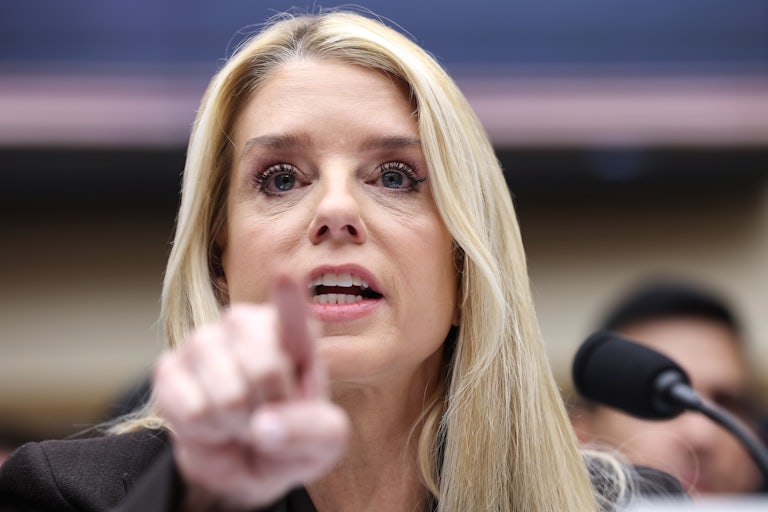
Attorney General Pam Bondi testifies in Congress.
Win McNamee/Getty Images
Attorney General Pam Bondi testifies before the House Judiciary Committee, on February 11.

Attorney General Pam Bondi has been subpoenaed by the House Oversight Committee to testify before lawmakers over her “possible mismanagement” of the Justice Department’s rollout of the Epstein Files.

“On March 4, 2026, the Committee voted to approve a motion directing the Committee to authorize and issue a subpoena to you for a deposition,” Committee Chairman Representative James Comer wrote in a letter to Bondi Tuesday. “The Committee has questions regarding the Department of Justice’s handling of the investigation into Jeffrey Epstein and his associates and its compliance with the Epstein Files Transparency Act. As Attorney General, you are directly responsible for overseeing the Department’s collection, review, and determinations regarding the release of files pursuant to the Epstein Files Transparency Act.” 

Bondi is set to be deposed on April 14, Comer noted. She and Deputy Attorney General Todd Blanche will also sit for a private briefing with Oversight Committee members on Wednesday. 

While Bondi has yet to publicly reply, a DOJ spokesperson called the subpoena “completely unnecessary.” 

“Lawmakers have been invited to view the unredacted files for themselves at the Department of Justice, and the Attorney General has always made herself available to speak directly with members of Congress,” the spokesperson told CNBC on Tuesday. “She continues to have calls and meetings with members of Congress on the Epstein Files Transparency Act, which is why the Department offered to brief the committee tomorrow. As always, we look forward to continuing to provide policymakers with the facts.”

From claiming that the Epstein client list was sitting on her desk (then claiming no such list exists), to giving the MAGA influencers those nothingburger white binders labeled “most transparent administration in history,” to contentious congressional hearings in which she appeared extremely defensive, Bondi has only managed to put even more eyes on the Epstein files—and the connections that President Trump and other elites have to them. Expect more indignation on April 14.  

This story has been updated. 

Watch Mike Johnson Struggle to Name Even One Example of Voter Fraud

The House speaker is unable to share even one real-life example of voter fraud that the SAVE Act would have stopped.

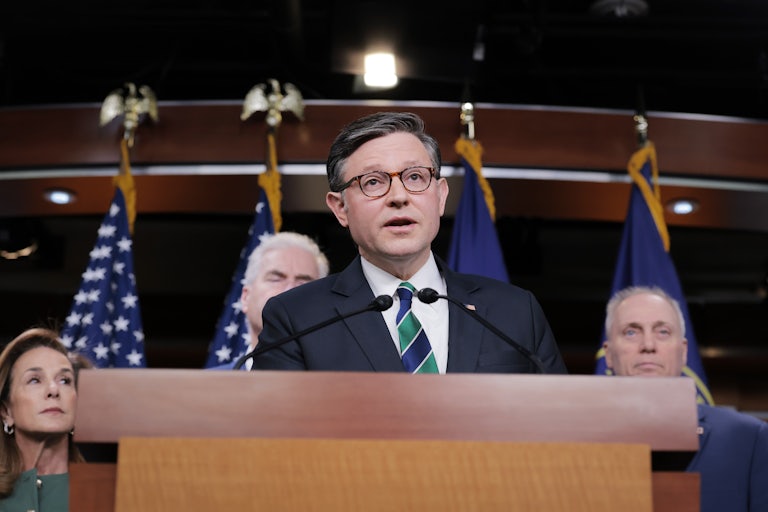
House Speaker Mike Johnson speaks during a news conference
Anna Moneymaker/Getty Images
House Speaker Mike Johnson speaks during a news conference, on March 17.

Speaker of the House Mike Johnson isn’t bothering to try and justify the SAVE Act.

A reporter asked Johnson Tuesday morning if he could point out any example of voter fraud in any previous election in any state that the bill, which would introduce extensive obstacles to voter registration, would have prevented. Johnson flippantly dismissed the question.

“Look, we’re not going to litigate all that. I can tell you what I’ll tell Democrats. You should listen to the American people. Ostensibly, we’re supposed to come here and represent the interests of the American people. This is a 90–10 issue in public opinion polling, and Democrats agree that you should be a citizen and have a photo ID to vote at a tune of about 70 percent,” Johnson responded.

There’s a reason Johnson couldn’t quickly come up with an example. In the past two decades, fraud has only been found in a tiny fraction of cases: much, much less than 1 percent.

Meanwhile, Johnson is exaggerating polling numbers on voter identification in general, not the specifics of the SAVE Act. The bill would require all current registered voters to reregister in person at a voter registration office, and in 45 states, a REAL ID would not be enough to satisfy the bill’s identification requirement. Instead, voters would have to produce a passport, passport card, or certified birth certificate.

Only roughly half of Americans have a passport, and getting a new one costs $165, in addition to the other costs to put together the application. A passport card costs $65, but applicants again face additional costs in terms of photos and required documents if they don’t have the original copy. And all prospective voters who have changed their name after birth, including married women, have to provide proof backing up their name change, such as a wedding license.

All of this would be burdensome for American voters across the country, and create a bureaucratic mess ahead of November’s midterms. It’s quite clear that the Republican Party, led by Trump, is trying to suppress votes and create confusion to prevent big losses in eight months and beyond.

Trump Refuses to Explain His Day-After Plan in Iran as He Bashes NATO

Donald Trump is winging this as he goes.

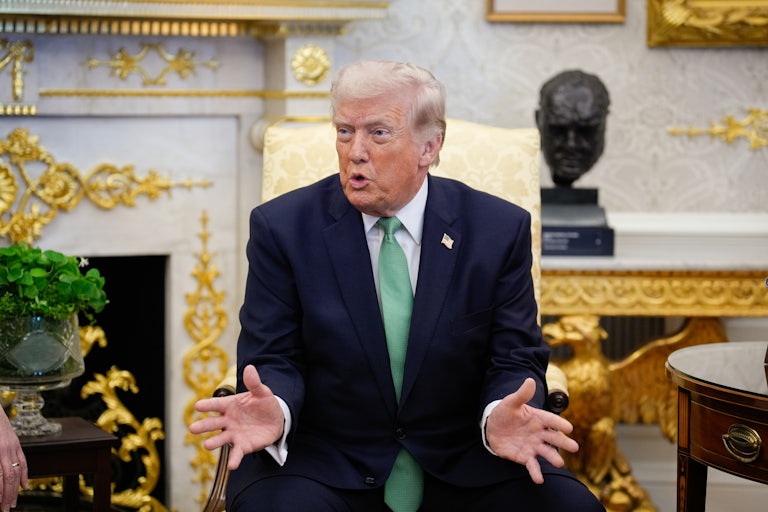
Donald Trump speaks while sitting in his golden Oval Office.
Yuri Gripas/Abaca/Bloomberg/Getty Images

President Trump can’t articulate any semblance of a real “day-after plan” in his war on Iran. 

The president was questioned by the media after his Tuesday meeting with Irish Taoiseach  Micheál Martin at the White House. 

“You just said that Iran is just a military operation to you. But do you not have a day-after plan, and if so what is your day-after plan for Iran?” a reporter asked. 

“Well we have a lot. Look, if we left right now it would take 10 years for them to rebuild. But we’re not ready to leave yet. But we—we’ll be leaving in the near future. We’ll be leaving in pretty much the very near future,” Trump said vaguely. “But right now they’ve been decimated from every standpoint. And again, we’ve had great support from countries in the Middle East. But we’ve had … essentially no support from NATO.” 

Once again, it sounds like the Trump administration went into this war with no real plan. First Trump was saying that he’d have a hand in picking Iran’s next leader. That didn’t happen. And his call for U.S. allies to help defend oil tankers attempting to pass through the Strait of Hormuz went unheeded—which is why he spent much of Tuesday bashing NATO instead of talking about a day-after plan. 

“NATO is making a very foolish mistake,” Trump said, earlier in the meeting. “I’ve long said that, you know, I wonder whether or not NATO would ever be there for us. So this was a great test. Because we don’t need them.”

Ultimately, Trump’s “near future” timeline offers no hope that this war will end anytime soon. And even if it does, at least 1,444 Iranians of all ages, 850 people in Lebanon, 15 people in Israel, and 13 American service members have already been killed. Thousands more have been injured, and both cultural heritage sites and basic infrastructure have been decimated in Iran. The grim real estate makeover plan he’s trying to build over the rubble of the Palestinian genocide in Gaza isn’t a viable option here. 

Trump Says He’s “Not Afraid” of Iran War Dragging on Indefinitely

Donald Trump brushed off a question about the war ending up the same as Vietnam.

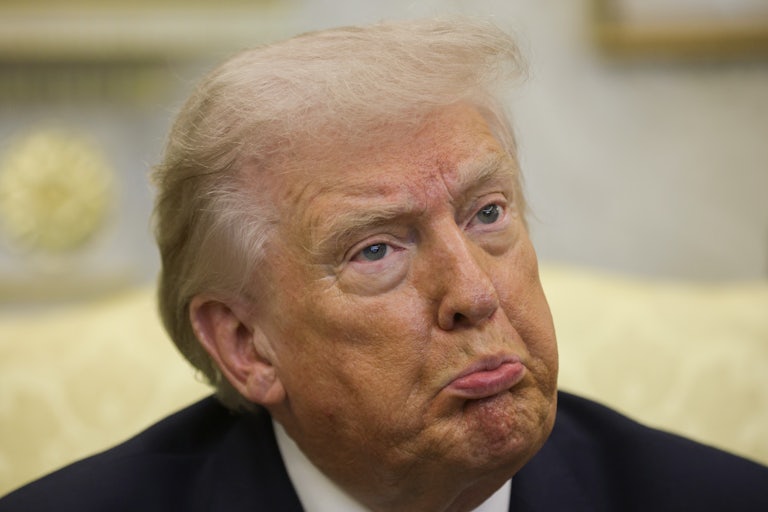
Donald Trump pouts while sitting in the Oval Office
Alex Wong/Getty Images

Donald Trump is openly entertaining the possibility of putting boots on the ground in Iran.

Speaking with reporters at the White House Tuesday beside Irish Taoiseach Micheál Martin, Trump sluggishly claimed that he wouldn’t be afraid to put the lives of American soldiers at risk in order to continue his nonsensical war.

“The Iranian regime has told Sky News that if you put boots on the ground in Iran, it would be another Vietnam. Are you afraid of that?” asked a journalist.

“No, I’m not afraid of—I’m really not afraid of anything,” Trump said.

Moments later, Trump said he would withdraw from the war “in the very near future” but that he wasn’t ready to leave yet.

“We have a lot,” Trump responded when asked if the White House had a “day-after plan,” apparently unwilling to elaborate on the details of what that plan would entail.

“If we left right now, it would take 10 years for them to rebuild,” he continued. “But we’re not ready to leave yet. But we’ll be leaving in the near future. We’ll be leaving pretty much in the very near future. But right now they’ve been decimated from every standpoint.”

But leaving may not be a feasible option in the very near future. The president’s allies have recently interpreted a shift in power, warning that while the early days of the war may have indicated an immediate victory, prolonged U.S. involvement in the conflict has dramatically increased the likelihood of boots on the ground. The changing tide has fueled concern that Trump could draw the country into yet another open-ended Middle East conflict.

At issue is whether the U.S. can obtain control over the Strait of Hormuz, the water channel situated between Iran and the United Arab Emirates. The strait is the single most important energy transit point in the world, funneling approximately one-fifth of all crude oil shipments. Iran began laying mines across the strait last week, effectively sealing the only sea passage from the Persian Gulf and the Gulf of Oman to the rest of the open ocean.

Ensuring the free flow of oil through the strait would likely require seizing control of portions of Iran’s shoreline, a war plan that would almost certainly require the physical presence of U.S. troops in Iran. But doing so could embroil the U.S. and American lives in yet another devastating and unpopular conflict—exactly the kind of action that Trump has railed against for more than a decade.