Breaking News
Breaking News
from Washington and beyond

Watch Mike Johnson Struggle to Name Even One Example of Voter Fraud

The House speaker is unable to share even one real-life example of voter fraud that the SAVE Act would have stopped.

House Speaker Mike Johnson speaks during a news conference
Anna Moneymaker/Getty Images
House Speaker Mike Johnson speaks during a news conference, on March 17.

Speaker of the House Mike Johnson isn’t bothering to try and justify the SAVE Act.

A reporter asked Johnson Tuesday morning if he could point out any example of voter fraud in any previous election in any state that the bill, which would introduce extensive obstacles to voter registration, would have prevented. Johnson flippantly dismissed the question.

“Look, we’re not going to litigate all that. I can tell you what I’ll tell Democrats. You should listen to the American people. Ostensibly, we’re supposed to come here and represent the interests of the American people. This is a 90–10 issue in public opinion polling, and Democrats agree that you should be a citizen and have a photo ID to vote at a tune of about 70 percent,” Johnson responded.

There’s a reason Johnson couldn’t quickly come up with an example. In the past two decades, fraud has only been found in a tiny fraction of cases: much, much less than 1 percent.

Meanwhile, Johnson is exaggerating polling numbers on voter identification in general, not the specifics of the SAVE Act. The bill would require all current registered voters to reregister in person at a voter registration office, and in 45 states, a REAL ID would not be enough to satisfy the bill’s identification requirement. Instead, voters would have to produce a passport, passport card, or certified birth certificate.

Only roughly half of Americans have a passport, and getting a new one costs $165, in addition to the other costs to put together the application. A passport card costs $65, but applicants again face additional costs in terms of photos and required documents if they don’t have the original copy. And all prospective voters who have changed their name after birth, including married women, have to provide proof backing up their name change, such as a wedding license.

All of this would be burdensome for American voters across the country, and create a bureaucratic mess ahead of November’s midterms. It’s quite clear that the Republican Party, led by Trump, is trying to suppress votes and create confusion to prevent big losses in eight months and beyond.
Trump Refuses to Explain His Day-After Plan in Iran as He Bashes NATO

Donald Trump is winging this as he goes.

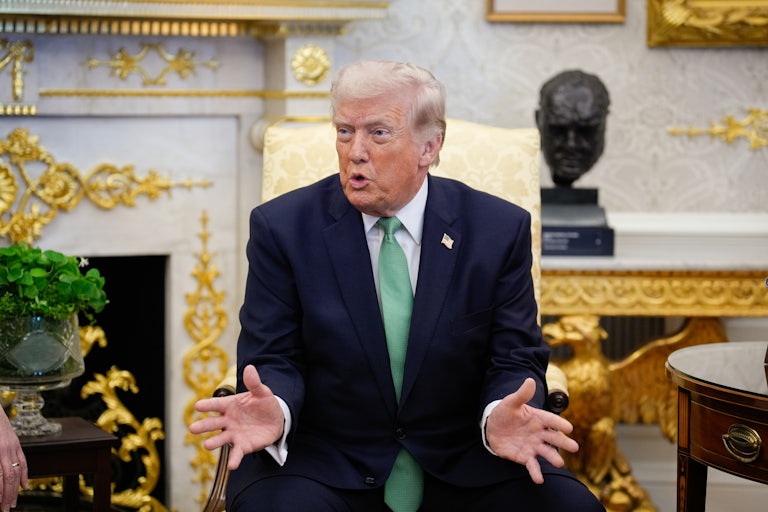
Donald Trump speaks while sitting in his golden Oval Office.
Yuri Gripas/Abaca/Bloomberg/Getty Images

President Trump can’t articulate any semblance of a real “day-after plan” in his war on Iran. 

The president was questioned by the media after his Tuesday meeting with Irish Taoiseach  Micheál Martin at the White House. 

“You just said that Iran is just a military operation to you. But do you not have a day-after plan, and if so what is your day-after plan for Iran?” a reporter asked. 

“Well we have a lot. Look, if we left right now it would take 10 years for them to rebuild. But we’re not ready to leave yet. But we—we’ll be leaving in the near future. We’ll be leaving in pretty much the very near future,” Trump said vaguely. “But right now they’ve been decimated from every standpoint. And again, we’ve had great support from countries in the Middle East. But we’ve had … essentially no support from NATO.” 

Once again, it sounds like the Trump administration went into this war with no real plan. First Trump was saying that he’d have a hand in picking Iran’s next leader. That didn’t happen. And his call for U.S. allies to help defend oil tankers attempting to pass through the Strait of Hormuz went unheeded—which is why he spent much of Tuesday bashing NATO instead of talking about a day-after plan. 

“NATO is making a very foolish mistake,” Trump said, earlier in the meeting. “I’ve long said that, you know, I wonder whether or not NATO would ever be there for us. So this was a great test. Because we don’t need them.”

Ultimately, Trump’s “near future” timeline offers no hope that this war will end anytime soon. And even if it does, at least 1,444 Iranians of all ages, 850 people in Lebanon, 15 people in Israel, and 13 American service members have already been killed. Thousands more have been injured, and both cultural heritage sites and basic infrastructure have been decimated in Iran. The grim real estate makeover plan he’s trying to build over the rubble of the Palestinian genocide in Gaza isn’t a viable option here. 

Trump Says He’s “Not Afraid” of Iran War Dragging on Indefinitely

Donald Trump brushed off a question about the war ending up the same as Vietnam.

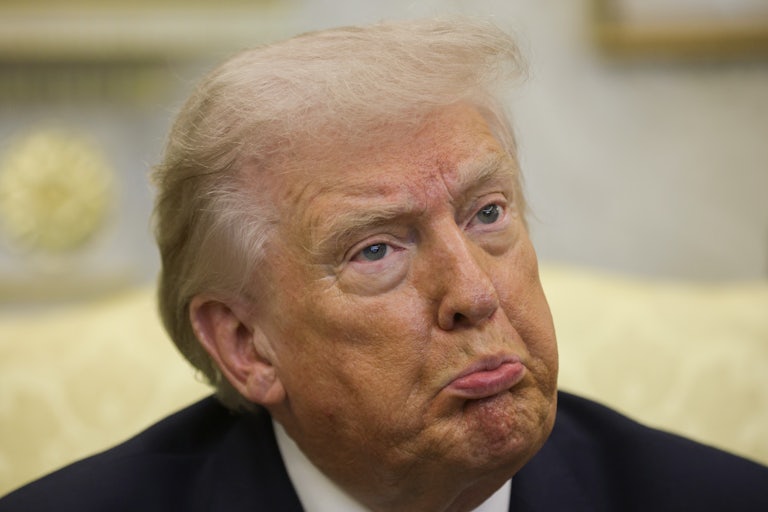
Donald Trump pouts while sitting in the Oval Office
Alex Wong/Getty Images

Donald Trump is openly entertaining the possibility of putting boots on the ground in Iran.

Speaking with reporters at the White House Tuesday beside Irish Taoiseach Micheál Martin, Trump sluggishly claimed that he wouldn’t be afraid to put the lives of American soldiers at risk in order to continue his nonsensical war.

“The Iranian regime has told Sky News that if you put boots on the ground in Iran, it would be another Vietnam. Are you afraid of that?” asked a journalist.

“No, I’m not afraid of—I’m really not afraid of anything,” Trump said.

Moments later, Trump said he would withdraw from the war “in the very near future” but that he wasn’t ready to leave yet.

“We have a lot,” Trump responded when asked if the White House had a “day-after plan,” apparently unwilling to elaborate on the details of what that plan would entail.

“If we left right now, it would take 10 years for them to rebuild,” he continued. “But we’re not ready to leave yet. But we’ll be leaving in the near future. We’ll be leaving pretty much in the very near future. But right now they’ve been decimated from every standpoint.”

But leaving may not be a feasible option in the very near future. The president’s allies have recently interpreted a shift in power, warning that while the early days of the war may have indicated an immediate victory, prolonged U.S. involvement in the conflict has dramatically increased the likelihood of boots on the ground. The changing tide has fueled concern that Trump could draw the country into yet another open-ended Middle East conflict.

At issue is whether the U.S. can obtain control over the Strait of Hormuz, the water channel situated between Iran and the United Arab Emirates. The strait is the single most important energy transit point in the world, funneling approximately one-fifth of all crude oil shipments. Iran began laying mines across the strait last week, effectively sealing the only sea passage from the Persian Gulf and the Gulf of Oman to the rest of the open ocean.

Ensuring the free flow of oil through the strait would likely require seizing control of portions of Iran’s shoreline, a war plan that would almost certainly require the physical presence of U.S. troops in Iran. But doing so could embroil the U.S. and American lives in yet another devastating and unpopular conflict—exactly the kind of action that Trump has railed against for more than a decade.

Trump Thought Iran Struck School Based on Report CIA Said Was Wrong

Donald Trump was initially told Iran was behind the strike on a girls’ school, but he has not changed his stance even after the CIA did.

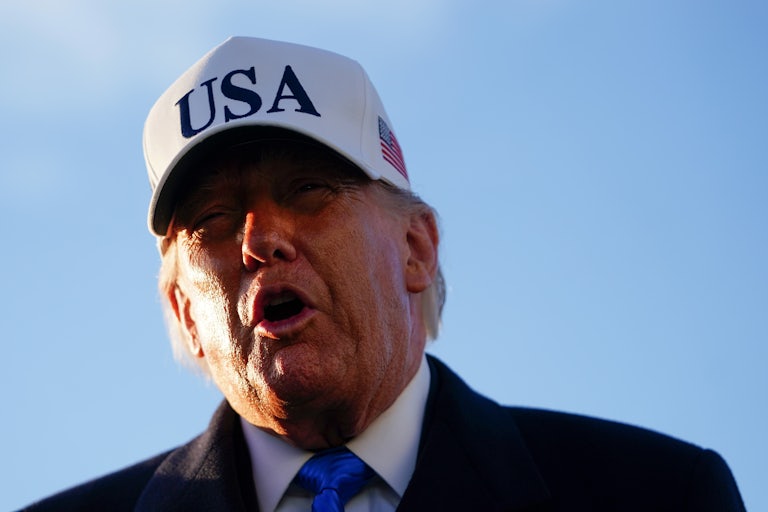
Donald Trump speaks while wearing a white cap that says "USA"
Nathan Howard/Getty Images

We now know why Donald Trump falsely claimed Iran struck one of its own schools, following the largest loss of civilian life in the war so far.

The Shajareh Tayyebeh girls’ school in southern Iran was hit by a Tomahawk cruise missile on February 28. “Dozens of seven to 12 year-old girls” were killed, The Guardian reported, with the official death toll rising to over 148, per Iranian officials. Unesco described the bombing as a “grave violation” of international law.

In the immediate aftermath, Trump asserted that Iran had accidentally bombed its own civilians.

“In my opinion, based on what I’ve seen, that was done by Iran,” he told the press on March 7, adding: “They’re very inaccurate, as you know, with their munitions. They have no accuracy whatsoever. It was done by Iran.”

But proceeding investigations have revealed it is likely that the U.S. was to blame for the bombing. Iran, for one, does not even possess any Tomahawk missiles. Even the Pentagon has since reportedly determined that the missile was fired by American forces.

The Guardian spoke to two sources who claimed that Trump had been given incorrect information by CIA officials—and then was either never briefed with the correct intelligence, or simply didn’t care to update his own stance.

The officials told Trump after the bombing that the missile seen in video did not resemble a Tomahawk. Within 24 hours, the CIA looked at more videos and realized they had actually been wrong: The missile was, in fact, a Tomahawk.

“It was not clear when Trump was briefed about the updated intelligence findings,” The Guardian reported.

Nonetheless, Trump has stuck with his version of events ever since with typical stubbornness. It’s one of many misleading narratives pushed by his administration on the war in Iran.

Entire Team of Oil and Gas Experts Got DOGE’d Before Iran War

The Trump administration fired key experts that could have helped with the current situation in the Strait of Hormuz.

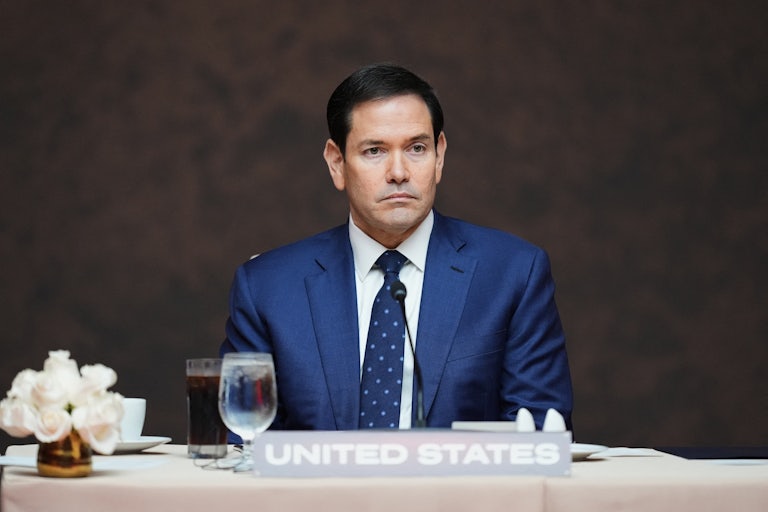
Marco Rubio looks uncomfortable as he sits at a table behind a United States nameplate.
Rebecca Blackwell/POOL/ AFP/Getty Images
Secretary of State Marco Rubio

The war in Iran has led to a worldwide energy crisis, with oil experts from the Persian Gulf being blocked by Iran’s closure of the Strait of Hormuz. 

Despite this being a cornerstone of Iranian defense for decades, the Trump administration seems to have been caught off guard, and a major reason is that the State Department no longer has any oil and gas experts, having fired them last July as part of reduction-in-force efforts, NOTUS reports

A total of 1,300 people were laid off from the State Department last summer, and the Bureau of Energy Resources was hit hard. The people fired were responsible for planning scenarios if the strait was ever closed, and others had professional relationships with oil and gas companies in the Middle East as well as with foreign diplomats who deal with energy concerns. The only people left in the bureau, ironically, are people who work with clean energy and critical minerals. 

“I’m sure Secretary [of State Marco] Rubio wishes he had that expertise available today,” Geoffrey Pyatt, who served as assistant secretary of state for energy resources during the Biden administration, told NOTUS. “Most of that institutional knowledge was lost with the elimination of the bureau and RIFs last fall.”

That expertise would be critical right now as oil and gas prices skyrocket around the world due to the closure of the strait and  attacks on oil and gas infrastructure in the region. Several former State Department officials who worked on energy told  NOTUS that the administration’s lack of preparedness before striking Iran is clearly apparent. 

“Before any of this should have happened, there should have been discussion about what are the implications of this, and what happens when the Strait of Hormuz turns off,” a former Bureau of Energy Resources staffer said. Other former staffers who now work for oil and gas companies said they don’t have clear points of contact in the Trump administration who they can discuss concerns with. 

Publicly, Trump has been dumbfounded by Iran’s response to U.S. and Israeli attacks. 

“They weren’t supposed to go after all these other countries in the Middle East. Those missiles were set to go after them. So they hit Qatar, Saudi Arabia, UAE, Bahrain, Kuwait. Nobody expected that,” Trump said Monday. The president fails to realize that he fired the people who likely did expect and plan for that exact scenario.