Breaking News
Breaking News
from Washington and beyond

Trump Asks Random Farmer Which Countries to Tariff Next

Donald Trump seemed confused about the extent of his own tariffs.

Donald Trump speaks to rice farmer Meryl Kennedy while sitting next to her at an agricultural roundtable
ANDREW CABALLERO-REYNOLDS/AFP/Getty Images
Donald Trump and Meryl Kennedy

President Donald Trump revealed Monday just how clueless he is about his own tariff policies, and appeared to improvise new rice tariffs on the fly after speaking with one rice farmer.

During a roundtable to unveil a $12 billion bailout package for American farmers, Meryl Kennedy, CEO of Louisiana-based Kennedy Rice Mill, told Trump that she believed other countries were “dumping” rice into the United States.

“Which countries?” Trump asked.

“India, Thailand, even China into Puerto Rico. Puerto Rico used to be one of the largest markets for rice, we haven’t shipped rice into Puerto Rico for years,” Kennedy said, adding that the president needed to “double down” on his tariffs.

“You want more?” Trump asked incredulously, and Kennedy replied that other countries were “cheating” by subsidizing their rice production.

Trump seemed to have no idea whether other countries were “dumping” rice, and asked Treasury Secretary Scott Bessent if India had a tariff exemption for rice.

“No sir, we’re still working on their trade deal,” Bessent replied. As of August, India is facing steep 50 percent tariffs on all exports, with exceptions for certain agricultural products, such as tea, coffee, and spices—not rice. In October, exports from India to the United States rose for the first time in months as trade negotiations were underway.

As Kennedy tried to explain how India might be illegally subsidizing its rice production, Trump interrupted her. “Give me the countries, if you could? Go ahead. India, who else? Mark it down, Scott,” the president said.

Kennedy repeated the “main culprits” of India, Thailand, and China, adding, “But there’s others too, and we can get you a full list.” Trump promised he’d “take care” of the problem quickly.

U.S. rice production is small compared to that of other grains, such as soybeans or corn. Across the six states that produce rice, there are only an estimated 5,500 farmers for that crop. In 2025, rice production in the U.S. reportedly suffered from adverse weather, while rice production in South American countries surged.

During the same roundtable, Trump also floated placing “very severe” tariffs on fertilizer imported from Canada—the largest supplier to the United States—which could boost domestic production but risks further hurting farmers.
Trump Loses His Mind When Asked About Flood of Retiring Republicans

Donald Trump doesn’t want to talk about how his party is quickly losing control of Congress.

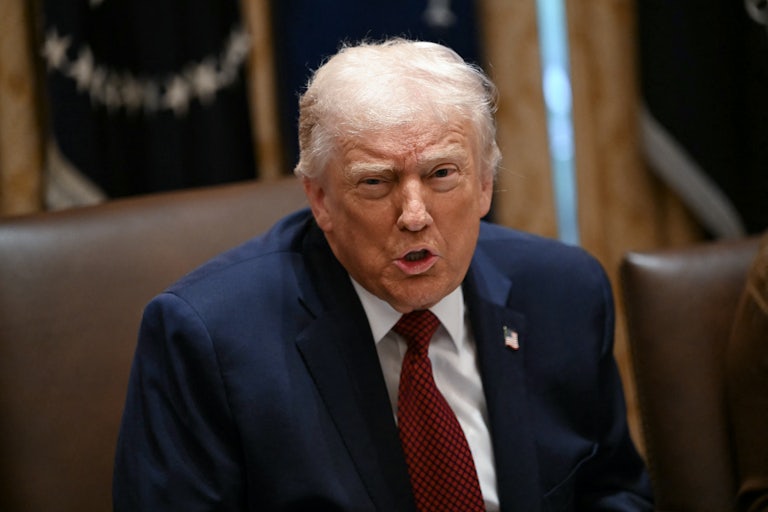
Donald Trump speaking at the White House
ANDREW CABALLERO-REYNOLDS/AFP/Getty Images

President Trump on Monday lashed out at a reporter who asked about impending GOP House resignations.

“There’s at least 20 House Republicans who have either said they’re going to retire or not run again—”

“And Democrats, and Democrats also. And Democrats also,” Trump chimed in. “Why don’t you mention them? How many Democrats have retired? How many Democrats?”

“Well that’s what I was gonna ask—”

“Well, why don’t you tell me the number of Democrats too?”

“Well, are you concerned about the narrow margins?”

“No, I’m not concerned, I think we’re gonna do well,” Trump said, talking over the reporter. “We’re gonna have the greatest economy.... We’re gonna have the greatest economy in history. How many Democrats are retiring? How come you only know the Republicans and not the Democrats?”

“Because I came prepared to ask you a question—”

“No no, you’re unprepared. Because you should know the Democrats. You’re totally unprepared.”

This weekend, Puck News reported that 20 House Republicans will announce their retirement in the coming weeks, in addition to the 23 who’ve already said they’re leaving Congress.

The reporter at the roundtable Monday, who was from Newsday, was likely asking President Trump a question about the Republican resignations because he is the Republican president. But the question—coming in the wake of months of reporting on internal rifts within the GOP—clearly struck a nerve with President Trump.

Very Stable Genius Trump Says Turning on a Lawn Mower Is Hard

Donald Trump interrupted himself during an agricultural roundtable to discuss the real challenges of life.

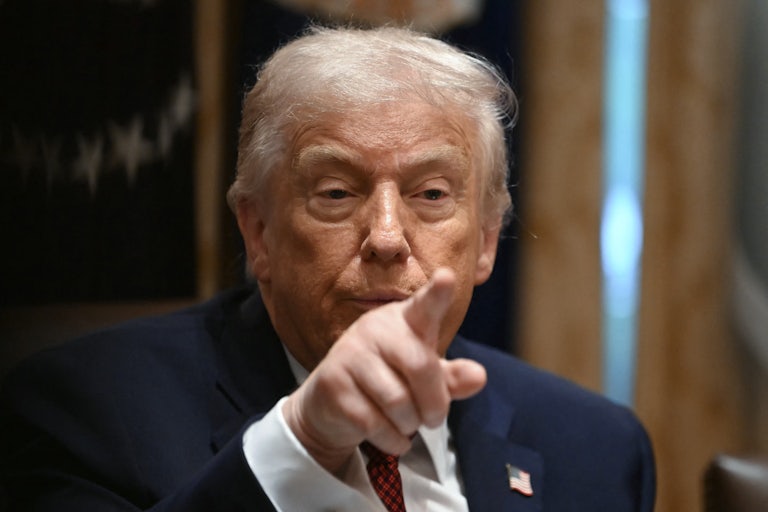
Donald Trump points while speaking during a roundtable
ANDREW CABALLERO-REYNOLDS/AFP/Getty Images

Donald Trump’s latest attempt to appeal to American farmers involves imagining that he’s ever operated a piece of farm equipment.

The country’s agriculture industry is in the toilet—largely thanks to the president’s volatile tariff plan, which has destabilized relationships with some of the industry’s biggest foreign markets. In the middle of announcing a $12 billion bailout package to offset the damage he caused to America’s farmers on Monday, Trump claimed that lawn mowers (of all things) had become so difficult to operate that you’d need to be a certified genius in order to turn on the ignition.

“Farming equipment has gotten too expensive, and a lot of the reason is because they put these environmental excesses on the equipment which don’t do a damn thing except make it complicated, make it impractical,” Trump said. “In many cases, you need about 185 IQ to turn on a lawn mower now.”

This is coming from the same very down-to-earth billionaire real estate mogul who claimed in 2017 that he didn’t want a “poor person” in his presidential Cabinet, and earlier this year threw a Great Gatsby-themed party at Mar-a-Lago during the longest government shutdown in U.S. history, as well as paved over the White House’s rose garden and repeated that he believes the term groceries is “an old-fashioned word.”

“We have a term, groceries,” Trump told the leaders of the United Arab Emirates in May. “It’s an old term, but it means basically what you’re buying, food, it’s a pretty accurate term but it’s an old-fashioned sound but groceries are down.”

Trump’s tariffs have devastated the American farming industry from both ends, hurting both supply and demand by raising costs on equipment and fertilizer while nixing key international markets such as China.

When the bailout was initially pitched in September, Trump said he intended to use the country’s supposedly surplus tariff money to subsidize American soybean farmers, though his concept of how much cash could be infused to America’s food producers was not coherent. Speaking with reporters, Trump mixed up “billions” and “millions,” apparently confused on the specifics of what government funds could amount to actual aid. Meanwhile, the Trump administration moved forward with a plan to send $40 billion in aid to Argentina.

Indiana Statehouse Rocked by Protests as Republicans Try to Rig Maps

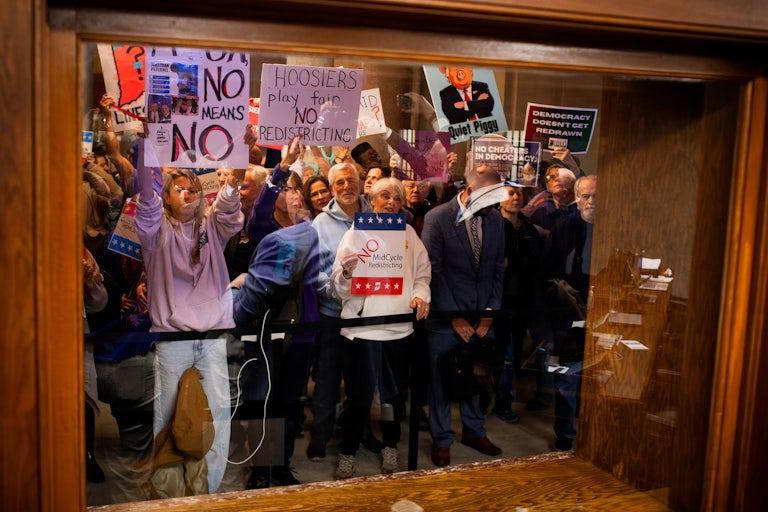
Demonstrators filled the Indiana statehouse as Republicans plot to gerrymander the congressional maps.

Demonstrators protest behind a glass holding signs like "Hoosiers Play Fair No Redistricting" and "Democracy Doesn't Get Redrawn."
Kaiti Sullivan/Bloomberg/Getty Images
Demonstrators protest at the Indiana Statehouse, on December 8

Protesters packed the Indiana Statehouse Monday to fight against Republican plans to redraw the state’s congressional maps to give their party an extra advantage and eliminate the state’s two Democratic congressional seats.

President Trump has pushed for the redistricting, which passed Indiana’s House of Representatives last week. Republicans in the state Senate have warned that there aren’t enough votes for new maps to pass, which Trump has met with insults and threats.

Monday is the last day for public testimony on the bills, and the past week has been full of dueling pro- and anti-redistricting rallies. Loud chants of “Stop the steal” filled the statehouse as lawmakers in the Senate Committee on Elections began their session Monday afternoon, with many protesters bringing homemade signs.

When public testimony began, pro-redistricting speakers were booed and heckled. One person yelled that Republicans were stacking the deck with redistricting supporters, which may be true considering those who signed up to testify on the bill stated their position on the form. Committee chairs often group speakers by position, according to the Indianapolis Star’s Cate Charron.

CNN’s Eric Bradner said that Monday’s anti-redistricting rally was much larger than the pro-redistricting rallies at the Statehouse, including one last week organized by Turning Point USA. The reason for that, CNN reports, is that there isn’t much enthusiasm among Indiana Republicans, with much of the pro-redistricting pressure coming from national groups such as TPUSA and the Club for Growth.

Trump likely sees redistricting as the only way to protect his presidency from a hostile Democratic Congress, and is threatening to support primary challengers to Republican senators who oppose redistricting and calling them names on his Truth Social account. At least 11 elected Indiana Republicans have faced swatting threats, including state Senator Greg Goode, who hadn’t even made any public comments about redistricting.

But in spite of the pressure campaign, Indiana Republicans are not coming out in droves to support the idea.

“It’s ridiculous to bring the whole thing up to begin with, but it’s what the president wants,” Debbie Myers, a Republican small-business owner in Martinsville, Indiana, told CNN about redistricting. “It’s wrong, and it’s a waste of money and a waste of these people’s time, and I don’t think it should have happened.”

Alina Habba Resigns as Trump Loses Yet Another Totally Inept Nominee

Habba’s pathetic attempt to become U.S. attorney for New Jersey is finally over.

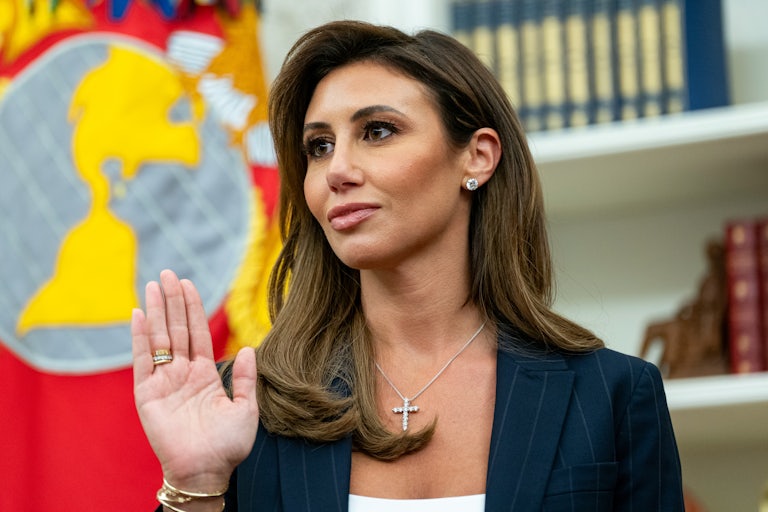
Alina Habba raises her right hand during a swearing-in ceremony at the White House.
Bonnie Cash/UPI/Bloomberg/Getty Images

President Trump’s former lawyer and interim U.S. attorney for New Jersey Alina Habba is stepping down from her role in the wake of a 3–0 appeals court ruling that found she was “unlawfully” serving in the position.

The U.S. Court of Appeals for the Third Circuit  agreed with a lower court’s ruling that Habba was given the U.S. attorney position through a “novel series of legal and personnel moves” and was not legally able to take the job. 

“While I was focused on delivering real results, judges in my state took advantage of a flawed blue slip tradition and became weapons for the politicized left.... They joined New Jersey senators, who care more about fighting President Trump than the well being of residents which they serve,” Habba wrote in her resignation letter, posted on X. “As a result of the Third Circuit’s ruling, and to protect the stability and integrity of the office which I love, I have decided to step down in my role as the U.S. Attorney for the District of New Jersey. But do not mistake compliance for surrender. This decision will not weaken the Justice Department and it will not weaken me.”

Habba was originally meant to leave her interim position over the summer, as New Jersey federal judges refused to extend her 120-day appointment as U.S. attorney. But the Trump administration fired Desiree Grace, the U.S. attorney first assistant and Habba’s planned successor, prior to the end of Habba’s appointment, purposefully leaving the role unfilled. It then made Habba first assistant, allowing her to take the role of acting U.S. attorney without a Senate confirmation—which she may have likely failed. 

“My fight will now stretch across the country. As we wait for further review of the court’s ruling, I will continue to serve the Department of Justice as the Senior Advisor to the Attorney General for U.S. Attorneys,” Habba’s statement concluded. “Make no mistake, you can take the girl out of New Jersey, but you cannot take New Jersey out of the girl.”