Trump Suffers Massive Loss Over National Guard Deployment to D.C.
But the judge stayed her own order until December 11.


The U.S. Coast Guard is no longer going to consider the swastika a hate symbol.
The Washington Post reports that a new policy will take effect next month at the military branch that will reclassify the swastika, used by the German Nazi Party and adopted as a global symbol of fascism and white supremacy, as “potentially divisive.” Other symbols being reclassified include the Confederate flag and nooses, although displaying the flag will still be banned.
Some historic displays or art with the Confederate flag will still be permitted, the Post reports. The new policy comes even though the Coast Guard isn’t part of the Department of Defense, under which Secretary Pete Hegseth has sought to overhaul standards on harassment and hazing.
Instead, the Coast Guard falls under the Department of Homeland Security, but that hasn’t shielded the military branch from the Trump administration’s attempts to change military culture. On Donald Trump’s first day as president, he fired the first woman commandant at the Coast Guard, Admiral Linda Fagan, ostensibly for focusing too much on diversity initiatives.
Days later, the new acting commandant, Admiral Kevin Lunday, suspended the Coast Guard’s hazing and harassment policy, which included the swastika in a “list of symbols whose display, presentation, creation, or depiction would constitute a potential hate incident.”
Both in his first and second terms, Trump has trafficked in racist tropes, and reclassifying the swastika may be an attempt to retain and attract people the military would have previously turned away. In any case, racism is becoming less and less of a dealbreaker for national service under Trump.

Drama continues to follow interim U.S. Attorney and former Trump defense lawyer Lindsey Halligan, as she had a heated exchange with a federal judge who suggested she may be the president’s “puppet.”
Halligan spoke to the New York Post exclusively about the spat, which occurred during a hearing for former FBI Director and Trump administration legal target James Comey.
“Personal attacks—like Judge Nachmanoff referring to me as a ‘puppet’—don’t change the facts or the law,” she said. “The Judicial Canons require judges to be ‘patient, dignified, respectful, and courteous to litigants, jurors, witnesses, lawyers, and others with whom the judge deals in an official capacity’ … and to ‘act at all times in a manner that promotes public confidence in the integrity and impartiality of the judiciary.’”
For what it’s worth, Judge Michael Nachmanoff never called her a puppet, and was asking the defense for clarification on their argument.
“So your view is that Ms. Halligan is a stalking horse or a puppet, for want of a better word, doing the president’s bidding,” he said, according to court files.
“Well, I don’t want to use language about Ms. Halligan that suggests anything other than she did what she was told to do,” the defense lawyer replied. Nachmanoff did not object.
Still, that was enough to set Halligan off, leading her to do a sit-down with a right-wing newspaper to speak directly about the judge presiding over the case she was actively prosecuting.
“Never have I ever … seen a sitting U.S. Attorney give an interview and make extrajudicial statements about a pending case,” Reuters’s Sarah Lynch wrote on X. “This is not customary for federal prosecutors. Usually DOJ only speaks through court filings.”
This isn’t the first issue Halligan has faced in the early days of her prosecution of Comey. On Monday, U.S. Magistrate Judge William Fitzpatrick said she made two “fundamental misstatements of law” to the grand jury, putting the entire case in jeopardy. And on Wednesday, Halligan told the court that only two grand jurors reviewed the Comey indictment before it was presented.
Aside from these flubs and unconventional media decisions, calling Halligan a “puppet,” even indirectly, isn’t too far off. The only reason the president’s former lawyer was awarded this position is because her predecessor, Erik Siebert, refused to indict Comey due to a lack of evidence.

The White House is falling neatly in line behind Donald Trump’s call to execute half a dozen Democratic lawmakers.
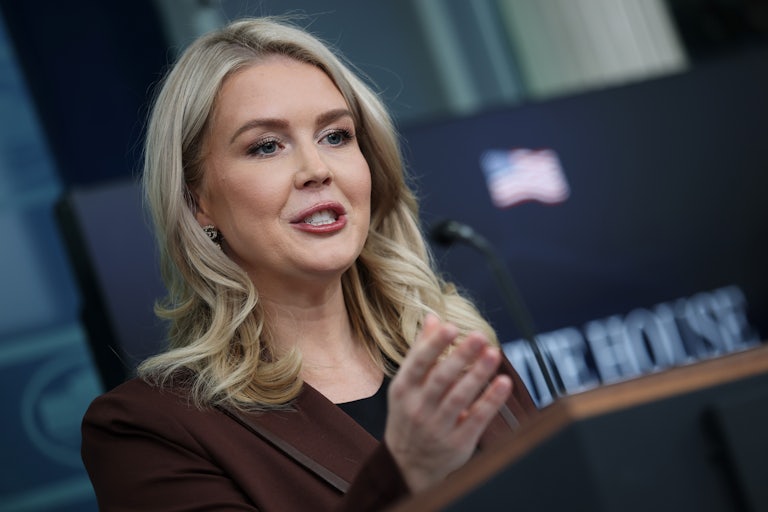
White House press secretary Karoline Leavitt practically snapped Thursday under a massive public backlash to the president’s dangerous language, accusing reporters during a press conference of inappropriately focusing on Trump’s comments instead of what made him upset. It wasn’t clear, however, if Leavitt was fully informed on the controversy, getting basic details about the situation incorrect.
“Let’s be clear about what the president is responding to, because many in this room want to talk about the president’s response but not what brought the president to respond in this way,” Leavitt said. “You have sitting members of the United States Congress who conspired together to orchestrate a video message to members of the United States military, to active-duty service members, to members of the National Security apparatus, encouraging them to defy the president’s lawful orders.”
Leavitt went on to accuse “three” members of Congress of having participated in the protest, though her count was wrong.
Six Democratic members of the House and Senate—a coalition of veterans and former national security professionals—posted a video on Facebook Tuesday, repeating the message to America’s military and intelligence communities that they “can” and “must … refuse illegal orders.” They made no reference to disobeying Trump directly, only reminding people to uphold the Constitution.
Those lawmakers were Representatives Jason Crow of Colorado, Chris Deluzio of Pennsylvania, Maggie Goodlander of New Hampshire, and Chrissy Houlahan of Pennsylvania, as well as Senators Mark Kelly of Arizona and Elissa Slotkin of Michigan.
“The sanctity of our military rests on the chain of command, and if that chain of command is broken, it can lead to people getting killed, it can lead to chaos, and that’s what these members of Congress—who swore an oath to abide by the Constitution—are essentially encouraging,” Leavitt continued.
“These members knew what they were doing. They were leaning into their credentials … to signal to people serving under this commander in chief, Donald Trump, that you can defy him and you can betray your oath of office. That is a very, very dangerous message, and it perhaps is punishable by law.”
She then added, “I’m not a lawyer.”
Trump responded to the video Thursday by warning that “their words cannot be allowed to stand. SEDITIOUS BEHAVIOR FROM TRAITORS!!! LOCK THEM UP???” He followed up on that Truth Social post an hour later by calling for their “DEATH.”
Despite the executive pressure, Democrats have refused to back down. In a joint statement Thursday, the same coalition of Democratic lawmakers reiterated that there was nothing illegal about reminding service members to “follow only lawful orders.”
“It is not only the right thing to do, but also our duty,” they wrote. “In these moments, fear is contagious, but so is courage. We will continue to lead and will not be intimidated.”

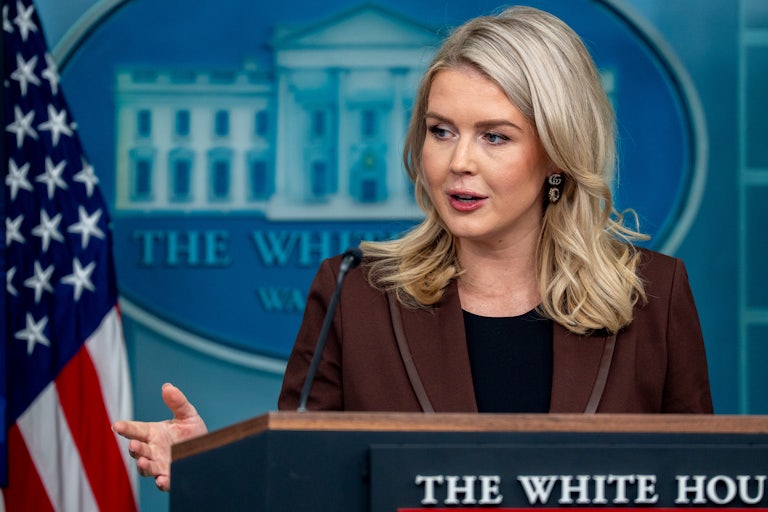
White House press secretary Karoline Leavitt offered a truly pathetic defense Thursday for President Donald Trump calling a female reporter “piggy.”
During a press briefing, Leavitt was asked to explain what the president meant when he said, “Quiet, piggy” to Bloomberg reporter Catherine Lucey earlier this week. Lucey had asked him a question about Jeffrey Epstein while on Air Force One.
Presenting her own wild spin, Leavitt claimed Trump’s crude and sexist comment was him being “frank and open” with the press, and an example of behavior that was “a lot more respectful” than that of the previous administration.
“So, I think the president being frank and open and honest to your faces, rather than hiding behind your backs, is frankly a lot more respectful than what you saw in the last administration, when you had a president that lied to your face and then didn’t speak to you for weeks, and hid upstairs and didn’t take your questions,” Leavitt said. “So I think everyone in this room should appreciate the frankness and the openness that you get from President Trump on a near daily basis.”
Leavitt’s right about one thing: This is completely normal behavior for Trump. The president has a well-documented history of berating female reporters who ask him tough questions, calling them “the worst” and “second-rate,” telling them “to be quiet” and that they “know nothing about nothing,” and saying that he doesn’t like their “attitude.”
A White House official responded earlier this week to the incident with Lucey, claiming that she had “behaved in an inappropriate and unprofessional way towards her colleagues on the plane.” When pressed on what specifically Lucey had done wrong, the White House did not respond.