Breaking News
Breaking News
from Washington and beyond

JD Vance Snaps Over Backlash to His Comments on Wife’s Religion

The vice president seemed to imply his wife, Usha, was going to Hell because she isn’t Christian.

Vice President JD Vance speaks to reporters outside the White House
Aaron Schwartz/CNP/Bloomberg/Getty Images

Vice President JD Vance had a social media meltdown Friday over the widespread backlash to his strange admission about wanting his wife to ditch her faith.

While appearing at a Turning Point USA town hall Wednesday, Vance said he harbored hopes that his wife, Usha, a Hindu, would be moved by the good word and become a late-in-life Catholic like him.

“As I’ve told her, and I’ve said publicly, and I’ll say now in front of 10,000 of my closest friends: Do I hope eventually that she is somehow moved by the same thing that I was moved in by church? Yeah, I do wish that. Because I believe in the Christian gospel, and I hope eventually my wife comes to see it the same way,” he said.

Many saw this as Vance rejecting his wife’s own religion and culture, including far-right commentator Ezra Levant, who wrote on X: “It’s weird to throw your wife’s religion under the bus, in public, for a moment’s acceptance by groypers.”

But Vance didn’t like that one bit and took at X to cry “anti-Christian bigotry.”

“What a disgusting comment, and it’s hardly been the only one along these lines,” Vance wrote Friday. He claimed that the question was from someone “seemingly to my left,” and he’d felt compelled to answer honestly.

“Second, my Christian faith tells me the Gospel is true and is good for human beings,” he wrote.

Vance claimed that Usha had urged him to reengage with Christianity. “She is not a Christian and has no plans to convert, but like many people in an interfaith marriage—or any interfaith relationship—I hope she may one day see things as I do,” he wrote. “Regardless, I’ll continue to love and support her and talk to her about faith and life and everything else, because she’s my wife.

“Third, posts like this wreak of anti-Christian bigotry,” he wrote, misspelling “reek.” “Yes, Christians have beliefs. And yes, those beliefs have many consequences, one of which is that we want to share them with other people. That is a completely normal thing, and anyone who’s telling you otherwise has an agenda.”

But Christianity doesn’t teach followers to disrespect others’ beliefs. And Vance has a tendency to refashion Christian teachings to support his arguments, like the time he presented a bastardized version of Catholic doctrine to argue that Americans should turn on their neighbors.

Crucially, Turning Point USA isn’t exactly a breeding ground for cross-cultural understanding. Earlier this month, DOGE czar-for-a-day Vivek Ramaswamy came face-to-face with the rampant racism of the right wing at another Turning Point USA event in Montana.

Republicans Secure Major Win in Ohio—With Redder Districts Come 2026

Ohio has adopted a new congressional map that puts the state’s few Democratic members of Congress at risk.

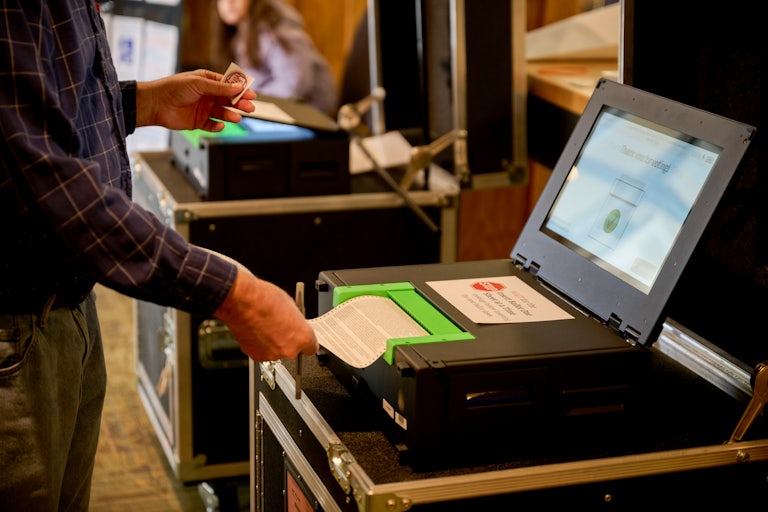
A man submits his ballot into a the voting machine.
Dustin Franz/Bloomberg/Getty Images

Ohio Republicans adopted a new congressional map on Friday that would give Republicans a big boost in two Democratic-held districts. The move comes as Republicans nationwide engage in an effort to gerrymander maps in their favor as midterm elections approach.

The Friday deal places two of the five Democratic Representatives in Ohio—Greg Landsman and Marcy Kaptur—into redder districts in their already purple state. In return, Democratic Representative Emilia Sykes will be drawn into a slightly bluer district, though the race would still be competitive. The remaining two Democratic members of Congress, Joyce Beatty and Shontel Brown, will remain in their deep blue districts.

While this map isn’t the worst for Democrats, Landsman and Kaptur’s districts flipping red could have massive implications come 2026, given the currently slim margin of control Republicans have in the House. A Democratic victory would make it easier for them to oppose Trump’s policies, as Republicans are fully aware.

The redistricting committee will meet once more at 4 p.m. on Friday to send in the final map.

“Ban partisan gerrymandering,” former Ohio state Senator Nina Turner wrote on X in response to the news. “Ohio deserves better.”

Why the Hell Did JD Vance and Erika Kirk Hug Like That?

The vice president had an uncomfortably close embrace with Charlie Kirk’s widow, for everyone to witness.

Erika Kirk buries her hand in JD Vance's hair, as he smiles and puts his head in her hair.
Brad Vest/Getty Images

Vice President JD Vance has some explaining to do over a hug that was a little too close with Erika Kirk, the widow of right-wing political activist Charlie Kirk.

The two were at the University of Mississippi Wednesday night for Turning Point USA’s “This Is the Turning Point” tour, the organization co-founded by Charlie that Erika took over after his death. Vance not only was the headlining guest but also filled Charlie’s old role of debating college students from a stage.

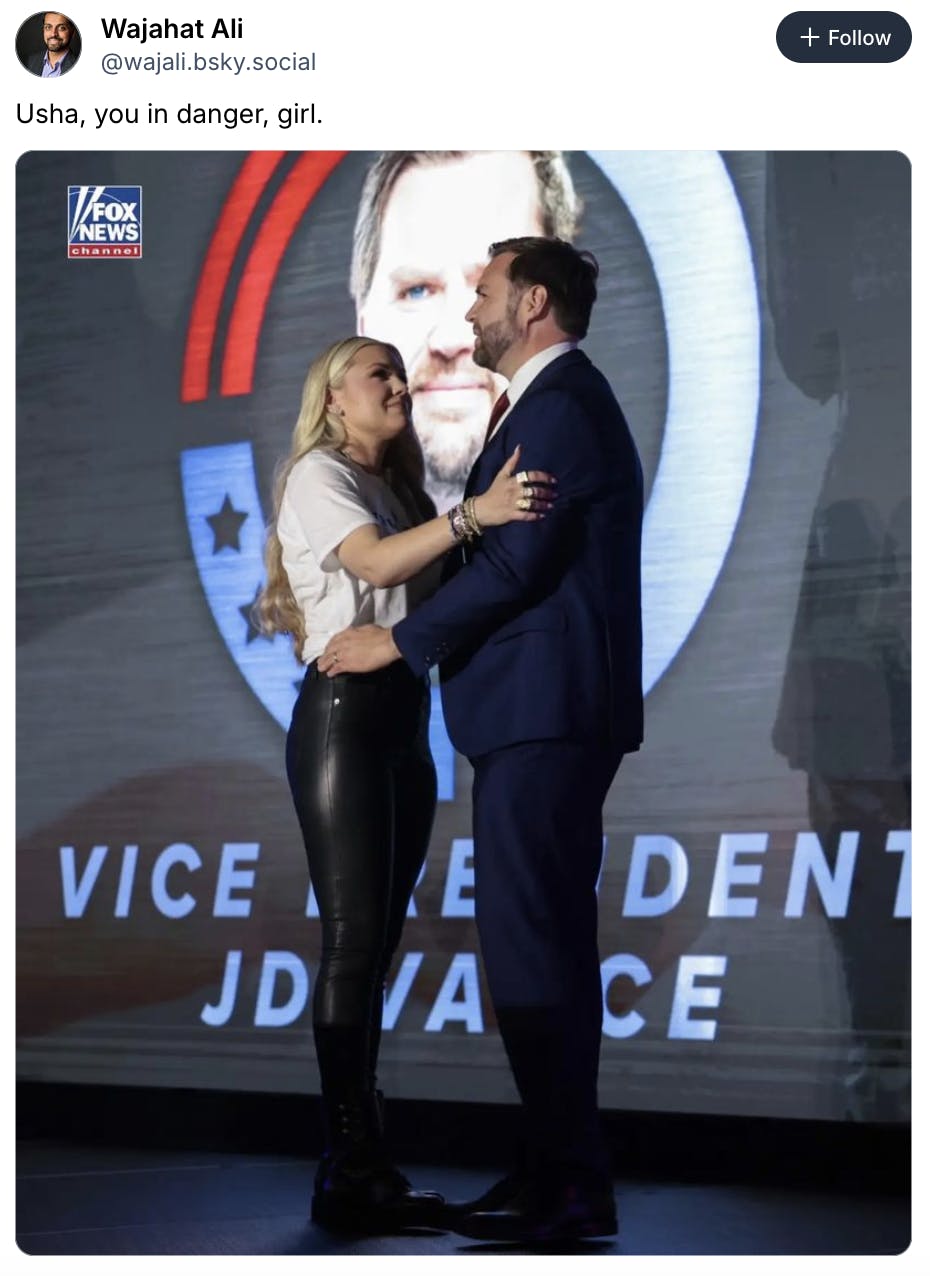
But the internet isn’t as concerned with the tour itself, or the fact that Vance has time to play conservative influencer while serving as vice president. Instead, they’re talking about the embrace between him and Kirk’s widow, with Vance’s hands on her waist and her face appearing to betray some emotion at the same time.

Several commentators seemed to suggest that this doesn’t bode well for Vance’s wife, Usha.

Bluesky screenshot Wajahat Ali ‪@wajali.bsky.social‬ Usha, you in danger, girl. (photo of Erika Kirk looking up at JD Vance as she places her hands on his arms)

The pictures from Mississippi aren’t helped by Vance’s remarks about his wife at the event, where he said he hopes Usha will leave her Hindu faith and convert to Christianity. All three of their children are being raised as Christians, with the two older ones attending a Christian school.

“I honestly do wish that because I believe in the Christian gospel, and I hope eventually, my wife comes to see it the same way,” he said. “If she doesn’t, then God says, everybody has free will, so that doesn’t cause a problem for me. That’s something you work out.”

Is there something going on between Kirk and Vance? If there isn’t, the vice president’s words and that hug are already spreading rumors otherwise. Usha and her parents have both done a lot for Vance, and what happened Wednesday looks disrespectful, at a minimum.

More on what Vance said at that Turning Point USA event

Trump’s Takeover of Kennedy Center Leads to Stunning Sales Collapse

The Kennedy Center is quickly dying thanks to the president’s new vision for the historic theater.

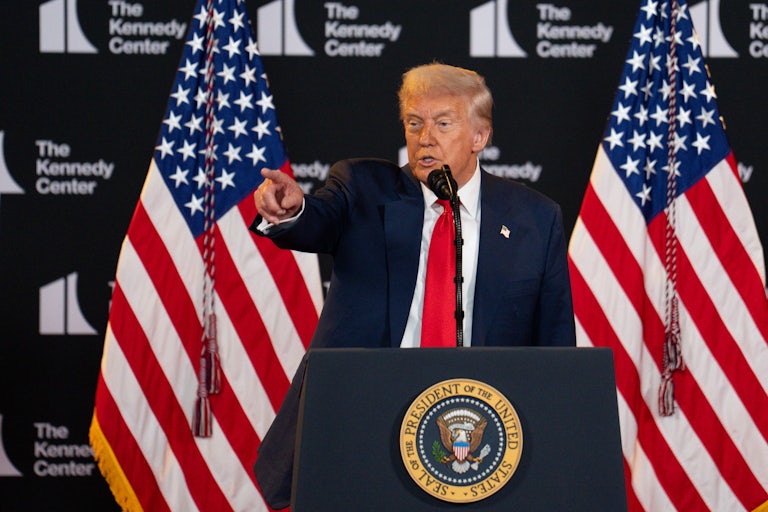
Donald Trump points while speaking behind the presidential podium at the Kennedy Center.
Kayla Bartkowski/Bloomberg/Getty Images

President Trump’s takeover of the Kennedy Center has been a financial death sentence for the famed cultural institution.

The Washington Post has reported that ticket sales at the Kennedy Center are the worst they’ve been since the Covid-19 pandemic. The average show is selling just over half of its tickets right now, with some of those tickets being comped for various reasons. This is a massive dip. In 2023, that number was at 80 percent, and in 2024, it was at 93 percent.

This likely is the result of Trump’s crusade to “unwoke” the Kennedy Center.

“The programming was out of control with rampant political propaganda, DEI, and inappropriate shows,” Trump said back in May. “They had dance parties for, quote, ‘queer and trans youth.’ And I guess that’s all right for certain people.… But that wasn’t working out too well.”

Trump promised to make the Kennedy Center “hot” again and reinvigorate ticket sales that didn’t need much help in the first place.

“Given the unprecedented takeover of a nonpartisan arts institution combined with the inexperience and rhetoric of the new management, I expected a decline in sales; however, it is truly shocking to see that these actions have been worse for business at the Kennedy Center than the aftermath of a global pandemic,” an anonymous former staff member told the Post. “These numbers are likely more dire than they appear, as they don’t account for canceled productions or shows moved into smaller theaters due to weak ticket sales.”

Furthermore, Trump has placed the center in another precarious position, as it risks losing donors due to Trump’s right-wing cultural push.

“Depressed ticket sales not only cause a shortfall in revenue; they also bode unfavorably for future fundraising revenue,” former Kennedy Center President Michael Kaiser wrote in an email to the Post. He had the center running at a surplus during his tenure. “The vast majority of donors are ticket buyers who are anxious to enhance their relationships with the organization by making contributions in addition to paying for their tickets. We had 40,000 generous individual donors by the time I left the Center in 2014. Funding from these individuals formed the foundation for all we accomplished.”

Not only is Trump bad for the quality of cultural stewardship, he’s bad for business. We risk losing even more of the Kennedy Center’s operations as this administration continues.

Scott Bessent Reveals Trump’s Infuriating China Trade Plan

Donald Trump’s plan is just ... limbo.

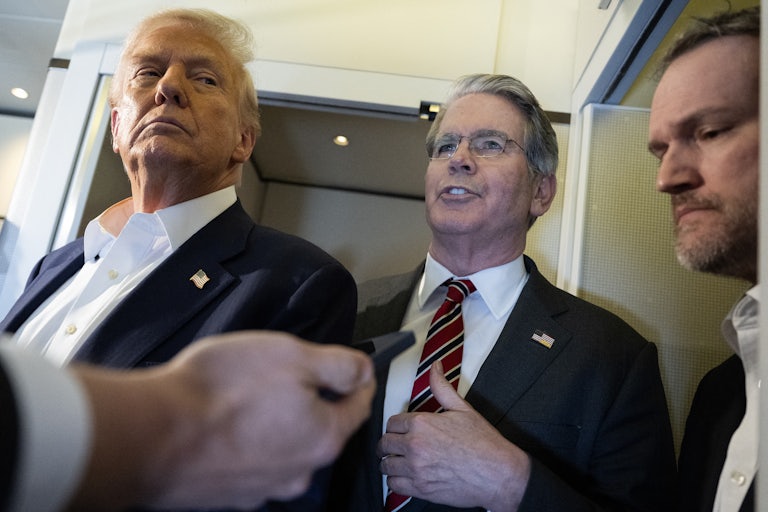
Treasury Secretary Scott Bessent speaks to reporters on Air Force One while standing between Donald Trump and Trade Representative Jamieson Greer
Andrew Caballero-Reynolds/AFP/Getty Images

Treasury Secretary Scott Bessent admitted Thursday that President Donald Trump’s supposedly triumphant talks about a rare earths deal with China were far from finished.

Speaking on Fox News, Bessent touted Trump’s recent efforts in getting China to agree to pause export controls on its rare earth minerals supply for one year. China, which is the dominant supplier of an array of rare earth minerals, had announced the export controls at the beginning of the month, prompting Trump to threaten outrageous 100 percent tariffs on Chinese goods.

“China unilaterally put, or said they were going to put, a rare earth licensing regime on the entire world, the entire world. And President Trump, as the leader of the free world, got this delayed by one year,” Bessent said. “So it wasn’t just for the U.S., it was for the entire world.”

“Well, what happens a year from now?” host Laura Ingraham asked.

“My guess is a year from now, we’ll be back at the table, and we’ll get another delay, another roll,” Bessent said.

The secretary explained that China’s dominion over rare earths was nothing compared to the threat of Trump’s tariffs on Chinese goods. “We are the deficit country, China has to export to us. So, the deficit country always wins. The surplus country loses,” Bessent said.

“What’s more interesting here is maybe we can settle into a good place where the competition is more fair,” he continued.

But there is no “settling” Trump’s plan—only an endless cycle of negotiation.

At the beginning of October, China’s Commerce Ministry added five more rare earths, as well as magnets and other materials made from them, to a list of 17 minerals that had export controls placed on them. China also placed restrictions on the export of rare earth processing equipment, battery manufacturing equipment, and diamond saws, which would allow other countries to build out their own rare earth manufacturing sectors.

Speaking with reporters on Air Force one this week, Trump claimed that the pause on export controls could be “routinely extended.” China’s Commerce Ministry, however, suggested that Beijing would suspend the measures for a year but then “study and refine specific plans.”

It seems that Trump delayed these new controls, but the original list still remains.

Evan Fiegenbaum, a political scientist and vice president of the Carnegie Endowment, criticized the administration’s approach on X. He warned that the U.S. should prepare for “China to retaliate tit-for-tat anytime the U.S. takes a punitive action,” and that there were plenty of other pressure points China could press.

Alternatively, Louise Loo, head of Asia economics at Oxford Economics, suggested that continuing trade negotiations with China could provide a pressure valve for tensions between the two countries. “China’s leverage in rare earths and critical minerals processing will continue to surface episodically, effectively capping any escalation in bilateral tensions,” Loo wrote in a note Thursday.