Breaking News
Breaking News
from Washington and beyond

Trump Fumbles When Asked Why He Blamed Biden for Bad Economy

And yet Donald Trump took credit for the economy while Joe Biden was still in office.

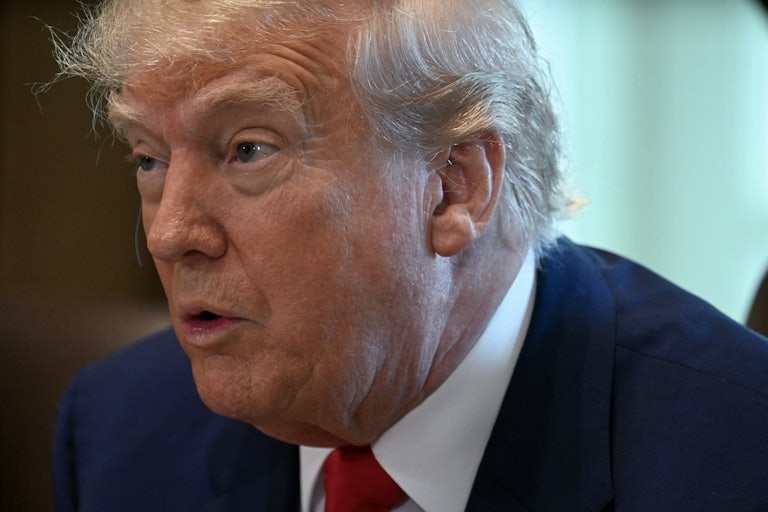
Donald Trump gestures and speaks while sitting in his Cabinet meeting
Jim Watson/AFP/Getty Images

Donald Trump has happily taken credit for the stock market’s success in the past but suddenly can’t explain the market’s current second-quarter downturn, weeks after his roller-coaster tariff proposals rattled the economy.

“You frequently took credit for the stock market highs, you said it was a reflection of how well you were doing in the polls,” said The Independent’s Andrew Feinberg at a White House Cabinet meeting Wednesday. “And then after you were elected, you said the stock market highs were a reflection of how well the transition was going and the American people’s confidence in your upcoming administration.”

“Now the stock markets are not doing so well, and you’re saying it’s the Biden stock market. Yet you are the president. Can you explain that?” asked Feinberg.

But Trump couldn’t.

“I’m not taking credit or discredit for the stock market,” Trump said, before again diverting blame toward the Biden administration.

“I’m just saying that we inherited a mess,” he said, referring to immigration as an example.

“You can look at every single one of the people here, and no matter who it is, they are doing better and they are far superior to what took place four years before us,” Trump continued, surrounded by his Cabinet members—several of whom have already found themselves at the center of seismic scandals just a handful of months into the term.

Unfortunately for Trump, former President Joe Biden’s economy was fruitful by a number of metrics. His tenure in the White House saw historic job gains, curated business development, and decreased unemployment. Biden’s stability in office also aided the market’s steady growth, helping it repeatedly defy negative forecasts and grow gross domestic product by 12.6 percent, which the last administration celebrated as a “historically robust expansion.”

Meanwhile, a 100-day report on Trump’s economy found that GDP in the first quarter decreased by 0.3 percent, a startling drop from 2024’s fourth quarter, which saw GDP increase by 2.4 percent.

“Compared to the fourth quarter, the downturn in real GDP in the first quarter reflected an upturn in imports, a deceleration in consumer spending, and a downturn in government spending that were partly offset by upturns in investment and exports,” the U.S. Bureau of Economic Analysis reported Wednesday.

That’s in large part thanks to Trump’s machinations in the White House, including releasing (and stalling) a sweeping and vindictive tariff proposal plan that economists argue will crush U.S. businesses, the majority of which depend on global supply chains. Experts observed (and the White House eventually confirmed) the tariffs were developed using bad math.

Earlier this month, the White House promised to make 90 deals in 90 days to drive down predicted costs and erase the trade war, a pledge that economists argue is no less than a monumental task. An unidentified White House official confirmed to Politico that the administration is scheduled to speak with 18 different nations over the next three weeks to coordinate possible deals.

But that hasn’t stopped Trump from hyperbolizing his metrics to thwart negative press: Last week, Trump claimed that he had already cut deals with 200 nations around the world—five more countries than actually exist.
Hakeem Jeffries Reportedly Fed Up With Democrats’ Trips to El Salvador

Remember when a ton of Democrats were trying to visit El Salvador to check in on the people Trump deported?

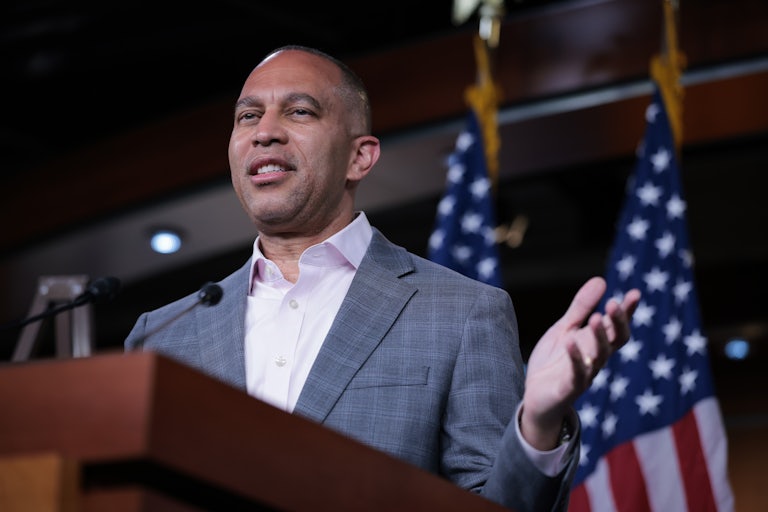
House Minority Leader Hakeem Heffries speaks at a podium in the Capitol.
Kayla Bartkowski/Getty Images

Hakeem Jeffries actually wants his party to be less courageous in the face of executive abuse and constitutional crisis, according to reporting from The Bulwark.

The House minority leader was asked about the trips Democrats like Senator Chris Van Hollen and Representatives Robert Garcia, Yassamin Ansari, Maxwell Frost, and Maxine Dexter have made to El Salvador’s CECOT prison on behalf of Kilmar Abrego Garcia and other men extrajudiciously deported by the Trump administration.

Rather than offer any kind of support for the initiative taken by his party members, Jeffries took a page out of the party’s neoliberal leadership handbook and played dead. “Our reaction [to the trips] is that Donald Trump has the lowest approval rating of any president in modern American history,” Jeffries responded, avoiding the question entirely to focus on Trump having bad polling numbers. But bad polling numbers won’t stop Trump from doing anything, much less stop him from deporting innocent people just for having tattoos or expressing solidarity with Palestine.

Jeffries’s disdain toward Democrats’ trips to El Salvador was corroborated by two sources who told The Bulwark that he is actually dissuading any future visits. “They want to let the El Salvador stuff slow down,” one staffer said. After initially refusing to respond, Jeffries’s office denied these claims, with a spokesperson stating that “Jeffries has repeatedly said, House Democrats will never stop fighting for the release of Mr. Abrego Garcia.”

This tiff over Jeffries’s nonanswer is a microcosm of the party’s current inability to acquiesce around a particular strategy or message. More moderate Democrats like Chuck Schumer and Jeffries seem content to stay mostly sedentary, betting on Trump running himself into the ground before he runs the country into the ground. Others—like Van Hollen, Representative Jamie Raskin, and all the others who are packing their bags for CECOT—don’t feel the need to wait for the obvious crisis to become an even bigger one.

Republicans Move to Give Themselves More Power Over Entire Government

Republicans are prepared to massively expand Donald Trump’s power—and their own.

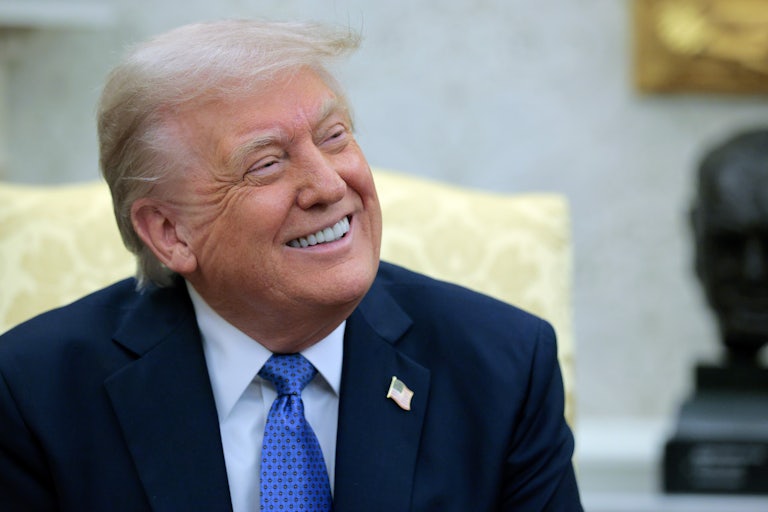
Donald Trump smiles while looking to his left.
Chip Somodevilla/Getty Images

House Republicans are trying to massively expand Donald Trump’s executive powers with a bill that is ostensibly about taxes and border security.

The House Judiciary Committee released a draft bill Monday that would move antitrust enforcement away from the independent Federal Trade Commission into the Justice Department. The bill would also require congressional approval for all new regulations, giving Republicans greater power over virtually the entire federal government.

Under the bill, federal agencies would have to submit portions of their rules to Congress, which would have to approve them within five years. If the rules aren’t approved, they would be gone, giving Republicans the ability to easily gut regulations they don’t like.

The committee is set to adopt the legislative draft at its meeting Wednesday and then include it in the House’s larger domestic policy bill, which Republicans plan to pass in the Senate via the reconciliation process. This would require a simple majority vote and is being used because the bill likely wouldn’t have enough votes otherwise.

“You’re having Congress basically involved in every agency decision,” said Republican Representative Kevin Hern of Oklahoma. “It’s somewhat controversial, and if you look at it historically, I think that’s probably why it hasn’t passed.”

The FTC would be gutted by the bill, and if it passes, Trump, or any other future president, would be able to control antitrust enforcement simply by issuing orders to the Justice Department.

“If you want to gut the agency who has shown itself willing to confront billionaire monopolists—and win—vote for this bill,” wrote Alvaro Bedoya on X Monday. Trump fired Bedoya as an FTC commissioner earlier this year, and Bedoya is challenging his firing in court.

The bill is another example of how Congress under Speaker Mike Johnson is abrogating its duty of checking the executive branch and instead is trying to give authoritarian President Trump even more power. Johnson is already trying to block House Democrats from opening up inquiries into the Trump administration, and if this draft bill goes through, Trump and his party would have considerable control over regulations and antitrust enforcement.

How Trump Convinced El Salvador’s President to Take His Deportees

Donald Trump struck a despicable deal with Nayib Bukele.

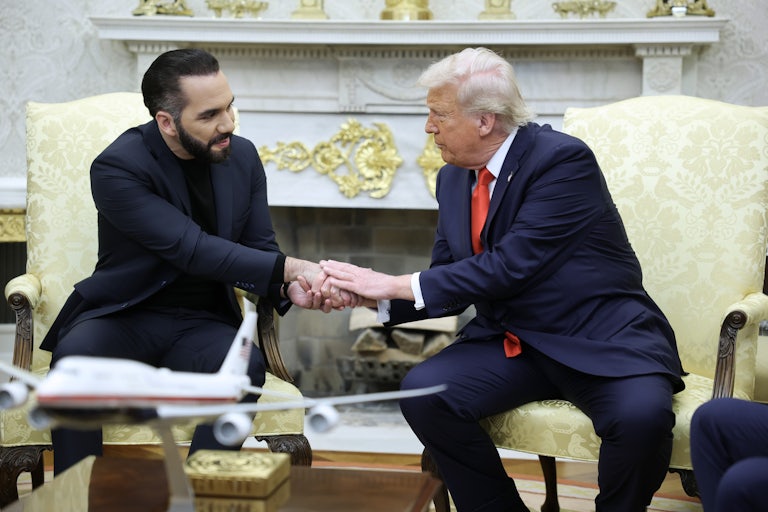
Donald Trump shakes hands with Salvadoran President Nayib Bukele as the two sit in the Oval Office of the White House.
Win McNamee/Getty Images

President Donald Trump got swindled as part of an ill-advised prisoner swap in return for El Salvador taking Venezuelan deportees with no criminal record, The New York Times reported Wednesday.  

At first, Salvadoran President Nayib Bukele was reluctant to take noncriminal immigrants and was doubtful he could convince his constituents that doing so was within the country’s national interests. While the Trump administration has repeatedly claimed that all 238 Venezuelans who were deported in March were members of Tren de Aragua, few of them actually had criminal records, and the criteria used to identify them as gang members were questionable. 

But Bukele saw an opportunity to get something he wanted. In return for taking Venezuelan detainees, he requested a list of high-ranking MS-13 members to be released into his custody. This immediately raised red flags for U.S. law enforcement officials, concerned over collaboration between Bukele’s government and MS-13.

Douglas Farah, an expert on El Salvador who previously collaborated with the Department of Justice on a task force targeting MS-13, told the Times that the Salvadoran government was trying to save its own skin. 

“What Bukele is desperate for is to get these guys back in El Salvador before they talk in U.S. court,” Farah said. 

The U.S. Treasury Department reported in 2021 that Bukele’s government had provided financial incentives to gangs to keep homicide numbers low, and said that gang members received special privileges in prisons, such as access to sex workers and mobile phones. The Justice Department has made similar allegations

Still, the Trump administration agreed to Bukele’s terms, convinced it was getting a great deal for the scale of its massive deportation undertaking. 

In addition to the $6 million the Trump administration paid to hold deportees at CECOT, the prison notorious for human rights abuses, U.S. officials agreed to send a dozen senior members of MS-13. This included César Humberto López-Larios, who was arrested in June and had been awaiting trial on several terrorism charges. Bukele has not yet received his complete list of MS-13 members, but U.S. officials said there were plans to send more, according to the Times. 

The Times separately reported Wednesday that Bukele had outright rejected a diplomatic request from the U.S. government to return Kilmar Abrego Garcia, the Maryland man who was wrongly deported to El Salvador in March as the result of an “administrative error.” In an interview on ABC News Tuesday night, Trump claimed that he could get Abrego Garcia back with just a phone call but that he wouldn’t because he was “not the one making this decision; we have lawyers who don’t want to do this.”

Trump Threatens 60 Minutes in Crazed Rant Amid Key Stage of Lawsuit

Donald Trump also dragged The New York Times into his tirade.

Donald Trump speaks during a Cabinet meeting
Jim Watson/AFP/Getty Images

Donald Trump’s performance numbers may be down, but his head is right where it should be: ruminating over last September, when former Vice President Kamala Harris sat down with 60 Minutes.

Since the interview aired, the president has insisted that the network had selectively edited Harris’s answers to a question regarding Israeli Prime Minister Benjamin Netanyahu—a detail made all the more confusing since CBS’s 60 Minutes and Face the Nation cut and aired different portions of her 21-second response on different days. An independent review by the Federal Communications Commission showed that the two answers were in fact cut from the same longer response. As odd as the discrepancy was for viewers, editing answers for time is considered general practice in television news.

But as of this week, Trump has seemingly decided to rope The New York Times into the alleged offense, claiming that the newspaper’s reporting that the case is “baseless” is tantamount to “tortious interference” and, apparently, worth its own lawsuit.

Trump sued CBS for $10 billion after the interview, claiming that the different clips amounted to “election interference” and merited the network losing its broadcast license. He also argued, at the time, that Harris should drop out of the presidential race over the GOP-baked scandal.

“The case we have against 60 Minutes, CBS, and Paramount is a true WINNER,” Trump posted on Truth Social Wednesday. “They cheated and defrauded the American People at levels never seen before in the Political Arena. Kamala Harris, during Early Voting and, immediately before Election Day, was asked a question, and gave an answer, that was so bad and incompetent that it would have cost her many of the Votes that she ended up getting. It was a disastrous answer!”

Against evidence, Trump further claimed that Harris’s real answer was “removed and deleted”—“every word of it,” he wrote—and “replaced” with a response to a completely different question.

“In other words, 60 Minutes perpetrated a Giant FRAUD against the American People, the Federal Elections Commission, and the Federal Communications System,” the president continued.

He then accused the Times—an entirely separate media organization—of being in on the scandal, claiming that the newspaper’s “noncurable case of TRUMP DERANGEMENT SYNDROME” makes it “liable for tortious interference.”

“Nothing like this, the illegal creation of an answer for a Presidential Candidate, has ever been done before, they have to pay a price for it, and the Times should also be on the hook for their likely unlawful behavior,” Trump wrote. “It is vital to hold these Liars and Fraudsters accountable!”

CBS’s parent company, Paramount, is reportedly moving to settle the lawsuit—much to the dismay of network staff—so that Paramount’s controlling shareholder Shari Redstone can close a business deal that would require Trump’s sign-off.