Life in a Warming World
A weekly reckoning with our heated planet—and the fight to save it

Get Ready for Expensive Tomatoes and Lots of Food Contamination

The Trump administration’s tariffs, funding freezes, and deregulation could spell chaos not just for farmers and consumers but also for food safety.

Pork and poultry products on a display shelf at a Safeway
Justin Sullivan/Getty Images

You could soon be hearing a lot of news about tomatoes. That’s because the Commerce Department announced this week that Mexican tomatoes will be subject to 21 percent tariffs starting July 14. If this goes through, expect tomato prices to rise precipitously: The United States relies heavily on greenhouse-grown tomatoes, of which the Agriculture Department estimates 88 percent are imported, with most coming from Mexico.

Of course, the Trump administration’s tariff policy so far has not exactly been consistent or predictable. The president could drop this tomato tariff tomorrow and announce that he and Mexican President Claudia Sheinbaum have reached an understanding, brokered by Laura Loomer, that henceforth tomatoes imported from Mexico will be exempt from import duties and be known as “prosperity apples.” (Any publication daring to call them “tomatoes” will be kicked out of the White House press corps.)

But again, if this tariff goes through, then taxing the bejeezus out of the second-most-consumed vegetable in the country will obviously have a noticeable impact on a lot of people’s grocery bills. Yet amazingly, this may be the least of American consumers’ worries right now when it comes to food disruption.

The Guardian reported Tuesday that recent torrential rains have caused “millions of dollars of crop losses” in Texas and the Midwest. When added to the Trump administration’s cuts to farming infrastructure, climate-smart farming initiatives, and various food assistance programs that provided a market for some farmers, plus the trade war jeopardizing export markets in Mexico and China, this means that many U.S. farms are in trouble. “Without a bailout, we can only imagine how bad this will be for farmers,” Food and Water Watch’s Ben Murray told reporter Nina Lakhani. But other experts noted that even with a bailout, delivering the money fast enough might be an issue, and trade relations in particular could take time to rebuild.

All this is in addition to, as this newsletter previously noted, substantial cuts both to the climate adaptation and mitigation efforts vital to long-term food production and to USDA’s operating budget. This week, Government Executive reported that planning documents reveal further cuts. They include firing “thousands” more USDA employees, “consolidat[ing] … local, county-based offices around the country into state committees,” and a 22 percent cut to salaries and expense accounts at the Farm Service Agency (which directly supports farms with loans and disaster assistance programs).

Food safety will also take a hit. The Food and Drug Administration’s Human Foods Program, which works on food safety, and the Centers for Disease Control and Prevention’s Division of Environmental Health and Science Practice, which headed the response to the applesauce lead-poisoning fiasco in 2023, have both been gutted, Time recently reported. This comes after last month’s news that the Trump administration had axed two USDA committees advising on food safety: the National Advisory Committee on Microbiological Criteria for Foods and the National Advisory Committee on Meat and Poultry Inspection, the former of which was busy reviewing last year’s fatal listeriosis outbreak and figuring out how to prevent repeats of the 2022 infant formula contamination that killed babies.

The USDA also announced that it would be increasing line speeds at meatpacking plants and nixing “redundant” worker safety reports. This is deeply troubling on a humanitarian level, given that worker safety at meatpacking plants is already a nightmare, with gruesome injuries affecting a highly vulnerable workforce. (For more on this, read Melody Schreiber’s recent report in The Guardian or Ted Genoways’s award-winning 2023 piece for TNR about the shooting of a worker in an Oklahoma pork-processing plant.) As the United Food and Commercial Workers International Union vice president Mark Lauritsen said recently to the Times: “If the work force is under more pressure for speed, with less safety oversight, that can lead to a miscut on a carcass, bile that could leak out of the intestine, that contaminates the equipment, and then the next carcass and the next and the next.”

Numerous outlets in recent years have reported the growing concerns about insufficient safeguards in the U.S. food system. Just two days after Trump’s inauguration, the Government Accountability Office delivered a report that rebuked USDA’s Food Safety and Inspection Service for its delays in finalizing rules to reduce pathogens in meat, and issued several recommendations for closing gaps in the agency’s approach to limiting salmonella and campylobacter outbreaks. It’s hard to imagine, given the chaos that has now befallen the entirety of the American food system and regulatory apparatus, that those recommendations are going to be speedily enacted.

Stat of the Week
470

That’s how many wildfires the state of Wisconsin has seen this year, as of Monday this week—”double the average for this time of year,” Wisconsin Public Radio’s Danielle Kaeding reports.

What I’m Reading

Revealed: Meat Industry Behind Attacks on Flagship Climate-Friendly Diet Report

In 2019, a major, long-researched study known as the EAT-Lancet report, which compiles top recommendations for sustainable diets, sparked major backlash over one single recommendation: to cut global red meat consumption in half. Now “new evidence” indicates the backlash “was stoked by a PR firm that represents the meat and dairy sector,” investigative outlet DeSmog reports:

A document seen by DeSmog appears to show the results of a campaign by the consultancy Red Flag, which catalogues the scale of the backlash to the report.

The document indicates that Red Flag briefed journalists, think tanks, and social media influencers to frame the peer-reviewed research as “radical”, “out of touch” and “hypocritical”...

Based on DeSmog’s review of the document, Red Flag’s attack campaign appears to have been conducted on behalf of the Animal Agriculture Alliance (AAA), a meat and dairy industry coalition that was set up to protect the sector against “emerging threats”. The AAA counts representatives from Cargill and Smithfield Foods—two of the world’s five largest meat companies—on its board. Red Flag is known to have previously worked for members of the AAA.

Red Flag’s campaign overview evaluates the success of social media posts from the AAA attacking the EAT-Lancet report, including a paid advertising campaign launched on behalf of the alliance that reached 780,000 people.

The surge of criticism had adverse consequences for the report’s authors.… In some cases, the backlash led them to withdraw from promoting the research in the media, and undermined their academic careers.

Read Clare Carlile’s full report at DeSmog.

This article first appeared in Life in a Warming World, a weekly TNR newsletter authored by deputy editor Heather Souvaine Horn. Sign up here.
Trump and RFK Jr. Want to Make America Poisoned Again

PFAS and “clean coal” for everyone!

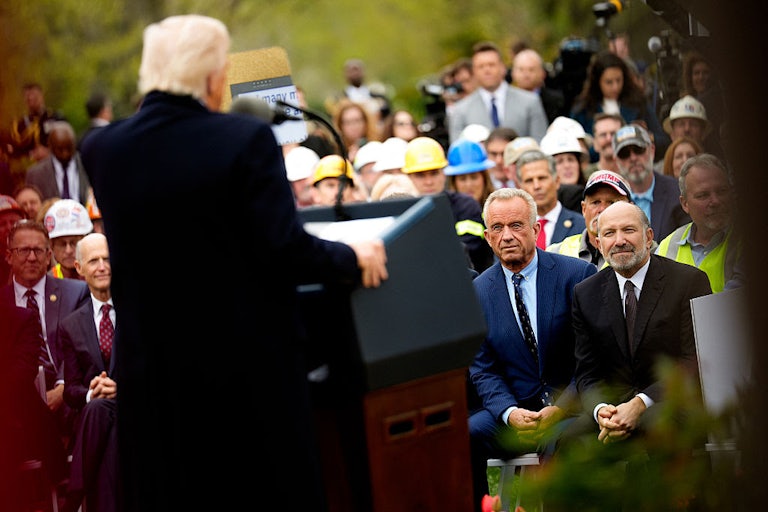
RFK Jr. sits in the audience, watching Trump, who stands at a podium facing away from the camera.
Andrew Harnik/Getty Images
Donald Trump speaks at a trade announcement event at the White House on April 2, with RFK Jr. in attendance.

This weekend, The Guardian reported that the Trump administration is “quietly” planning to gut both federal and state regulations on PFAS, which are commonly known as forever chemicals. It would do this, Tom Perkins reported, by “changing the way the [Environmental Protection Agency] carries out chemical risk evaluations, which would also pre-empt state laws that offer one of the few meaningful checks on toxic chemicals in consumer products.” An EPA employee, who requested anonymity over retaliation fears, said the administration would “exclude a huge number of consumer products from being considered for risk management.”

This approach to PFAS would be something of a masks-off moment for the administration on public health. While dismissive or hostile toward vaccines, cancer research, epidemiology, and more, the administration at least claims to be interested in limiting chronic disease, boosting fertility, and advancing other health and purity preoccupations under the banner of Health and Human Services Secretary RFK Jr.’s slogan “Make America Healthy Again.” HHS has moved to ban food dyes, and one would assume that RFK Jr. would see PFAS as a similarly ubiquitous threat to personal health—especially since he has previously been a vocal critic of forever chemicals, as well as microplastics.

For those who have been following the administration closely, the Guardian report is absolutely not the first or only sign that it may not actually be serious about chronic disease and environmental health. The EPA earlier withdrew a Biden-era plan to limit the release of PFAS into drinking water. Under RFK Jr.’s leadership, HHS has canceled vital grants that were working to address some of the chronic diseases he claims to be interested in. And as TNR contributing editor Liza Featherstone recently pointed out, Kennedy seems to have completely abandoned his former bête noire, microplastics, in recent months—even as new, troubling research has emerged suggesting the threat they pose is far greater than previously realized.

Yet there’s perhaps a special drama and dissonance in the administration’s PFAS position. PFAS, which get their nickname from their astonishing persistence in the environment and the human body, have been linked to cardiovascular disease, kidney and testicular cancer, type 2 diabetes, childhood obesity, hormonal disruption, and reduced immune system function—you know, chronic disease and bodily fitness–type stuff. There’s some evidence they also disrupt fertility, a fixation of Vice President JD Vance and prolific babymaker Elon Musk. In a particularly grim twist noted previously in this newsletter, research suggests women who’ve borne multiple children may have lower levels of PFAS solely because they pass some of their PFAS load into their children’s bodies during pregnancy. And prenatal and early-childhood PFAS exposure has even been linked to symptoms of ADHD, rates of which the Trump administration claims to find especially troubling. (In a typical move, the administration has also attacked ADHD medication.)

Limiting PFAS is also wildly popular with the public: In polling last year by Data for Progress, three-quarters of likely voters—including a whopping 71 percent of Republicans—supported new EPA standards limiting the amount of PFAS in drinking water. Trump’s EPA head Lee Zeldin previously supported federal action on PFAS, in his prior life as a congressman representing Long Island, and said in his confirmation hearing that PFAS would be a “top priority” for him in his current role.

Yet if this recent report is accurate, the Trump administration isn’t just dismantling PFAS regulations at the federal level. It’s trying to prevent states from limiting PFAS too. This tactic, colloquially known as “preemption,” has been a favorite tool of the right in recent years—ironic, perhaps, given conservatives’ self-professed devotion to small government and local sovereignty. Republicans often deploy the tactic to protect corporations’ prerogative to poison people: 20 GOP-dominated states have passed preemption laws that prohibit cities from banning gas hookups.

The Trump administration’s war on both state and local authority and on environmental health appears to be escalating. On Tuesday, the president signed an executive order to “[Reinvigorate] America’s Beautiful Clean Coal Industry.” Coal pollution has been linked to respiratory disease, cardiovascular disease, and even cognitive impairment and neurodegeneration. In 2023, researchers combing through Medicare death records concluded that coal pollution had caused roughly half a million of those deaths between 1999 and 2020. The president also signed an executive order on “Protecting American Energy From State Overreach.” In the name of “American energy dominance and our economic and national security,” it seeks to block policies any state might enact to try to protect its people from the risks of fossil fuels.

Taken together, these moves make clear that Trump and Kennedy were never serious about making America healthier. The only people these actions will protect are corporate executives, who will get richer as the country gets sicker.

Stat of the Week
80,000

That’s how many houses in the New York area could be “lost to floods over the next 15 years,” per a new report.

What I’m Reading

Relentless rain and storms kill at least 24 in South and parts of Midwest

The stories out of Tennessee, Kentucky, and other nearby states in the past few days—including that of a 9-year-old swept away by floodwaters on his walk to the bus—make for very hard reading. They come amid steep cuts to both the National Weather Service and the Federal Emergency Management Agency.

Cities have ordered evacuations as rescue crews in inflatable boats checked on residents in Kentucky and Tennessee, while utilities shut off power and gas in areas from Texas to Ohio. The Tennessee Emergency Management Agency said it is working with local and federal partners to evaluate storm damages and decide whether they meet the criteria for a major federal disaster declaration. The agency has advised residents to report any damages to their local emergency management offices.

“As long as I’ve been alive—and I’m 52—this is the worst I’ve ever seen it,” said Wendy Quire, the general manager at the Brown Barrel restaurant in downtown Frankfort, Kentucky, the state capital built around the swollen Kentucky River.

“The rain just won’t stop,” Quire said Sunday. “It’s been nonstop for days and days.”

Officials diverted traffic and turned off utilities to businesses in the city as the river was expected to crest above 49 feet Monday at a record-setting level, said Frankfort Mayor Layne Wilkerson. The city’s flood wall system is designed to withstand 51 feet of water.

Read the full report at CBS News.

This article first appeared in Life in a Warming World, a weekly TNR newsletter authored by deputy editor Heather Souvaine Horn. Sign up here.
Worried About the Climate? Get Off the Couch. The Data Supports It.

Activism isn’t just the “antidote to despair.” A growing body of research suggests it’s also pretty effective at changing the world.

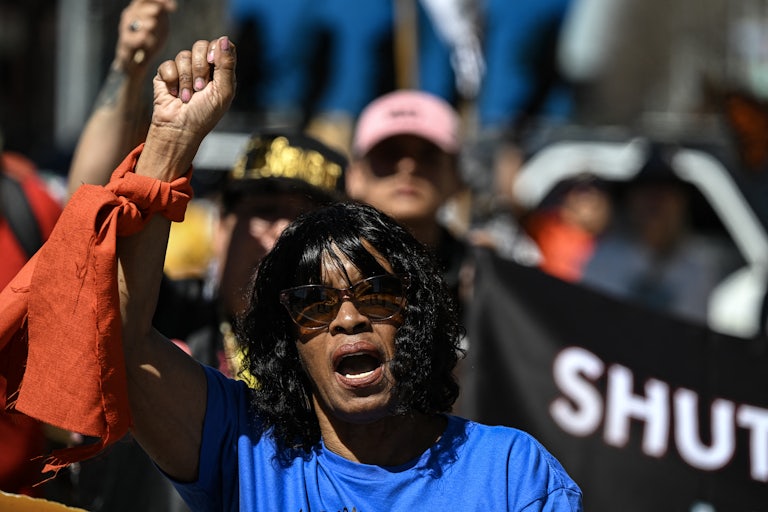
A demonstrator holds up a fist as others stand in the background.
Ronaldo Schemidt/Getty Images
A protest outside the Ceraweek by S&P Global energy conference in Houston, on March 10

In the wake of the election, many discouraged leftists announced they were tuning out. Two months into Donald Trump’s presidency, however, the case for sitting on the sofa and drowning anxieties in escapist television is getting slimmer. And that’s especially true for people concerned about the climate crisis, who are often presumed to be at particular risk of despair and burnout.

“Action is the antidote to despair,” Joan Baez famously said, a line frequently quoted in climate circles. It’s not just an inspirational meme: There’s now a growing body of evidence that climate protest works—not just to decrease anxiety in your head but to change the world outside of it. And contrary to all the stereotypes about preachy greenies putting other people off the cause, there doesn’t seem to be much risk of provoking backlash.

When researchers working with the Yale Program on Climate Change Communication reviewed 50 recent studies on the impact of climate activism for an article published last week, they found “strong evidence that climate activism shifts public opinion and media coverage in a pro-climate direction.” They also found evidence that activism can sway policymakers and increase the percentage of vote share going to pro-climate candidates. One particularly intriguing study from Germany found not only that “areas that were exposed to protests had a higher share of the vote (+2-2.5% points) go to the Green party,” but also that “repeated exposure [i.e., more protests] increased this effect.”

The ubiquitous fear that the wrong types of protest might turn people off, on the other hand, doesn’t seem very well supported. “We’re beginning to think that concerns about backlash are a bit overstated, generally,” lead author Laura Thomas-Walters told me over Zoom, noting that this trend held both for climate protest and for political messaging in general. Even if the public objects to certain activism, like people vandalizing artwork or monuments, that doesn’t mean that particular group turns them off the climate cause in general.

Cautioning that she was speaking for herself and not necessarily for the other authors, Thomas-Walters said that “there will be some people who get pissed off, but they’ll be pissed off no matter what you do. If you mention you’re vegan, they’ll say I’m going to eat two steaks tonight just to spite you.” The review also found recent evidence that more extreme actions can actually increase support for moderate climate groups, in what’s known as the “radical flank effect.” This is a known phenomenon that goes back decades and isn’t just about climate activism. “There’s a good argument,” Thomas-Walters said, “that Martin Luther King wouldn’t have been so successful if it wasn’t for Malcolm X making him look a lot more moderate than he basically was.”

This research comes at a complicated time for activism in the U.S. Protest against the Trump administration and Elon Musk is growing, and seems to be having an effect. But moves to suppress and even criminalize protest are growing, as well. Earlier this week, TNR’s Kate Aronoff wrote about the proliferating signs that the administration is cracking down not just on pro-Palestine demonstrators but on activists of all stripes. The recent verdict holding environmental group Greenpeace liable for the company Energy Transfer’s expenses due to the Dakota Access Pipeline protests has also rocked the environmental movement.

At the same time, the evidence that engagement can help people struggling with their anxiety about current events and the environment keeps building. And the YPCC review now adds more information about how activism functions in the broader world.

“One of the reasons I did this review, personally, is because I’m also a climate activist in the U.K.,” said Thomas-Walters, who’s a member of Extinction Rebellion. “You are relying on people’s limited attention and energy and money and stuff,” so having data about what works is useful. “Activists and people get burned out, so we want to be as effective as we can.”

I asked her whether she had a sense of what U.S. activists, in particular, might take away from this review. Much of the evidence this review included, even research from Europe, she said, should “apply relatively well to a lot of the Western world,” and some of it came specifically from the U.S. And she pointed to one other thing that U.S. climate activists might want to focus on in this moment: “With Trump in power, we’ve seen some evidence of successful climate stuff that’s happening on the local scale, and I think building that deeper community of activists on a local area and being able to achieve local wins might be a good way to keep people going.”

Stat of the Week
40% poorer

That’s the hit the average person will take if the world warms by four degrees Celsius, according to a new study.

What I’m Reading

Pension Funds Push Forward on Climate Goals Despite Backlash

Banks are scrapping their climate goals left and right. But pension funds, Eshe Nelson reports, are taking a different approach—and their investing power shouldn’t be discounted.

At a time of growing backlash to environmental, social and governance goals and investment strategies, pension funds, particularly in blue states and Europe, have emerged as a bulwark against efforts to sideline climate-related risks.

The funds, which sit at the top of the investment chain, have stepped up engagement with asset managers and companies on climate goals and have kept public commitments to use their fiscal might to reduce carbon emissions. In some cases, that has meant shifting to European asset managers, which have not backed off on climate commitments as much as their American counterparts have.

[NYC Comptroller Brad] Lander’s office oversees investments for five public pension funds for 700,000 of the city’s current and former employees. The funds are pushing ahead with engagement, bringing more shareholder resolutions to banks to disclose the ratio of their fossil fuel investments versus clean energy and to utilities companies on their climate targets.

Read Eshe Nelson’s full report at The New York Times.

This article first appeared in Life in a Warming World, a weekly TNR newsletter authored by deputy editor Heather Souvaine Horn. Sign up here.
Snag Those Rebates for Home Energy Upgrades Before the GOP Kills Them

The Inflation Reduction Act’s incentives for buying, say, an energy-efficient boiler or water heater are safe—for now.

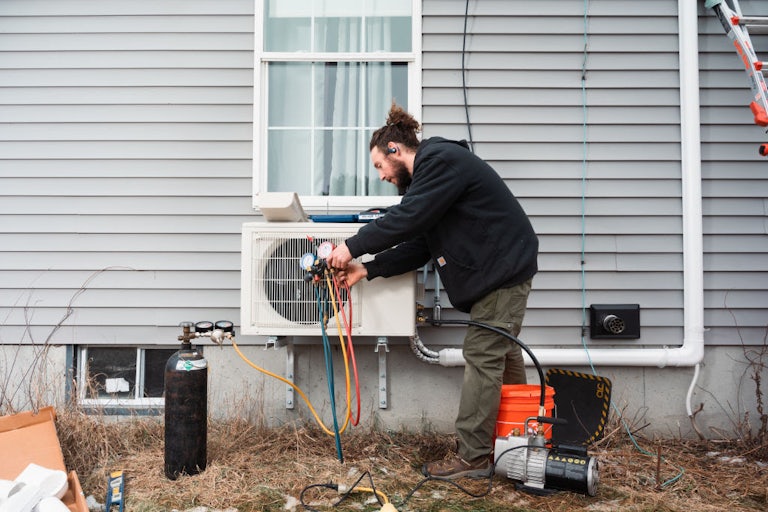
A person bends over a heat pump on the outside of a house, holding wires and gauges.
The Washington Post/Getty Images
An HVAC technician working on an electric heat pump

The Trump administration has disrupted quite a few money flows in its first two months, reserving special effort and scorn for those authorized by the 2022 Inflation Reduction Act. Farmers who undertook infrastructure improvements with the guarantee of Agriculture Department reimbursement suddenly found the payments frozen. Green banks, nonprofits, local governments, and other groups who had been awarded Environmental Protection Agency grants for everything from clean energy financing to lead pipe remediation found these grants “terminated.” The administration has even accused the grantees of fraud—though so far without much evidence.

This has startled people who thought you couldn’t legally cancel stuff that’s already been promised. Trump’s campaign pledge to rescind “unspent” IRA funds, it turns out, didn’t mean already committed funds were safe. Court rulings against the administration haven’t necessarily turned the taps back on. Nor, at the political level, has the IRA’s track record of benefiting red districts offered as much protection in these initial weeks as experts and advocates predicted it would; a congressional repeal effort is now underway, and while 21 House Republicans have said they oppose repealing the entirety of the act’s clean energy tax credits, their leaders show no sign of slowing their roll.

But let’s say you’re not a green bank or a farmer. Let’s say you’re not one of the groups currently suing the administration for breach of contract while the administration not-so-subtly threatens to sic the FBI on you for having the audacity to apply for and receive a government grant.

Let’s say you’re a homeowner whose boiler or water heater badly needs replacing, and you’re looking to defray some costs or even save on energy bills going forward. Let’s say your electrical panel is a growing fire hazard that you’ve ignored for way too long and the IRA’s provisions for panel upgrades could enable you to replace it. Do all those funds still exist? Or did you miss the window?

The incentives still exist, said David Friedman, senior director for federal policy at Rewiring America, a nonprofit focused on electrification. There are two main categories: tax credits, which get counted against your tax liability at tax time, and rebates, which can reduce up-front costs. The rebates, which the IRA stipulated had to be administered via state governments, “were a little more up in the air” for a bit, Friedman said. Only 10 states plus the District of Columbia had their programs up and running when Trump took office, and two of those paused them when the Energy Department suddenly froze the funds needed to reimburse states for the rebates. Now that the payment portal has reopened, The Washington Post recently reported, “some states, including California, New York, Maine and New Mexico, are continuing their rebate programs.”

Even if you live outside one of those states, the federal tax credits never went away. “It’s going to take an act of Congress to change that,” Friedman said. And even if Congress were to repeal this particular part of the IRA, “it’s pretty rare and honestly would be pretty painful to take away a tax credit in the middle of the year.… Typically when changes are made to tax law, it’s going forward, not present or going back.” If Congress were to repeal these, they’d probably just end them ahead of schedule—maybe by a few years, he said, or maybe in 2026, rather than cutting them midyear.

Tax credits don’t offer the instant affordability perks of rebates, of course. In the case of a new electrical panel or a heat pump water heater, the rebates could offer lower-income households $4,000 and $1,750, respectively, off the cost of the new devices, whereas the federal tax credit for a panel upgrade offers only 30 percent of the project cost, for a maximum of $600.

Rebates “help people who can least afford the skyrocketing energy prices people are facing today,” Friedman explained. “They’re targeted at low-and moderate-income households. These are folks who are much more likely to put a Band-Aid, effectively, on their hot water heater or their heating and cooling system because they can’t afford to repair it, and that traps them in an expensive cycle. It sticks them with an outdated unit that costs more to operate and so they have higher utility bills.” In theory, the rebate programs are set to expand, because every state except for South Dakota applied to participate in the program, Friedman said. Even states that don’t yet have their programs up and running have “got contracts with the money that is legally obligated to them.”

Contracts, of course, have not exactly deterred the Trump administration so far in its quest to freeze funds—despite a barrage of unfavorable judicial rulings. A growing number of advocates for these home energy incentives, though, are arguing that axing them would also be bad politics. “I think that one thing that’s become evident in the last year or so is that household energy costs—inflation, fossil fuel prices—those do seem to be more top of mind for Americans,” Energy Innovation senior director Robbie Orvis recently told Heatmap’s Matthew Zeitlin, in a piece about the “dollars-and-cents arguments” for keeping the IRA. Heatmap Pro’s own opinion modeling, Zeitlin noted, backed that up, showing that “lower utility bills is the number one perceived benefit of renewables in much of the country.”

“A package of heat pump, water heater, heat pump heating-cooling system, and some good insulation and windows is going to save you nearly a thousand dollars a year,” Friedman said. Getting rid of the incentives that make that more affordable for people, he said, “would be a tax hike on the American public. And at a time when you’ve got a president who’s promised to cut people’s energy bills in half, it would cripple their ability to fight high energy prices.” That’s in addition to Trump’s tariff policies possibly raising utility bills all on their own.

When analysts point out that IRA funds have particularly benefited red districts, they’re typically referring to money that has gone into manufacturing. But the home energy incentives could particularly benefit Republicans too. Homeowners are both more likely to lean GOP than Democrat and about twice as likely to self-identify as “strongly Republican” than renters are.

Whether either the manufacturing benefits or the utility-bill benefits to their constituents convince the GOP to spare the IRA remains to be seen. After all, lots of groups lean much further right than homeowners do; that hasn’t stopped Trump from pursuing policies that wreak havoc on their bottom lines.

Stat of the Week
26 gigawatts

That’s how much power—“more than the total generation capacity of most U.S. states,” Inside Climate News reports—it would take to clean up the wastewater from oil operations in Texas’s Permian Basin.

What I’m Reading

This muggy city keeps cool with minimal AC. Here’s how.

The Washington Post’s Allyson Chiu profiles Palava City in India, a newish experimental community where one study found that “maximum temperature is consistently 2 to 3 degrees Celsius (3.6 to 5.4 degrees Fahrenheit) cooler than in nearby cities, including Mumbai.” Low-energy cooling solutions are no small feat here, given that a lot of passive cooling strategies (like windcatchers) work better in drier climates. But buoyed by government support, high-income residents, and a more or less blank slate, developers are quickly throwing a lot of ideas on the table, Chiu reports. What they learn through trial and error, some hope, could help more traditional, cash-strapped cities:

Early apartments were built with smaller windows to reduce the amount of heat that could enter, Abdullah said. But when residents complained about the window size, he said, the developers responded by constructing apartments with larger windows set farther back into the building. This design provides shade and cuts the amount of direct heat hitting the glass. More recently, Abdullah said, they’ve been experimenting with glass treatments such as films that can be applied to windows to keep heat out.

On a sunny June day, the interior of a newly constructed unit with treated windows is noticeably cooler than the outdoors, even with the air conditioning shut off.

But window design is just one way the community saves energy. Palava has cut residential energy use through a combination of approaches, including installing solar-powered water heaters on buildings and efficient air conditioners inside.

Read Allyson Chiu’s full report at The Washington Post.

This article first appeared in Life in a Warming World, a weekly TNR newsletter authored by deputy editor Heather Souvaine Horn. Sign up here.

Trump Wants to Revive the Timber Industry—but Shot Himself in the Foot

Experts explain why the president’s plan to scale up production on federal lands will be hindered by his own administration.

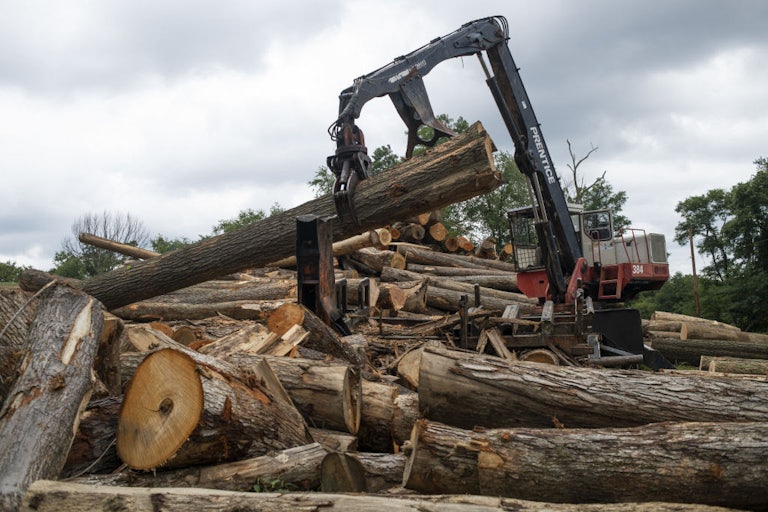
A log loader picks up a log amid a large pile of logs.
Bloomberg/Getty Images
A worker operates machinery to cut logs in Moundsville, West Virginia.

Days before new tariffs on Canada, Mexico, and China took effect earlier this month, President Trump issued two executive orders. One bemoaned America’s status as a net importer of lumber, ordering the secretary of commerce to investigate the “national security risks” of importing lumber and what would be needed for domestic production to fulfill all domestic demand. The other decried “onerous Federal policies” that have hampered the industry, directing the government to speed the approval of forestry projects on federal land and find ways to minimize the effect of the Endangered Species Act and National Environmental Policy Act.

Boosting logging is controversial from several angles. But as with many industries Trump claims to champion, there’s also a second question here: Is the administration’s theory of the industry’s decline—and prescription for its revival—actually accurate?

Trump’s tariffs and executive orders seem to assume that foreign competition and lack of lands to log are the primary things hampering U.S. timber production. But when I talked to experts familiar with the industry’s history, they painted a more complicated picture. There are some potential upsides to boosting domestic timber production—even on the environmental front. But the U.S. timber industry’s struggles aren’t as simple as the president seems to think, and some of his policies could even hurt the industry he claims to be helping.

Access to prime logging land “[is] really not the main factor holding things back,” said Michael Snyder, the former commissioner of Vermont Forests, Parks, and Recreation, who now consults on forestry and forest policy with Greenfire Enterprises. “Sure, increased supply of raw material … would seem on the surface to be helpful, but [it’s] not if you don’t have a workforce—that includes loggers, truckers in particular; if you don’t have receiving primary processing facilities, basic sawmills, secondary manufacturing facilities, retailers, and all of those elements of any value chain in the forest economy, which are all in distress right now pretty much everywhere.” Sawmills closing has been a problem for decades, and might not be an easy trend to reverse. “In Vermont, we’ve lost 158 mills since 2000, and I think last year Oregon lost seven major mills,” said Snyder.*

“There’s not one single factor that led to the decrease in both jobs as well as harvests,” said University of Oregon historian Steven Beda, who focuses on the history of the U.S. timber industry. Environmental backlash in the 1980s definitely had an effect in terms of limiting access to federal lands, he said. But also, the broader economic problems of the 1970s hit the industry hard, and over time traditional logging states like Oregon, Washington, and Idaho began to “pivot” from natural resource extraction “towards more of a high-tech economy,” said Beda, “so there’s less of an incentive for politicians to support the timber industry. Then you also have capital flight—a lot of the timber companies realizing that they can be more profitable operating in the South,” in part because of lower rates of unionization there. Both international competition and regional competition, he said, have played a role in reducing the size of the Northwest timber industry, which is the one Trump primarily seems to be targeting with his executive orders, since that’s where most of the federal forest land is located.

If the goal is to resurrect the pre-1980s Northwest timber industry, Beda said, that might be tough, because “both the workforce and the sawmills kind of stabilized and readjusted to the harvest rates that took shape after the end of the spotted owl conflict,” referring to the environmental backlash and endangered species advocacy that closed off many federal lands to logging.

Neither Beda nor Snyder see themselves as anti-timber. “I’m actually someone who believes that the Forest Service lands should be open to more logging,” said Beda. Snyder is a long-time advocate for people to value forestry more and take it seriously. “People realize they need plumbers and are willing to pay for it,” he said. “People don’t realize how much wood and wood products they use in their daily lives, from floors and cabinets to textiles and food additives and paper. They think we just need to leave forests alone. I don’t know where we’re going to get these materials. Plastics, concrete, and steel are far worse. So if not wood, what, and if not here, where?”

But both pointed to a serious problem with the Trump administration’s approach. It “just doesn’t add up,” said Snyder, pointing to the administration’s massive cuts across the Forest Service. “We’re going to get more wood off federal land but get rid of thousands of federal employees who actually do that work? It’s absurd.”

Beda agreed. “You can’t do both. You can’t cut Forest Service staff and say you want more logging on Forest Service lands. You need people to administer the contracts, put together the budgeting, all the zillion pieces that are part of public lands logging.… When you actually go back and look to the peak, the Forest Service harvests, at least in Oregon, peaked in the early 1980s, and that not coincidentally is also when the Forest Service had the largest budget and the largest staff.”

Tariffs could also hurt the industry long before they help because of the cross-border nature of wood processing. As the tariffs on Canada took effect, Snyder said, he heard from loggers in Vermont that their exports to the sawmills on the Canadian border immediately cratered. “Everything from up to a 50 percent price drop to complete shutoffs of deliveries. This is coming when we’re about to head into mud season, which is a traditional time for loggers to stay out of the woods ’cause of the vulnerable soft ground,” he said.

At the end of the day, “we should in my view be using more of our own wood, but these are not the buttons and levers to pull and push to get us there,” Snyder said. “It’s going to take an integrated, coherent, comprehensive approach.”

He’d like to see the Endangered Species Act protected, serious money put into research on sustainable forestry, how to preserve habitats and water quality, and whether wood products could substitute for things like single-use plastics and carbon-intensive construction materials like concrete. “The way we invest in high-tech, medical, automotive—we need to have the same kind of approach to the forests of our country and the people who manage and make their living in them,” he said. But “it’s not going to happen with sweeping executive orders and tariffs like this. It’s just going to piss everybody off.”

Stat of the Week
66%

That’s how many respondents support the U.S. transitioning to 100 percent clean energy by 2050, according to the Climate Opinion Maps that the Yale Program on Climate Change Communication recently published. (Also, 75 percent backed regulating carbon dioxide “as a pollutant” and 67 percent backed requiring fossil fuel companies to pay a carbon tax—striking numbers given that the Trump administration is moving in the exact opposite direction.)

What I’m Reading

‘Our people are hungry’: What federal food aid cuts mean in a warming world

Ayurella Horn-Muller and Naveena Sadasivam introduce readers to Mark Broyles, a 57-year-old living in Big Stone Gap, Virginia, where over 80 percent of residents voted for Donald Trump. Broyles’s “family of four, his mother, and her husband” have been using the food boxes provided by the nonprofit Appalachian Sustainable Development, which “helps small farmers sell fresh goods to public schools and grocery stores.” But now, due to Trump administration funding cuts, the food box program is gone. Programs benefiting both farmers and food-insecure households are folding across the country.

For decades, the USDA has funded several programs that are meant to address the country’s rising food-insecurity crisis—a problem that has only worsened as climate change has advanced, the COVID-19 pandemic led to layoffs, and grocery prices have skyrocketed. A network of nonprofit food banks, pantries, and hubs around the country rely extensively on government funding, particularly through the USDA. The Appalachian Sustainable Development is but one of them. The first few months of the Trump administration have plunged the USDA and its network of funding recipients into chaos.

The agency has abruptly canceled contracts with farmers and nonprofits, [frozen] funding for other long-running programs even as the courts have mandated that the Trump administration release funding, and fired thousands of employees, who were then temporarily reinstated as a result of a court order. Trump’s funding freeze and the USDA’s subsequent gutting of local food system programs has left them without a significant portion of their budgets, money they need to feed their communities. Experts say the administration’s move to axe these resources leaves the country’s first line of defense against the surging demand for hunger relief without enough supply.

Read Ayurella Horn-Muller and Naveena Sadasivam’s full report at Grist.

This article first appeared in Life in a Warming World, a weekly TNR newsletter authored by deputy editor Heather Souvaine Horn. Sign up here.

* This article originally misstated the state in which these mills were lost.