Breaking News
Breaking News
from Washington and beyond

Mike Johnson Reveals His Disastrous Plans for Medicaid

The House speaker has a cruel plan now that he’s passed the budget.

Mike Johnson speaks to reporters in the Capitol
Kayla Bartkowski/Getty Images

House Republicans approved a budget Thursday, pushing Donald Trump’s dream bill closer to reality.

With the budget framework in the rearview, conservatives in both chambers are now squaring away how they can slice trillions of dollars from the details of the federal budget in order to extend Trump’s 2017 tax cuts for corporations and billionaires, and make an estimated $6.8 trillion addition to the deficit more palatable to their base.

One much-discussed solution includes taking a metaphorical chain saw to indirectly strip $880 billion from Medicaid, but House Speaker Mike Johnson still wasn’t ready to admit the reality of that proposal Thursday—despite the fact that his colleagues have already publicly acknowledged the party’s intention to gut the low-income insurance program.

“No one has talked about cutting one benefit in Medicaid,” Johnson insisted, instead offering another solution to afford Trump’s tax cuts. “What we’ve talked about is returning work requirements, so for example you don’t have able-bodied young men on a program that’s designed for single mothers and the elderly and disabled.”

The eyebrow-raising pitch also came packaged with an insult for young American men, who Johnson argued were wasting their lives playing video games.

“They’re draining resources from people who actually do that,” the speaker continued. “So if you clean that up and shore it up you save a lot of money and you return the dignity of work to young men who need to be at work instead of playing video games all day.”

But Republican proposals to introduce a work requirement to Medicaid have thus far asked recipients to navigate work-reporting and verification systems on a monthly basis—a detail that would require significant federal funding. The plans would also negate coverage for individuals who find themselves temporarily unemployed, such as those who were recently fired or laid off.

A February report by the Center on Budget and Policy Priorities found that introducing work requirements to the insurance program could strip upward of 36 million Americans of their health coverage—half of Medicaid’s 72 million enrollees.

And, at the end of the day, if work requirements for Medicaid are actually intended to encourage employment—rather than punish the poor—then the whole effort is founded on a dud philosophy.

“Research shows that work requirements do not increase employment,” the think tank’s report said.
Four Democrats Pass Bill Making It Harder for Married Women to Vote

The House of Representatives—with the help of four Democrats—just passed a bill that could disenfranchise millions.

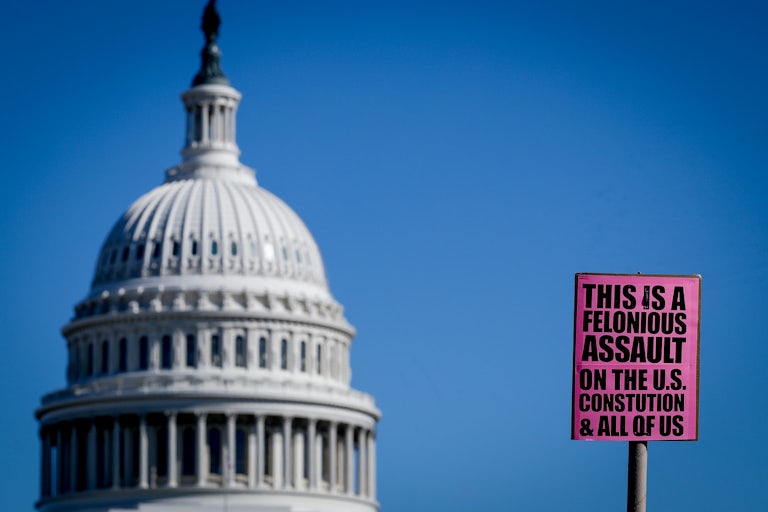
A sign near the U.S. Capitol reads "This is a felonious assault on the U.S. Constitution & all of us."
Chip Somodevilla/Getty Images

Republicans, and apparently some Democrats, are still obsessed with limiting noncitizen voting, which is already illegal and exceedingly rare.

The House on Wednesday passed the Safeguard American Voter Eligibility Act, or SAVE Act, which would require people to present a passport, birth certificate, or other documentation proving citizenship in person in order to vote in elections. The legislation is so extreme that many have warned that it could even make it harder for married women to vote.

The SAVE Act passed 220–208, with Democrats Jared Golden, Marie Gluesenkamp Perez, Henry Cuellar, and Ed Case voting in support of a bill that could disenfranchise millions of voters.

This is the second time Republicans have tried to codify the bill, which passed in the House last year but failed in the Senate.

“I voted for the SAVE Act for the simple reason that American elections are for Americans. Requiring proof of citizenship to register to vote is common sense,” Golden wrote in a post on X in an attempt to defend himself from his party’s scrutiny. “Some claim that requiring proof of citizenship is too onerous a burden, or that it will ‘disenfranchise’ those whose names have changed for reasons like marriage. The truth is the SAVE Act ensures name changes will not prevent anyone from registering to vote.”

But the bill will no doubt make it more difficult for millions of people to vote, particularly some 69 million married women who have taken their spouse’s name and do not have a birth certificate matching their legal name.

The SAVE Act would also disenfranchise marginalized groups like naturalized citizens, Native American voters, and low-income voters who do not have documents that prove their citizenship readily available, and prevent people from registering to vote online or by mail. It’s yet another form of Republican-led voter suppression disguised as a way to protect the country from voter fraud.

“In order to preserve this republic, we must uphold what it means to be able to vote in a U.S. election,” Representative Chip Roy, who sponsored the bill, said in a statement. “I am grateful that my colleagues answered the call and passed the SAVE Act, as this serves as a critical first step to ensure that we maintain election integrity throughout our country.”

Though noncitizen voting is extremely rare, it’s long been an obsession of the GOP, which frames the practice as an existential threat to democracy. It was a top Republican issue throughout last year’s election, and lawmakers used it to push their fearmongering anti-immigration agenda. Last month, President Donald Trump signed an executive order that would similarly boost proof of citizenship requirements for voter registration.

The SAVE Act will now head to the Republican-led Senate, where it will require more betrayal from Democrats in order to pass.

More on wtf Republicans are up to:

Trump Makes Startling Confession About Takeover of Panama Canal

Donald Trump and Defense Secretary Pete Hegseth are openly talking about U.S. troops in Panama.

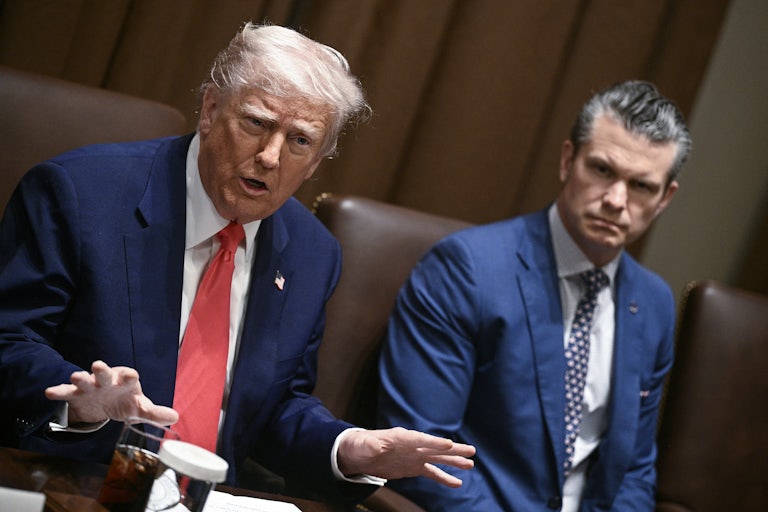
Donald Trump speaks animatedly as Defense Secretary Pete Hegeth look on. They’re all seated around a table for a Cabinet meeting.
BRENDAN SMIALOWSKI/AFP/Getty Images

At the White House Thursday, Secretary of State Pete Hegseth and Donald Trump admitted that U.S. troops have been deployed to the Panama Canal.

“We’re taking back the canal. China’s had too much influence, Obama and others let them creep in. We along with Panama are pushing them out, Sir,” Hegseth said to Trump at a Cabinet meeting held in front of the press, adding that after his trip to the country earlier this week, President José Raúl Mulino spoke positively of partnering with U.S. troops to get “the Communist Chinese out.”

“We’ve moved a lot of troops to Panama, and, uh, filled up some areas that we used to have, we didn’t have any longer, but we have them now, and I think it’s in very good control, right?” Trump said, turning to Hegseth, who replied, “Yes, Sir.”

The exchange seems to indicate that Trump has moved to control the canal and is working with Panama’s president, despite Trump previously antagonizing the country by expressing the desire to retake it. Hegseth’s visit to Panama earlier this week seemed to calm down tensions between the two countries, with Hegseth acknowledging Panama’s sovereignty over the canal.

But Trump asked the military last month to draw up plans for retaking the canal, meaning that he prefers to have that option on the table. Panama has taken steps to try to appease Trump, making a deal to reimburse U.S. ships for any transit fees for going through the canal, signing a security cooperation agreement, and agreeing to allow U.S. troops to resume jungle warfare training.

Panama has also agreed to end an infrastructure agreement with China and conduct a financial audit of Hong Kong–based CK Hutchison Holdings, which controls ports on the canal’s opposite sides. Whether all of this will be enough to keep Trump happy and allow Panama not to worry about a full U.S. military takeover of the canal remains to be seen.

Eggs Prices Soar to Record High as Trump Plays King

Eggs keep getting more expensive, even as the bird flu outbreak is slowing.

A shopper looks at the price of eggs in a grocery store.
Scott Olson/Getty Images

As Donald Trump enacts economic mayhem with his relentless tariff flip-flopping, eggs are still getting more expensive.

The average cost of a dozen large eggs jumped 6 percent in March, now costing about $6.23 per dozen, according to the Bureau of Labor Statistics, more than double what it was a year ago. That price is up from $5.90 in February and $4.95 in January, when bird flu spikes were cited as the main reason for rising costs. More than 30 million egg-laying chickens were killed to stop the disease from spreading.

In March, however, there were no bird flu outbreaks on chicken farms and the price of wholesale eggs dropped to $3 per dozen, the U.S. Department of Agriculture reported. “The supply situation at grocery outlets has greatly improved in recent weeks and consumers are once again seeing fully stocked shelves and enjoying a range of choices without purchase restrictions,” the USDA report reads.

Shortly before Trump announced his disastrous tariff scheme on “Liberation Day,” he told Agriculture Secretary Brooke Rollins she did a “fantastic job,” because the country has “lots of eggs” that are “much cheaper now” and will only continue to drop in price.

He was wrong, and corporate profits are soaring. A recent report from Food and Water Watch details how the nation’s top egg producer, Cal-Maine, used bird flu as a pretext to gauge prices, leading to record-high egg sales and soaring profits.

With Trump’s unpredictable flip-flopping on tariffs and trade, eggs could get even more expensive in the coming months—a grim reminder that consumers are ultimately at the mercy of the president’s volatile mood swings and reckless economic decisions.

Trump Dealt Huge Blow in Central Park Five Defamation Lawsuit

Donald Trump had sought to block the lawsuit from proceeding.

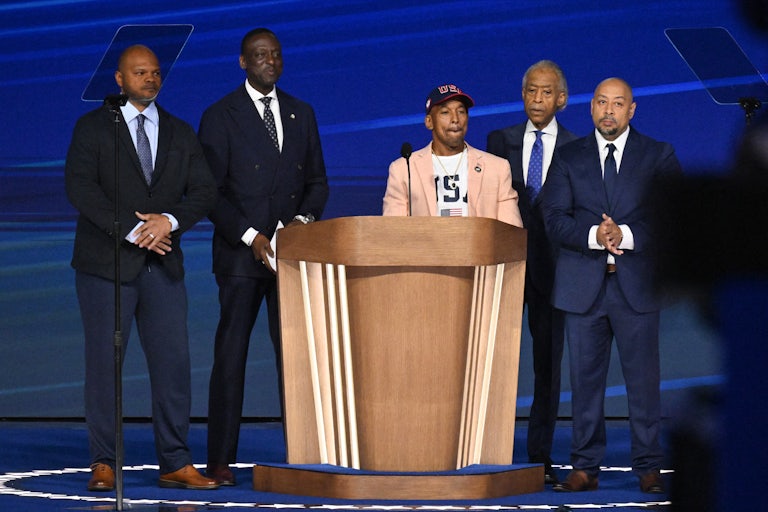
Four members of the Central Park Five and Reverend Al Sharpton stand on stage at the Democratic National Convention
Alex Wroblewski/AFP/Getty Images

A federal judge on Thursday denied Donald Trump’s motion to dismiss a new defamation lawsuit from the Central Park Five.

In a 20-page filing, Pennsylvania District Court Judge Wendy Beetlestone ruled that Trump’s recent comments about the group of five Back and Hispanic men, who were wrongly convicted of assault and rape in 1989, could not be defended as “substantially true.”

The lawsuit was filed in October 2024 after a 2024 presidential debate, during which Kamala Harris reminded viewers that Trump was “the same individual who took out a full-page ad in The New York Times calling for the execution of five young Black and Latino boys who were innocent, the Central Park Five. Took out a full-page ad calling for their execution.”

Trump responded, claiming that “a lot of people, including Mayor Bloomberg, agreed with me on the Central Park Five.”

“They admitted—they said, they pled guilty. And I said, well, if they pled guilty they badly hurt a person, killed a person ultimately. And if they pled guilty—then they pled we’re not guilty. But this is a person that has to stretch back years, 40, 50 years ago because there’s nothing now,” Trump said.

Beetlestone ruled that Trump’s statements could be “objectively determined” to be false, so his statement could be construed as fact, not opinion.

“Here, Plaintiffs were not just in the process of being exonerated, their name had been cleared for over twenty years, so Defendant cannot argue that stating that they pleaded guilty to crimes is substantially true, when the truth is that Plaintiffs are not guilty at all of those crimes,” she wrote.

She added that the plaintiffs had “plausibly alleged actual malice” by demonstrating that Trump was “closely familiar” with the Central Park Five’s not-guilty plea, conviction, and subsequent exoneration and therefore knew that they were not guilty and had not hurt or killed anyone at all.

Beetlestone ruled to dismiss the plaintiffs’ claims of intentional infliction of emotional distress and a defamation-by-implication theory included in their original complaint. She wrote that they would be permitted to amend their complaint to omit those arguments.