Newsletter
Power Mad
A weekly review of the rogues and scoundrels of American politics

The Washington Post Is Taking a Dive

Jeff Bezos’s reign of error at the venerable newspaper has wrecked subscriber trust—and there’s no reason to believe it will rebound anytime soon.

The building of the Washington Post newspaper headquarters is seen on K Street in Washington, D.C.
Eric Baradat/Getty Images

In his most recent piece documenting the slow and steady rise of the right-wing media Wurlitzer and its impact on the 2024 election, TNR editor Michael Tomasky made a dire prediction. “I predict Sinclair or the News Corp. will own The Washington Post one day,” he warned. “Maybe sooner than we think.” It’s a sad thing to say about the hometown newspaper that gave me my first job (I was 13 and was a paperboy), but the paper has the stench of a distressed asset these days. In the tumultuous period that followed the paper’s decision to spike its endorsement of Kamala Harris, it lost 250,000 subscribers—10 percent of its readership.

Suffice it to say, I hardly think the paper’s decision impacted the election. I have long been of the opinion that newspaper endorsements mostly serve the purpose of making an outlet’s stodgiest eminences feel like their opinions are consequential, when in reality they don’t at all move the needle with voters. Which makes it all the more bizarre that Jeff Bezos didn’t just let his editors’ wholly inessential natterings on the presidential election see the light of day, where they would have sparked an hour or two of conversation among a vanishingly small number of people, then faded like the evening sun.

Bezos instead went for Option B: melodramatically vomit down your shirtfront in full view of everyone, anger subscribers for no good reason, and touch off a wave of resignations. This says a lot about Bezos’s reign at the paper, which we can call a comprehensive failure. (The only successful way for a plutocrat to own a newspaper is for the Richie Rich in question to follow my two-step plan: Shut your mouth, and write those checks.) The only question now is what’s next: Is the paper going full Trump, or will it merely end up in the same place as so many of the platforms built by Bezos’s benighted generation of tech moguls (including Amazon)—a state of permanently enshittified disrepair.

Bezos had been in charge of the paper for three years before Trump’s election kicked off a sugar-rush period for newspaper subscribers, who flocked to the biggest brands in the belief that they’d play something of a vital role in heading off what looked to be a historically corrupt presidency with timely accountability journalism. The Post was there to capture the moment, rebranding itself with its “Democracy dies in darkness” motto. Having lured so many to its tender embraces with the promise of a more crusading form of truth telling, when the paper made its poorly timed decision last month to spike the endorsement, it was destined to land with a loud splat—and a sense of treachery. As TNR contributor Parker Molloy wrote, “This move didn’t come across as a principled stand for neutrality; it felt like capitulation, a betrayal of trust.”

Bezos then compounded the original error by trying to explain it, in terms that suggested that he needed to wreck his paper’s credibility with subscribers in order to save the journalism industry. “Our profession,” Bezos declaimed, “is now the least trusted of all.” It’s a pretty remarkable thing for a person who bulldozed his way into that profession 11 years ago, and who hitherto had, ostensibly, a very strong hand in guiding one of the industry’s biggest brands, to say about how things had fared under his watch. Every accusation is a confession, as they say.

But this was the central mystery of Bezos’s “how things work” explainer: whether and how he was there, in the rooms where the paper’s leaders met, at all. His presence in these great affairs was by his own account phantasmal; his fingerprints on decisions, according to his recollections, impossible to trace. His noncorporeal approach to running the paper didn’t say much about whether some virtue could be assigned to the spiking of the endorsement. But it did offer a window into his management style. “I wish we had made the change earlier than we did, in a moment further from the election and the emotions around it,” Bezos wrote. “That was inadequate planning, and not some intentional strategy.” Who is the “we,” here? Who was ultimately in charge of these decisions? What guided the paper to this public endorsement fiasco?

Bezos had an incomplete answer to the last question, at least. “I would also like to be clear that no quid pro quo of any kind is at work here,” he wrote. This was implicitly a rebuttal of reports that, in The Guardian’s words, “executives from his aerospace company met with Donald Trump on the same day the newspaper prevented its editorial team from publishing an endorsement of his opponent in the US presidential election.” Taken as a whole, it makes you wonder which of his companies Bezos is actually in charge of, to be so conveniently at a remove from the comings and goings of the people under his employ.

Bezos’s explanation arrived too late and too stupid to stem the tide of subscribers stampeding toward the exits. You can hardly blame a constituency nurtured on the Post’s flamboyant Trump-era marketing for deciding to bolt once management staged its endorsement rug-pull. As Brian Beutler remarked in his Off Message newsletter, “That’s quite obviously not what pro-democracy Americans signed up for.” The whole sordid mess left the paper’s top brass with what Beutler termed “a wake-up call … that the country’s anti-Trump majority is still a force to be reckoned with.”

But it would appear that the wake-up call went unheeded, for the next move undertaken by the paper’s editorial board hardly recognized their subscribers as this “force to be reckoned with” but rather characterized them as pests that needed to be brought to heel. As the paper’s editorial board wrote in their election postmortem:

Those understandably worried about another Trump term need also to keep an open mind regarding the reasons it is occurring and how, in fact, Mr. Trump broadened his support, forging a diverse coalition. It won’t do to dismiss a majority of the country as biased, ignorant or otherwise basely motivated. Yes, prejudices against foreigners, people of color and other targets of Mr. Trump’s rhetoric surely play a part in his extraordinarily durable appeal, but they can’t explain it all; indeed, the condescension of elites is itself a factor against which his voters were protesting by supporting him.

Leaving aside the matter of whether Trump truly did broaden his support, this is a galling rebuke of the Post’s own readership, to say nothing of liberal Americans everywhere. The edit board makes it sound as if dismissing “a majority of the country as biased, ignorant or otherwise basely motivated” is some big political no-no. But this kind of broad dismissal is precisely what Trumpism is, and Trumpism—last time I checked—seems to be doing rather well!

Here the paper’s top brass has speed-run to the very place where one has to assume that Bezos wants them to go: It’s OK for one political movement to be broadly alienating toward a wide swath of the country and impose retributive policies upon them, while the out-group disfavored by these vengeful political actors have no recourse but to participate in mandatory empathy sessions with the people who are out for revenge.

Obviously, the editors of The Washington Post are entitled to their opinion, but one must ask: What then, is the proposition for subscribers here? The Trump era has been replete with endless efforts to plumb the depths of Trump voters, to discover their motivations, sand off their edges, humanize them in the face of those who might judge them harshly. There’s been no concomitant effort to reach out to liberal voters, even after they won an election in 2020. But electoral victories shouldn’t be the issue that decides whether people have value or not. Liberals have just as much right to be met on the high road as anyone else. And they should perhaps think twice about supporting an institution that insists otherwise.

This article first appeared in Power Mad, a weekly TNR newsletter authored by deputy editor Jason Linkins. Sign up here.
A Cold, Hard Look Into Our Trumpian Future

The road ahead is filled with peril—for our fellow Americans, the Democratic Party, and Donald Trump himself.

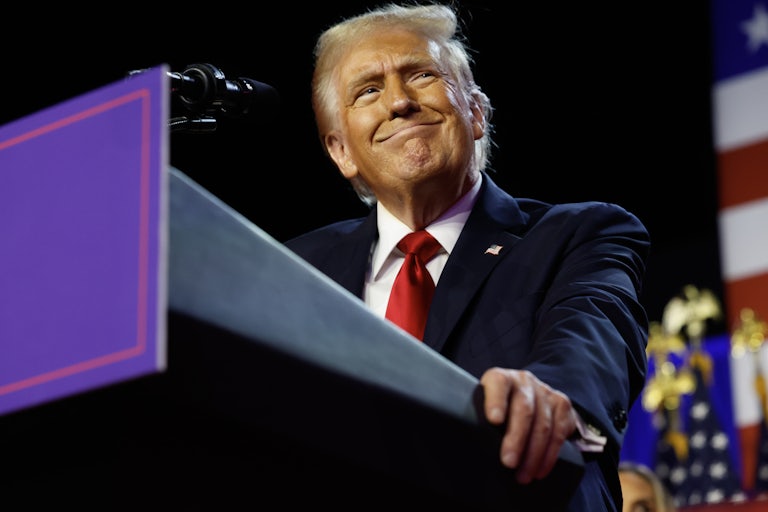
Donald Trump arrives to speak during an election night event at the Palm Beach Convention Center.
Chip Somodevilla/Getty Images

Let’s begin with the simplest and most obvious observation: A majority of Americans prefer what Donald Trump has been selling over Kamala Harris. It’s hard to stomach, because this election offered a pretty clear choice between a cheerful and humane future and a rapturously brutish one. But the latter won out. More Americans wanted the 1939 German-American Bund–style hate rally at Madison Square Garden than the big-tent party with high ideals about the American constitutional order. And we can no longer reassure ourselves, as we did in 2016, that Trump voters didn’t precisely know what they were getting or that much of what he promised to do was not to be taken seriously. We know what he’s about now, and a majority of voters clearly want it.

The country is set to change in stark ways, as Project 2025 jumps from the pages of a far-right dream journal into our lives. There will be big rollbacks in the civil rights many of us have come to enjoy, causing disproportionate pain to women and members of the LGBTQ community. I feel terribly for all the people who voted to protect reproductive freedoms in their states because the effort may be all for naught. As we have relentlessly explained on TNR’s pages, Trump’s Department of Justice can create a national abortion ban by enforcing the Comstock Act, thus bypassing the legislative process and the will of voters entirely. Wherever reproductive rights have managed to secure a haven in a state constitution, those rights will be fought over in inhospitable venues, like the Supreme Court.

Trump’s signature policy proposal is a mass deportation scheme that will target legal citizens for “remigration” alongside the undocumented. The regulatory state will be transformed into something that serves corporations instead of the public. The civil service, as I have mentioned before, will be reconfigured into something that, at best, may look like the “spoils system” of yesteryear; more likely it will exist to dole out punishments to Trump’s political opponents. Imagine a world in which blue states don’t receive disaster relief; where Democrats don’t get their Social Security checks.

Part of Trump’s second-term agenda includes a plan to crush left-liberal organizing. The movement to end the war in Gaza, which was highly effective in shifting public opinion on Israel’s ongoing military assault, will feel this hammer blow first. Trump has been lately dogged by generals who opposed his fascist inclinations; his future generals will be much less reluctant. Supreme Court Justices Clarence Thomas and Samuel Alito will retire and be replaced by younger versions of themselves. Probably worst of all, the timeline on permanent climate catastrophe has moved up—it’s not unfair to say that we may soon arrive at a point of no return (though my strong suspicion is that we have reached it already).

At the moment, I can’t exactly figure out what kind of Democratic Party emerges from the wreckage of this election. Harris ran a distinctly centrist style of politics, for which influential members of the punditocracy and the party’s most entrenched elites had long agitated. This approach flopped, badly. This brand of politics makes complete sense on paper to a lot of people who now need to contend with the fact that the voters that Democrats need the most to win presidential elections are rejecting it in substantial numbers.

But these failures are not the biggest problem Democrats face. The real crisis is that all the roads ahead are fraught with peril. The country has clearly tacked to the right in substantial ways. It’s going to make sense to a lot of Democrats to keep chasing the electorate in that direction. But a party that, in 2024, was only really defending a narrow portfolio of traditionally Democratic principles ceases to be the Democratic Party in any meaningful sense if they abandon those few battlements which they’ve retained the courage to defend. Tacking right might be a path to power, but we should dispense with the delusion that a Democratic Party choosing this path would continue to be a liberal party. Rather, it would come to reside in the same ideological province of the pre-Trump Republican Party—and remember, that’s a movement that Trumpism dispatched far more rapidly and soundly than the Democrats.

At the same time, organizing the party around a bolder, leftward direction is difficult to fathom. A more leftist set of domestic policy prescriptions requires its proponents to run the sort of piping-hot, high-spending economy that Biden attempted—and probably to a greater extent than Biden was willing to go. The failure of Bidenomics to impress the very voters it strove so mightily to help will make politicians extremely skittish about taking that approach again anytime soon. But even if Democrats were brave enough to let it rip, bolder policies also require a functioning administrative state to administer them. Right now, the Supreme Court is not committed to the administrative state’s survival and is more likely to keep dismantling it. So a Democratic Party that shifts in this direction is destined to make a ton of near-term promises that it can’t fulfill and risk making voters more cynical about government, which helps strongmen like Trump stay in power.

All that said, Trump might very well run up against the problem of unfulfillable promises a lot sooner than the Democrats. Trumpism has always been a slow march into the thickets of its own policy paradoxes, and this will only grow more pronounced as all the reins and fetters that impeded Trump’s first-term ambitions come off in the second. Here, the laws of gravity snap back with a vengeance. Trump cannot deport millions of people without sending the economy into a doom spiral. He can’t create a more efficient government by asking a noodlehead failure like Elon Musk to manage it. He can’t put a quack like Robert F. Kennedy Jr. in charge of public health without people getting a lot sicker. You can’t make America great again while destroying the regulatory regime that keeps a staggering range of everyday harms at bay: coal ash spills and E. coli and shoddy building construction and, lest we forget, pandemics. And, no, you can’t arrest climate change by pretending it’s not happening.

The problem, of course, is that the rug-pull always arrives too late for the conned to prevent. While we are waiting for these bills to come due, however, Trump will probably manage to keep two of his promises: He will duck accountability for the malfeasances for which he’s already facing judgment in various legal fora (and likely extend this privilege to a grip of bad actors, beginning with the January 6 rioters), and he will hurt the people he deems to be his enemy. Those supporters who are inclined to dole out punishments of their own will feel a freer hand to do so. This is going to be an immediately more dangerous country to reside in for lots of Americans.

This has, unfortunately, been the cauldron in which recent Democratic electoral successes have been conjured: The collapsed reality and widespread destruction wrought from GOP misrule provokes a backlash that drives up enough public support for a change. This is how we got Barack Obama and Joe Biden to the White House. This is also the widening gyre in which we’re now trapped: Republican failures, and the intense period of crisis management that follows, have made it harder for Democrats to build anything of their own that’s truly enduring, which in turn gives them little to run on. I’m left with the strong impression that the only thing most people know about Democrats is that they didn’t want Trump to be president.

As Talking Points Memo’s Josh Marshall noted on election night, “Incumbent parties have been losing in basically every industrial democracy since the pandemic.” Perhaps this outcome was predetermined. But it wasn’t our fate to end up with, as Marshall described, “Trump, with his degenerate, autocratic ways” as the alternative. That a cruel president is returning to office on the promise of doubling down on the cruelty speaks to something really unpleasant about ourselves. There was a notion, once, that Obama’s election indicated that the United States was closer than ever to becoming the nation we were always destined to be. With Trump’s reelection, we should reckon with the dreadful possibility that New York Times columnist Jamelle Bouie is correct when he says, “Most of us will probably die living in the political order that will emerge out of this election.”

This article first appeared in Power Mad, a weekly TNR newsletter authored by deputy editor Jason Linkins. Sign up here.
The Never Trump Moment Is Over. Does Harris Realize It?

Voters in Pennsylvania aren’t warming to the Kamala and Cheney show. Perhaps this alliance has reached a natural end point.

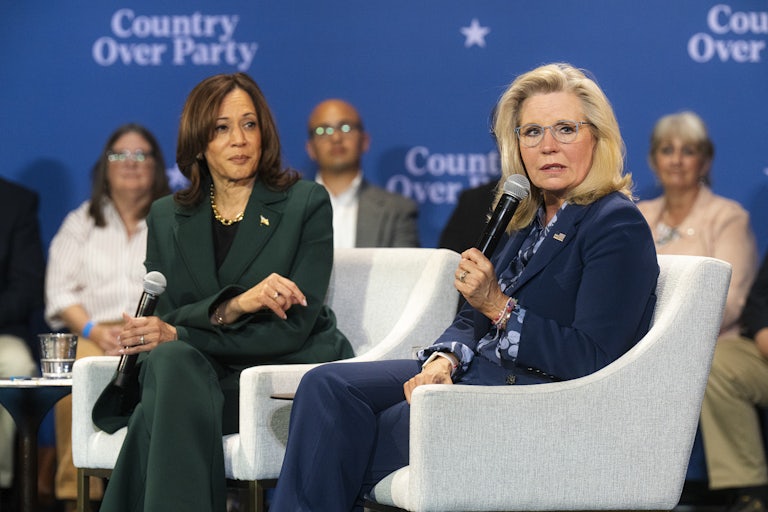
Kamala Harris holds a town hall event with former Congresswoman Liz Cheney.
Sara Stathas/Getty Images
Kamala Harris holds a town hall event with former Congresswoman Liz Cheney.

This week, I’ve been having rude flashbacks to one of the dumbest and cringiest campaign decisions in recent memory. In the waning days of the 2021 gubernatorial race in Virginia, the folks at the Never Trump outfit the Lincoln Project inexplicably tried to do a stunt in which five of their members, cosplaying as tiki torch–carrying white supremacists, turned out as fake supporters of Glenn Youngkin at a Charlottesville campaign stop. It fooled nobody, and it went over about as well as dengue fever in a day care. Everyone involved should have been driven out of both the Commonwealth of Virginia and politics in general.

I am not going to attribute Terry McAuliffe’s eventual loss to these idiots. But I am going to let it stand as an example of how the Never Trump Republican set, especially those who plied their trade doing dark arts against Democrats for decades before being forced out of their own party, don’t have the greatest political instincts. It’s kind of axiomatic, really: If they did have good political instincts, there wouldn’t even be “Never Trump Republicans.” But now, instead of celebrating—I don’t know—President Marco Rubio’s Supreme Court and the way it gutted Roe and ended Chevron deference, they’re all looking at each other with hangdog faces, trying so hard to remember that they enthusiastically support Democrats now.

All of which brings us to Kamala Harris, who has recently taken the Never Trump Republican community unto her bosom, in an effort to pull mildly conservative fence-sitters into her camp with some light Dick and Liz Cheney slap and tickle. There is definitely defensible politics in this collaboration—and if you’ve any familiarity with the Democratic Party, you know that this is the traditional time for its great Pivot to the Center. But that pivot happened a while ago. And while I don’t think of this necessarily as a Faustian bargain, I am concerned that Harris might have taken this partnership too far.

Let me start by saying that there are things that don’t worry me about Harris’s embrace of supportive Republicans. Unlike your pissy friend on Twitter—or the progressive leaders who’ve recently fretted about the matter to the press—I’m not concerned about Harris voters getting demoralized or demobilized at the sight of Harris campaigning with Republicans. If you climbed aboard this campaign back in its gung-ho, good vibes days, there’s no logical reason to have jumped off the bandwagon. I’m certainly not mad that Dick Cheney is going to vote for Harris—I’ve been waiting for that gobshite to come around to my way of thinking for years, and he should keep right on shedding his wrong and dumb political ideas in favor of my smart and correct ones. As a general rule, you should never feel insecure about your political convictions if the worst person you know starts to agree with you, and anyone who’d tell you otherwise doesn’t have your best interests at heart.

Similarly, I’m not worried about Harris selling out anything significant on the domestic policy front. She actually looks a little better than Biden (who thought he had a duty to try to work with the GOP) and a lot better than Obama (who, under no real pressure, constantly angled to give away big New Deal entitlement programs to Republicans in return for nothing). I am slightly more worried that the Never Trumpers have had a malign influence on Harris’s foreign policy and immigration messaging, but this is leavened somewhat by the fact that Democrats are really bad on these issues all on their own. (Similarly, to the extent that Harris has worse economic ideas than Biden, I am convinced she comes by them honestly. Most Democrats simply don’t share Biden’s good and correct opinions on these issues!)

The far more pressing problem here is about political tactics, not policy, and especially so in Pennsylvania, where the “Liz Cheney and the Democracy Defense Avengers” pageantry is not resonating. And that might be putting it charitably: According to a fresh survey from the Center for Working-Class Politics, or CWCP, Harris’s “democracy threat” messaging is a huge dud: “the least popular message among the working-class constituencies Harris and the Democrats need most.”

This is especially concerning because these voters are bucking an overall national trend: Recent polls have found that democracy is creeping back to the front of mind for most voters as a key issue. But if this election comes down to Pennsylvania, as it well might, Democrats may not be targeting the voters who will decide the race with the right rhetoric. As the CWCP’s Dustin Guastella puts it, “All of this suggests that the messaging pivot is a big mistake.”

It is true that the Never Trump Republican set are eager beavers. And their presence in Kamala’s camp helps to reach certain voters and assure them that Harris isn’t a Marxist. And as I noted last week, Harris’s associations with influential Republicans may help conservative election officials withstand the pressure that will inevitably come from Trump to commit election fraud.

But Never Trumpers are, strictly speaking, not Democrats. Nor do they have experience doing Democratic Party organizing or campaigning. And so they likely miss something essential: A lot of the non-MAGA diehards who have gravitated toward Trump over the years have done so because he has convinced them that he intends to shake up the status quo in Washington and take on the old plutocratic, warmongering GOP elite. Harris runs the risk of making Trump seem like a guy who’s going to break the shitty corrupt system that these Americans hate if she’s seen as too inextricably linked to the Cheneys, who may as well have their picture in the dictionary next to “shitty corrupt system.”

At this point, Harris is better off making the kind of arguments that the guys from the Lincoln Project don’t know how to make, and for which the Cheneys aren’t an avatar: Democrats have better policies and politics than the GOP. Democrats will replace Alito and Thomas with liberals who support abortion rights. Democrats will stop Trump from implementing a mass deportation scheme that will blow up the economy. Democrats will preserve Obamacare and Social Security. And the Democrats’ “enemies within” aren’t Haitians or trans people or the line producer at 60 Minutes—they’re corporate special interests and financial sector cheats who’ve been stealing your money. Democrats will run these dirty thieves to ground and crush them into pulp.

I don’t want to ride the Harris campaign too hard here. They ended up with a campaign that was awkwardly bootstrapped to a Biden reelection effort that barely launched, they’ve not shown a whit of complacency since grabbing the reins, and they have to operate in an unforgiving electoral environment where Republicans have a lot of room for error while Democrats have to be perfect. And however belatedly, a messaging shift does appear to be underway. This team has very nearly completed the political equivalent of drawing to an inside straight.

But like it or not, if Harris bottles this race at the end, it’s going to end up serving as a kind of referendum on a centrist style of Democratic politics that simply cannot, in 2024, afford to fail on its own terms. And should it fail, it will take the Never Trump Republicans down with it. So perhaps here in the final act, it’s time for a parting of the ways. The Never Trump set should perhaps do the thing they should have done a better job at when Trump first emerged: tend to their knitting. Let them get their souls to the polls and quietly convince any remaining persuadable voters to disembark the Trump train. And let Harris be what she needs to be: a person who typically champions the kinds of things Never Trump Republicans hate, running against a guy who isn’t really all that different from the politicians they have historically supported.

This article was adapted from Power Mad, a weekly TNR newsletter authored by deputy editor Jason Linkins. Sign up here.

How Harris Got Democracy Back on the Ballot

The vice president has shrewdly started using Trump’s own words against him, raising the salience of his authoritarian streak and righting her media strategy ship along the way.

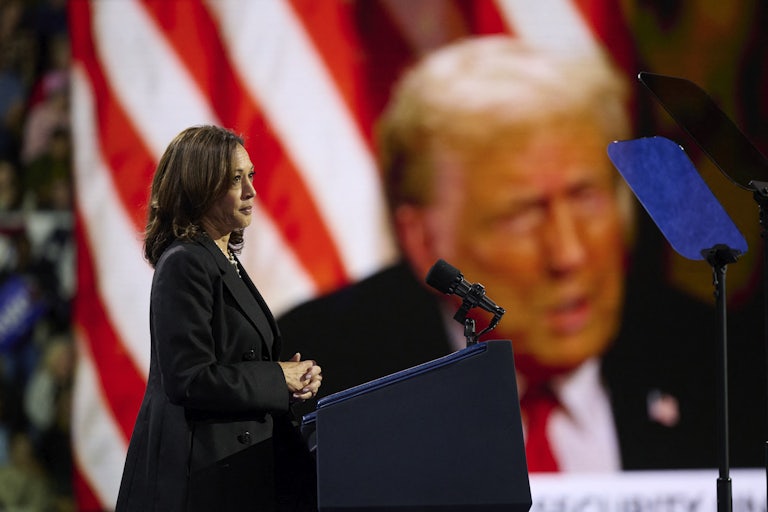
Kamala Harris shows video of Donald Trump at a campaign event in Erie, Pennsylvania.
Dustin Franz/Getty Images
Kamala Harris shows video of Donald Trump at a campaign event in Erie, Pennsylvania.

Last week, on these pages, I went into some detail about big issues that Vice President Kamala Harris needed to incorporate into her closing argument, lest she miss opportunities to draw important attention to—and contrasts with—what a second Trump term would mean for America. Since then, I’ve realized I missed an opportunity of my own. As a rather relentless assault of political news reminded me, beyond his bad policies and ideas, Trump is a uniquely dangerous threat to our democracy. It’s not a matter that should go unmentioned for too long.

Fortunately, Kamala Harris doesn’t seem to need urging from me to take up this matter. In her most recent work on the stump, she’s gone to great lengths to raise the salience of the danger that Trump poses. What’s more, she’s making her case in a way that gets media attention and appeals to wide swaths of the electorate—and she’s making her democracy case at a moment when the public seems ready to hear it. The approach she’s taking is some of her best strategic output since her debate.

Trump’s been giving her a lot of material to work with lately. His most recent stump speeches have been nearly undiluted herrenvolk pornography, flamboyant arias against migrants and other “enemies within,” coupled with some of the most despotic ideas he’s ever mused about, including invoking the Alien Enemies Act of 1798 to dispose of his political enemies. (His former secretary of defense has urged people to take Trump seriously in this regard.) These recent appearances have been so disturbing that his Monday rally in which he slipped into a fugue and swayed to music for a half an hour seemed to be a nice break from relentless invocations to political violence and oblique threats to political rivals.

Far from letting Trump slide, Harris has been making Trump’s recent rants the centerpiece of her campaign appearances. On Wednesday, Harris appeared at a rally in Bucks County, Pennsylvania, with former GOP Representatives Adam Kinzinger and Barbara Comstock and a slew of other Never Trump Republicans, and made a speech about protecting our constitutional values. She wove in recent news—Trump’s aforementioned plans to punish his political enemies; General Mark Milley’s warning that the former president was “fascist to the core”—in an effort to make these stakes clear: “He considers any American who doesn’t support him or bend to his will to be an enemy to our country.… He says that as commander in chief he would use our military to go after them. Honestly, let that sink in: Trump is increasingly unstable and unhinged.”

As NPR noted, this turn from Harris is part of a larger effort to “appeal to moderate Republicans and independent voters,” which may cause some consternation to those who’d prefer she center her rhetorical efforts toward left-liberal audiences. But Harris’s overtures to center-right fence-sitters aren’t the bipartisan triangulations of yesteryear. Harris isn’t Biden, making impossible promises to lead GOP electeds back off the QAnon cliff, and she’s certainly not following Barack Obama into the Grand Bargain weeds. 

Harris needs moderate suburbanites to climb on board with her. The Democrats have a rough Senate map, so Harris has to run in a way that might help save Montana Senator Jon Tester’s job. But this outreach is all about democracy as well: Some of the Republicans Harris might reach are conservative election officials who haven’t drunk the Trump Kool-Aid, for whom a little bit of assurance might help them steel themselves against the pressure to commit ballot jankery. At any rate, if the terms of our détente with moderate Republicans is that we all agree a dangerous caudillo shouldn’t be president, these are perhaps the most favorable-to-the-left negotiations in recent memory. At any rate, I’d rather spend the next four years having policy arguments with a too-centrist Kamala Harris than being rooted out as an “enemy of the people.”

Harris doesn’t just save this rhetoric for the Never Trump set, however. This is but a part of a recent push to make these arguments in front of rallygoers of all stripes, often by doing little more than standing out of the way and letting Trump speak for himself. As NPR reported on a rally in Erie, Pennsylvania, Harris showed attendees a 30-second mastercut of Trump’s recent public derangements—a montage that “showed Trump repeatedly complaining about ‘the enemy from within’ suggesting they should be jailed—or dealt with violently.”  

By showing rallygoers videos of Trump’s demented ravings, Harris is buying herself more coverage of Trump at his worst. The key difference here is that rather than just sit back and hope that the political press might decide to cover Trump as a dangerous, blathering loon, she’s giving them what they really want: a big ol’ partisan slapfest to cover. 

Stunting on Trump in this fashion meets a media that’s eternally horned up for conflict and controversy where they live, increasing the odds that the wild, authoritarian fantasia Trump’s been spinning on the stump gets more daily coverage. It’s also something of a twofer, because in addition to all the vile racism and violent musings, you’re also wrapping in Trump’s visible infirmities in forming complete sentences and following a conversation. 

It also advantages Harris if Trump takes more questions about the crazy things he says. The fallout from Trump’s invocation of using the law to pursue and punish “enemies within” has been considerably worse for Trump now that Harris is drawing attention to it. In the first place, when Trump’s been pressured to be more specific about who he means by “enemies within,” he’s included well-known Democratic politicians like Adam Schiff and Nancy Pelosi, which probably sounds great if you attended a Nazi boat parade for Trump in recent days; less so if you’re a moderate voter with normie tastes. 

It’s also clear that this coverage is annoying Trump as well: At Wednesday’s Fox town hall event (in which Trump was peppered with questions from an audience of what seemed to be Republican organizers cosplaying as undecided voters), Trump was asked about his recent “enemy from within” remarks, and he offered a petulant response. “You know what they are,” he groused about the Democrats complaining about his rhetoric. “They’re a party of sound bites.” The man truly does not like having his own words read back to him. But it’s an easy way to bait him—and as Harris demonstrated during the debate, baiting Trump is a time-tested way to throw him off his game.

The shift Harris is making here is a laudable break with a bad dynamic that Democrats get into with the media. Far too often, Democrats expect the media to take the lead on pointing out that Trump is a psychopath, in order to demonstrate the fourth estate’s commitment to democracy. The media, meanwhile, expects Democrats to take the lead on policing Trump’s lies because, to their mind, it’s the best way to demonstrate their mettle as politicians. It’s arguable that this arrangement consigns all parties to the job for which they’re least well-suited. More to the point, Democrats will probably witness the heat death of the universe before the mass media develops the sort of patriotic impulses that would lead it to save democracy of its own volition. 

It’s better to make good use of the small-minded, shiny object–obsessed political press that we have and feed them the birdseed they want—chaos, controversy, and cheap conflict—than pretend that this industry is going to have some kind of nick-of-time civic awakening. The only way the media will cover Trump as an enemy to democracy is for Harris and her fellow Democrats to make a daily habit of serving up broadsides on the topic. If Democrats have figured this out, it’s a consequential step that could decide the election in their favor.

This article first appeared in Power Mad, a weekly TNR newsletter authored by deputy editor Jason Linkins. Sign up here.
Three Critical Arguments Harris Needs to Make in These Final Days

Here are some ideas to help Democrats close the deal with the widest possible swath of persuadable voters.

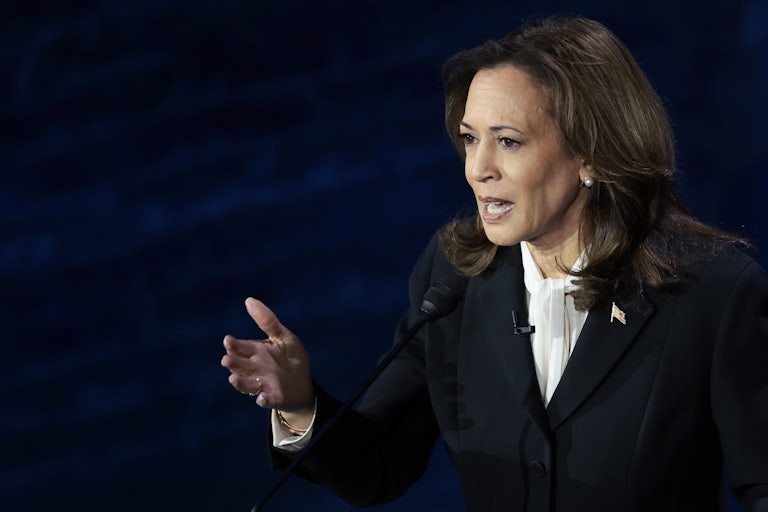
Kamala Harris debates Donald Trump for the first time during the presidential election campaign at The National Constitution Center in Philadelphia, Pennsylvania.
Win McNamee/Getty Images

Our exhausting permanent presidential campaigns eventually lead us to this point: less than one month to go, the home stretch, the closing argument. It’s taken a lot for Democrats to reach this point with a real shot at actually winning the presidency, but it will still be a white-knuckle affair. For Kamala Harris, the polling is good, and rather steady, but not great. Donald Trump, despite having spent the past few weeks defaming innocent Haitian Americans and spreading untold lies about hurricane recovery efforts, is still very close to winning himself.

Is Harris doing enough to beat him at the finish line? I’m not so sure. As The New Republic’s Alex Shephard wrote this week, Harris is making something of a too-close-for-comfort retread of her first, failed presidential run. Harris has arrived at this point too guarded and overcautious, he argues, with too many edges sanded off and what seems like a different policy walk-back every day. “With Election Day fast approaching,” Alex writes, “there’s a growing sense that she could—and should—be doing more.”

But what “more” should she be doing? My two cents: Harris needs to drill down on specific matters that help define her candidacy, contrast it with the corrupt impunity that a second Trump term will bring, and cast the widest possible net to woo any or all voters who might join her coalition. Specifically, here are three matters critical enough to be part of any closing argument that Harris and her Democratic allies make in these final days:

1. I know that I’m a broken record on this, but Democrats really need to raise the salience of the Supreme Court. Everyone committed to a Harris victory should make it clear that there are two Supreme Court vacancies at stake: Clarence Thomas and Samuel Alito may not be signaling a desire to retire from the bench, but a Trump win gives them the option to escape, knowing that like-minded replacements will be on their way. And while it might be difficult to find juridical minds more troglodytic than the two most venerable members of the conservative majority, you can definitely find younger bodies into which their ideas might be stuffed.

This is honestly the alpha and omega of anything Democrats might otherwise argue. Right now, with the current majority having gutted Chevron deference, anything that might be considered a “Democratic policy” is subject to the review of a hostile court that’s making up the rules as they go along. It’s possible that Democrats don’t really understand how bad a position they’re in now that Loper Bright is the law of the land. They should listen to the judicial experts in their corner—or get some new ones. Regardless, “Two Supreme Court vacancies are at stake in this election” needs to become a mantra.

2. As I predicted some months ago, 2024 has become a year defined by Republicans largely lying about their unpopular positions on abortion rights. They will, of course, seek to ban nationally as soon as the opportunity presents itself (before moving on to other retrograde policies from Project 2025’s pages). Trump and his running mate, JD Vance, have in recent weeks gone all in on the centerpiece of their deception, constantly reiterating that Trump will veto any abortion ban that crosses his desk. While it’s ordinarily sufficient to point out that Trump cannot be trusted and that Harris and her fellow Democrats have more convincingly committed themselves to safeguarding reproductive rights, Harris and her allies must do a better job explaining how Republicans actually plan to bring about a national abortion ban if Trump is elected.

As The New Republic’s Melissa Gira Grant points out, such a ban is not going to arrive in the form of a bill landing on Trump’s desk; Congress need not be involved at all.

What Trump might do—what his allies want him to do—is enact a ban by enforcing the 1873 Comstock Act, which can’t be vetoed since it’s already on the books. Trump’s misdirection distracts from his consistent anti-abortion record while in office, what the Republican Party platform states, and the very public plans of his former staffers detailed in Project 2025, which Trump also pretends he has nothing to do with. That is part of the Trump-Vance campaign’s plan on abortion: to do whatever they can not to talk about that plan, or at least to confuse the public about what that plan is.

This is a strong issue for Harris, which is all the more reason not to fight this battle on Trump’s terms but to actually level with people about what he intends to do. In their two debate performances, the Harris-Walz ticket failed to make mention of Comstock, despite the fact that Vance actually asked the DOJ to enforce it in a January 2023 letter. This needs to change: Democrats have the truth on their side, and it’s stupid to not use it against an inveterate liar, dissembling on an issue of paramount importance.

3. If abortion is one of the Democratic Party’s best issues, then immigration has to be one of their worst. As I noted a few weeks ago, any hope that we might return to sane comprehensive immigration reform policies has been scotched after the Biden administration entered into a race to the bottom with the GOP’s nativist cranks. The biggest overhang of Trump’s first term is that he managed to set the terms on immigration and yank Democrats to the right. He’s also managed to drag public opinion in his direction. A September 18 Ipsos poll found that there is majority support for some form of mass deportation—a policy Trump plans to deliver.

Democrats haven’t exactly met Trump’s demonization of Haitian Americans with a full-throated defense of these citizens, and it’s not clear that Harris has the stomach for that sort of entanglement. There’s too little daylight between Trump and Harris on immigration, but his plan to exile tens of millions of Americans is the centerpiece of his campaign, so Democrats should attack it with gusto. Fortunately they have another angle to wage war: Correctly depict Trump’s plan as a neutron bomb on the American economy.

As The New Republic contributor Nicholas Slayton reported this week, a recent report from the American Immigration Council found that Trump’s plan would unleash a parade of economic horrors, including estimated GDP losses between 4.2 and 6.8 percent, a $46.8 billion hole in federal coffers, corresponding state and local revenue losses in excess of $29 billion, and “significant labor shocks across multiple key industries, with especially acute impacts on construction, agriculture, and the hospitality sector.” These aftershocks would all create an environment in which “hundreds of thousands of U.S.-born workers could lose their jobs.”

Plus, the total cost to taxpayers just to implement this plan to destroy the U.S. economy would be in the vicinity of $315 billion (a figure the AIC says is “highly conservative”), which would give Democrats the chance to ask Trump the question so often chucked in their direction: “But how will you pay for it?”

It’s not ideal that Harris has been a risk-averse politician—and I personally wish she was more like Biden on economic matters. But these faults are things we can all fight about later down the line. Harris needs to end this election making the arguments necessary to put the Trump epoch behind us. These three areas give Harris broadly appealing arguments to make and clear contrasts to raise, forcing Trump to defend the MAGA extremism that now dictates much of our everyday lives.

Best of all, these aren’t the kind of risky stances from which Harris has heretofore shied away. This is normie bait: good for the broad Democratic coalition, salient to swayable Republican voters, and relevant to habitual nonvoters that both campaigns hope to get off the fence. Winning in November may boil down to a few big contrasts that will define the future—and whether or not Democrats can speak with one voice about why their version of the future is preferable.

This article first appeared in Power Mad, a weekly TNR newsletter authored by deputy editor Jason Linkins. Sign up here.