This spring, Mac Barnett, the award-winning children’s author of such contemporary picture-book classics as Sam and Dave Dig a Hole, dug himself a hole. In Make Believe: On Telling Stories to Children, his new book-length work of literary criticism about children’s books, he makes a forceful argument for adults to take children seriously as readers. Their sense of taste, their sense of justice, their sense of imagination. Too many children’s books, he suggests, condescend to their readers. The best stories for kids, he argues, don’t preach or preen or strive to impart pat moral lessons but “tell the truth about what it means to be a human in the world.” And, because of this possibility for great art in children’s literature, and because of its intimate importance to the young people who read it, it behooves us to take it seriously as a mode of literature. “If you don’t think children’s books are real books,” he writes, “on some level you don’t think children are real people.
Then, he steps in it. “I have a nagging fear,” he writes, “that children’s literature suffers from a slightly higher crud percentage than literature as a whole.” For Barnett, this means that the preponderance of kidlit is clunkily didactic at best, thinly exploitative at worst. On its own, it’s probably hard to argue with this sentiment—the sheer number of children’s books based on Paw Patrol episodes alone seems to prove the point. But Barnett goes on to facetiously offer a guesstimate that 94.7 percent are duds. Only 5.3 percent of children’s books, then, would be worthy of the children reading them.
The backlash was immediate, especially among authors of color who felt that the books Barnett dismissively described as “didactic” might likely include many titles meant to reach out to children historically underrepresented in children’s literature. Barnett immediately apologized, but the damage was done. A petition circulated, and a movement began to have his position as the Library of Congress national ambassador for young people’s literature revoked. Barnett’s “crud” remarks, many felt, stood to cause real harm in an industry that is still struggling to diversify and that is threatened constantly by state-sponsored book bans. As the writer and publisher Meg Reid pointed out, though, Barnett’s (hyperbolic) assertion reads differently if you think about the sheer volume of children’s literature published every year. If we take Barnett’s unserious analytic seriously, then his claim means that many thousands of children’s books of the vast number published annually are not crud. Pretty good!
Children’s television, I’d argue, is in a similar state. In this streaming environment, there is more space for children’s TV series than ever before. Lots of it is CGI sludge, of course, and nursery school nonsense and cynically concocted consumer training, but, amid all that “crud,” there’s a lot to be grateful for. If I were to make a long list of the best TV series of the past decade or so, a decent number of those series would certainly be children’s TV shows: Netflix’s City of Ghosts, Hilda, and The Baby-Sitters Club; Cartoon Network’s Steven Universe; Disney+’s Gravity Falls and The Owl House; and, of course, Bluey, the formally perfect Australian animated series that would be pretty hard to keep out of the top 10. Kids don’t automatically reject series that challenge them. They can feel when they’re being taken seriously, and they like it.
It’s into this environment of crud and classics that Netflix has now released two series adaptations of beloved novels: Little House on the Prairie and Lord of the Flies. One is a show for kids, the other a show about kids. But both tell the truth—or at least part of it—about what it means to be a person in an often inhospitable world.
You may have heard that the new Little House on the Prairie series is “woke.” When the new adaptation of Laura Ingalls Wilder’s novel series was announced early last year, former Fox News pundit Megyn Kelly immediately tweeted at Netflix, “if you wokeify Little House on the Prairie I will make it my singular mission to absolutely ruin your project.” Melissa Gilbert, star of the original 1974 series, responded by saying, “Ummm…watch the original again. TV doesn’t get too much more ‘woke’ than we did. We tackled: racism, addiction, nativism, antisemitism, misogyny, rape, spousal abuse and every other ‘woke’ topic you can think of. Thank you very much.” And this was all before the new show even had a cast list.
The actual series, which has already been green-lit for a follow-up season, is neither the nostalgic tradlife fantasy Kelly hoped for nor the Resistance Lib fever dream she feared. Still, it’s easy to imagine that she might take umbrage with the new show’s primary departure from the beloved series of her childhood. That show, also called Little House on the Prairie, was not strictly an adaptation of the novel of the same name. Indeed, the ’70s series, set in Minnesota in the 1870s, takes place after the events of Wilder’s Little House on the Prairie novel. In other words, the Little House on the Prairie that Kelly romanticizes isn’t really Little House on the Prairie at all.
This new show is. That slightly nudged timeline makes Netflix’s Little House not only different, but dirtier, too. It begins, as the novel does, with the Ingalls family departing the big woods of Wisconsin and traversing the mighty West in a covered wagon, heading for a new home, and free land, on the Kansas prairie. There’s handsome, hopeful Pa (Luke Bracey), worried and wary Ma (Crosby Fitzgerald), angsty older sister Mary (Skywalker Hughes), and, of course, rascally, openhearted Laura (Alice Halsey). A tight-knit unit, they brave the elements and the isolation of frontier life together.
Upon arriving in the town of Independence, Kansas, however, Pa realizes that he’s brought his family there on a false promise. The “free” land advertised by the crumpled poster he carries in his pocket actually belongs to the Osage. Building a home, as he does, on that prairie, makes him a squatter and a speculator. The Ingalls family’s future, then, rests entirely on the completion of an unlikely treaty between the Osage and the federal government that would sell the land to the United States and legitimize all of the settlers’ claims. Pa’s sense of disappointment and guilt—and the sense that he’s betrayed his family by not telling them—hangs over everything.
If the new show is “woke” at all, it’s in the way it holds on to the dark moral compromise at the foundation of the Ingalls family’s adorable log home. Indeed, its primary innovation is in the degree to which it tests Laura’s relentless cheer. There’s nothing uncomplicated about even the show’s happiest moments. The script teases a troubled backstory, suggesting that the Ingallses are less pioneers than exiles from Wisconsin after some unacknowledged family squabble; Pa has several encounters with the ghost of his dead younger brother; the odd fact that the family has come alone, without siblings, parents, or cousins to help settle the land, is pointed out ominously by several different experienced settlers. Even the construction of the “little house” itself seems cursed: Ma graphically injures her foot hauling logs, only then to have a falling-out with neighbor Mr. Edwards over his alcoholism. Laura is the same bright-eyed optimist Megyn Kelly remembers, but her optimism here can read as almost delusional in its insistence.
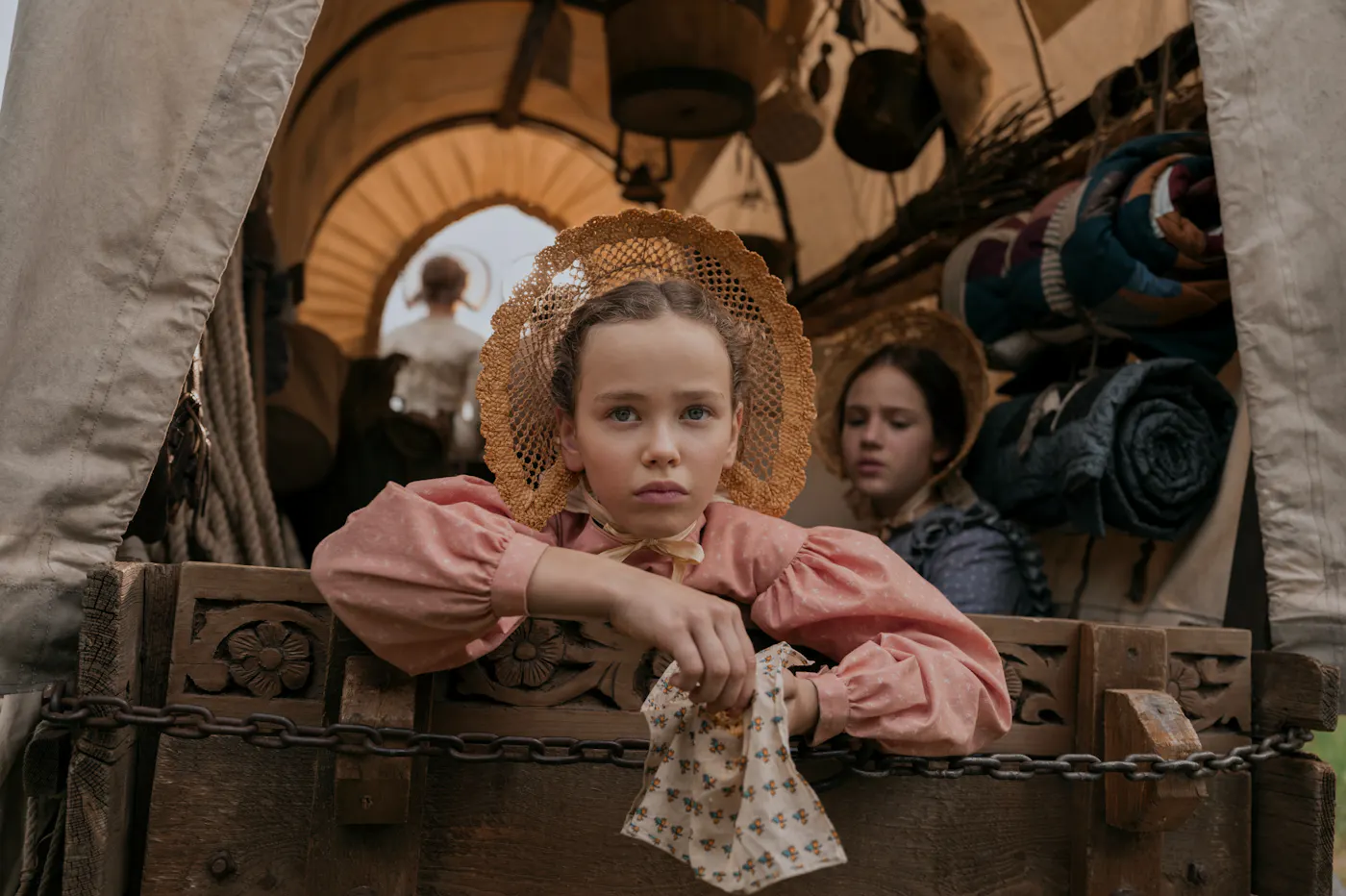
This is, in some ways, a change that actually makes the show more faithful rather than less to the tone of Wilder’s stories. The biggest structural departure from the book is in the addition of an Osage family, whose trials we follow in parallel with the Ingallses: There’s Mitchell (Meegwun Fairbrother), a mixed-race Osage man; White Sun (Alyssa Wapanatâhk), who is as distrustful of the white settlers as they are of her; and their daughter, Good Eagle (Wren Zhawenim Gotts), who is basically an Osage Laura Ingalls. They don’t get the same screen time as their white counterparts, but the struggle of a mixed-race Osage family caught between a desire to make peace with newly arriving white settlers and make amends to their furious, soon-to-be-displaced people is a crucial element of the new show.
Wilder’s books feature famously vicious depictions of Indigenous people, so there is certainly some corrective impulse in the show’s fleshed-out portrayal of a Native American family, especially as Laura and Good Eagle become besties. The show never has the full courage to make the Ingallses true antiheroes—Ma, for instance, is only frightened by rather than prejudiced against their Osage neighbors—but it gestures toward self-consciousness about the kind of erasure that allowed Wilder’s cottagecore mythology to grow in the first place. In the pilot, Laura finds a torn Indian doll on a riverbank. She takes it for her own and has Ma sew it back up with ribbon but gladly surrenders it when she realizes it belongs to Good Eagle. The Osage girl gets back what belongs to her, mended by her new white neighbor.
Netflix’s Lord of the Flies is a nasty little hallucination of a show—I mean that as a compliment. The four-part miniseries, developed and written by Jack Thorne for the BBC, should be read as a spiritual sequel to Thorne’s acrobatic dirge Adolescence—his 2025 miniseries about a young boy’s seemingly inexplicable murder of a teenage girl and all the apps that drove him to it. This time, there’s no social media to turn these little chaps into monsters, but they still manage the old-fashioned way.
As in William Golding’s novel, the new Lord of the Flies starts when a planeload of young British boys crashes on a tropical island. Left to their own devices, the boys fight between the impulse to reestablish some form of civilized society and the temptation to go absolutely wild, indulging in every taboo impulse their parents and schoolteachers forbade. On the side of order and democracy are Ralph (Winston Sawyers), a charming young man who has a way with the littler children, and Piggy (David McKenna), the smartest and least socially adept of the castaways; on the side of bacchanalia is Jack (Lox Pratt), a real little shit of a sociopath, who commands fierce devotion from the other boys who sang with him in the school choir.
All the stuff that happens in Lord of the Flies, the novel, happens here, too, though often from a slightly different perspective or turned out in a slightly different way. This is a story about logistics and survival, and, ultimately, about what the way we choose to survive says about us. Ralph and Piggy struggle to get a beach full of kids to reproduce the civic ideals of modern Britain; they can’t even get them to pee in the right place. Meanwhile, Jack’s and the choir boys’ efforts to assert their heroic masculinity—by hunting for boar and maintaining a dangerously large signal fire—produce only disappointment and strife. And yet, the stunning complexity of these child actors’ performances convinces us of the inevitability of their roles. McKenna imbues Piggy with an almost immediate frank command of this situation and its requirements, while Pratt seethes with the kind of theatrically compensatory overconfidence that both makes men legends and gets men killed.
While not shot with the long-take extravagance of Adolescence, Lord of the Flies is similarly visually striking. Lots of fish-eye lenses help us to share in the topsy-turvy swirl of the boys’ new situation, and some pretty hardcore color-grading gives the gorgeous flora of the island the texture of Gothic horror. Outside of these cinematographic flourishes, Thorne’s major addition to the text is some degree of backstory for our main characters. Specifically, he goes out of his way to show that Jack—the show’s main antagonist—and the spiritual Simon (Ike Talbut) both have difficult fathers back home. These boys aren’t just allegorical baddies or toxic men-in-training; they’re damaged little kids who act out in ways that ultimately make sense. Hurt people hurt people.
As Rebecca Onion has pointed out, this change means that Thorne’s series makes it harder to read the boys as archetypes or as metaphors for this or that geopolitical crisis. They are individuals; their failure to be peaceable doesn’t tell us anything about boys in general or society in general. All they need, perhaps, is love.
I showed the pilot episode of the new Little House to my daughters, who are 10 and six years old. The show was too scary for the six-year-old, and too serious, I think, too. But it was catnip for the tween. Lots of shows she watches occupy this same realm of socially conscious melodrama. This Laura will immediately be the kind of heroine, navigating the thorny contradictions of her world, that appeals to girls in her age bracket. I will not, however, be showing my daughters Lord of the Flies. The extreme violence of these boys in crisis is not exactly pitched at my elder daughter’s age range—and, honestly, might too closely resemble some of the social dynamics she sees on the playground every day. Much like Adolescence, Lord of the Flies is mostly a horror series aimed at parents. All the same, both of these shows take seriously Barnett’s admonition that children are real people—people who can understand concepts like justice, complicity, and repair, and who can, left to their own devices, destroy a new world as easily as they can imagine one.